In 2026, the business setup cost in Saudi Arabia runs from about SAR 45,000 to SAR 120,000 (roughly USD 12,000–32,000) in year one for a 100% foreign-owned service company. Government fees make up the smallest slice usually under SAR 10,000. Your office lease, document legalisation, the manager’s visa and the expat levies eat the rest. Trading and industrial activities cost far more, though capital rules drive that, not fees.
So where does the money actually go? Below you will find what you pay once, what repeats every year, and how the number shifts by city and structure. If you are still choosing a structure, start with our guide to business setup in Saudi Arabia.
- What MISA Actually Charges in 2026
- Full Business Setup Cost in Saudi Arabia: The 2026 Breakdown
- One-Off vs Ongoing Costs
- Cost to Start a Business in KSA by Entity Type
- Cost by City
- Hidden Costs Nobody Quotes You
- Country Notes
- Get an Exact Number
- Frequently Asked Questions
- 5. FAQ (schema-ready Q&A pairs)
What MISA Actually Charges in 2026
Most articles quote a fixed MISA fee. That number is out of date.
Since the Investment Law amendments landed in 2025, foreign investors no longer buy an “investment licence.” You now apply for investment registration with the Ministry of Investment (MISA).
MISA’s own Investor Guide prints no price. It says the Ministry sets your fee when it approves your application, and you then have 15 business days to pay. Miss that window and your registration lapses. Most post-registration steps cost nothing at all — MISA lists activity changes, ownership changes and cancellation as free.
The old published schedule ran to SAR 2,000 a year plus a SAR 10,000 first-year subscription, climbing steeply after that. Many advisers now report that MISA suspended those service fees back in 2024. We watch files clear with little or no MISA fee. Even so, we never budget on it.
What to do: model MISA at SAR 0–12,000 for year one, check the live amount on the MISA portal before you file, and walk away from any quote that buries the MISA line inside a package price.
Full Business Setup Cost in Saudi Arabia: The 2026 Breakdown
The table below covers a foreign-owned service LLC in Riyadh with one expat manager.
| Item | Who charges it | Typical 2026 cost (SAR) | One-off or ongoing |
|---|---|---|---|
| Investment registration | MISA | 0–12,000 (MISA sets it on approval) | Annual update |
| Trade name reservation | Ministry of Commerce | From ~200 (Arabic); more for a non-Arabic name | One-off |
| Articles of Association notarisation | Ministry of Justice | 1,000–2,000 | One-off |
| Commercial registration + publication | Ministry of Commerce | ~1,200–2,000 plus 15% VAT | One-off, then annual confirmation |
| Chamber of Commerce membership | Chamber of Commerce | 800–3,000+ by class | Ongoing |
| Municipal (Balady) licence | Municipality | 500–5,000 by activity and premises | Ongoing |
| Legalisation + certified Arabic translation | Home authorities, MOFA, licensed translator | 5,000–20,000 | One-off |
| Office lease, Ejar registration, national address | Landlord and Ejar | 20,000–150,000+ | Ongoing |
| Manager’s work visa, Iqama, medical, insurance | MoI and MHRSD | 4,000–8,000 | Ongoing |
| Work permit levy | MHRSD | 8,400–9,600 per expat | Ongoing |
| Dependant fee | MoI | 4,800 per dependant | Ongoing |
| Accounting, VAT filing, e-invoicing, payroll | Private providers | 12,000–40,000 | Ongoing |
| Setup and PRO fees | Consultancy | By scope | One-off |
Fees move without much warning, so confirm current figures with the authority or with Expandway before you commit. To model your own mix of activity, city and visas, try our cost calculator.
One-Off vs Ongoing Costs
What you pay once
The one-off layer stays small. Government filings plus legalisation usually land between SAR 10,000 and SAR 25,000, on top of whatever your consultant charges. Founders rarely trip up here, because these costs arrive early and every provider quotes them.
What repeats every year
Year two breaks budgets. A three-person Riyadh office — lease, levies, chamber, municipal licence, accounting and VAT work — typically runs SAR 90,000 to SAR 200,000 a year before salaries. Plan the recurring number first and the setup fee second. That number decides whether the entity earns its keep.
Cost to Start a Business in KSA by Entity Type
| Structure | Suits | Capital rule | Cost signal |
|---|---|---|---|
| Foreign-owned LLC (service) | Most SMEs, consultancies, tech | No statutory minimum, but MISA and banks expect capital matching your plan — often SAR 100,000–500,000 declared | Cheapest foreign route |
| Branch of a foreign company | Parent-controlled project delivery | No separate capital, heavier parent documents | Similar fees, more legalisation |
| Trading, 100% foreign | Wholesale, retail, import | SAR 30 million capital, presence in 3+ markets, and SAR 200–300m of investment over five years | Very high |
| Trading with a Saudi partner (25%) | Importers with a local partner | SAR 26,666,667 | High |
| Regional Headquarters (RHQ) | Multinationals | 15 full-time staff within a year, 3 at executive level | 0% corporate tax and withholding tax for 30 renewable years |
| SEZ company (KAEC, Jazan, Ras Al-Khair) | Manufacturing, logistics, maritime | An LLC inside the zone | 5% corporate tax for 20 years, 0% withholding tax, outside Zakat |
| Saudi or GCC-owned LLC / sole establishment | Saudi and GCC nationals | None | Often under SAR 5,000 in government fees |
Why trading costs so much more
The company formation cost in Saudi Arabia jumps hardest when you cross from services into trading. That SAR 30 million sits on your balance sheet — it never becomes a fee you pay. Many groups therefore open a service entity first and add trading later, once the Saudi business generates its own capital. Saudi Arabia published the SEZ bylaws in January 2026 and switched them on in April, so zone incentives now count as a live route rather than a promise.
Cost by City
Riyadh: the Gulf’s tightest office market
Riyadh charges a premium, and 2026 sharpened it. Prime Grade A rent reached about SAR 3,630 per sqm per year in Q1 2026 (JLL), with prime vacancy near 0.5%. Knight Frank put the wider Grade A average closer to SAR 2,750 per sqm. Meanwhile Grade B climbed roughly 26% year-on-year as occupiers gave up on the top tier. Service charges then add another 15–25%.
The rent freeze that changes the maths
Here is the reform most cost guides miss. On 25 September 2025, the Real Estate General Authority (REGA) froze the total rent on residential and commercial leases inside Riyadh’s urban boundary for five years — existing and new contracts alike. Landlords must now re-let vacant units at the last value on Ejar. Landlord and tenant still agree a first-time rent freely, but the freeze then locks it. So sign a Riyadh lease today and your rent holds until 2030.
Jeddah and Dammam: the value plays
Jeddah asks about SAR 1,320 per sqm for Grade A (JLL, Q1 2026), down 3.8% year-on-year at 6% vacancy. That is roughly a third of Riyadh prime, and landlords there still negotiate. Dammam and Al Khobar sit lower again, which suits industrial, logistics and energy supply chains. MODON prices industrial land and ready-built factories separately, on application.
Choose Riyadh only if you need ministries, government tenders or an RHQ. Otherwise Jeddah or the Eastern Province halves your biggest line.
Hidden Costs Nobody Quotes You
Levies on expat staff and families
This one surprises everybody. You pay SAR 700 per expat per month while your expat headcount stays at or below your Saudi headcount. Each expat above that line costs SAR 800. So budget SAR 8,400 to SAR 9,600 a year for every foreign employee. Every dependant then adds SAR 400 a month, or SAR 4,800 a year. A manager with a spouse and two children therefore costs roughly SAR 24,000 a year in levies before his salary. Industrial licence holders report exemptions, so check your status with MHRSD.
Saudization and GOSI
Nitaqat quotas vary by activity and company size. A Saudi hire only counts once you register them with GOSI and pay at least SAR 4,000 a month. Employer GOSI costs 2% for expats but 11.75–12.75% for Saudis. The rate for post-July-2024 entrants stepped up again on 1 July 2026.
Documents, translation and rejections
Only a Saudi-licensed office can certify your Arabic translation. Notarise it abroad and MISA will send it straight back. One bad document pack costs more in lost weeks than careful legalisation ever costs in fees.
Filings that can freeze your bank account
Commercial registrations stopped expiring in April 2025. Instead you confirm the data every year on the issuance anniversary. Miss that by 90 days and the CR suspends, taking your bank account and government services with it. Fines reach SAR 50,000. You must also file your beneficial ownership with the Ministry of Commerce and keep it current.
Tax, e-invoicing and sector approvals
VAT registration turns mandatory above SAR 375,000 in taxable supplies, and you can register voluntarily from SAR 187,500. VAT runs at 15%, and ZATCA’s Fatoora e-invoicing needs a compliant system rather than a spreadsheet. SFDA (food, drugs, devices, cosmetics), REGA (real estate) and the Saudi Central Bank (finance, insurance, payments) each add their own fees and weeks. Serve Saudi clients for more than 183 days in any 12 months and you can trigger a permanent establishment — plus a 20% corporate tax bill — before you register anything.
Country Notes
Only the parts that genuinely differ.
For Indian investors
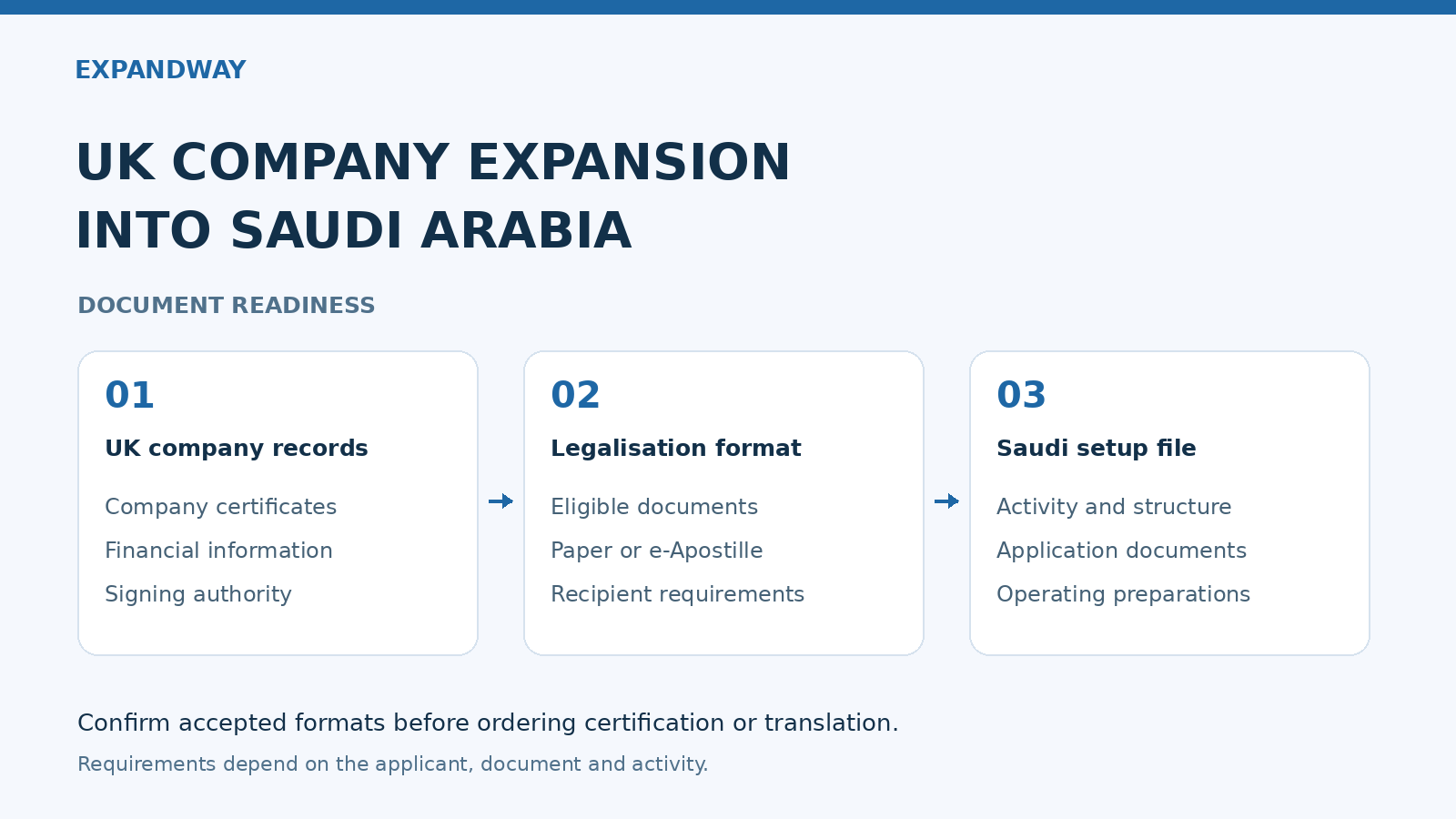
Saudi Arabia belongs to the Hague Apostille Convention, so Saudi authorities normally accept MEA-apostilled corporate documents. Watch one gap, though. MISA’s guide still refers to Saudi embassy certification, and some banks still ask for the older chain. Confirm your route before you pay for it. Degrees also still need Saudi Cultural Attaché (SACA) verification. You must route the investment itself through the RBI’s Overseas Investment framework via your AD bank. That step usually takes two to four weeks. At about SAR 1 = INR 25.5 (July 2026), a SAR 100,000 setup works out near ₹25.5 lakh. If you already live here on an employer’s Iqama, MISA wants a no-objection letter from that employer.
For Pakistani nationals
Apostille runs through MOFA Pakistan, but only after pre-verification — HEC or IBCC for education, your Chamber of Commerce for commercial papers. Outward equity investment needs State Bank of Pakistan approval, and that usually sits at the front of the critical path. So start it before you touch the MISA file. At roughly SAR 1 = PKR 74, SAR 100,000 lands near PKR 7.4 million. The employer NOC point above applies to you too if you already hold an Iqama here.
For UAE-based companies
Free zone habits do not travel. The Kingdom sells no licence-only product, so you need real premises, an Ejar-registered lease and a national address before much else moves. If GCC nationals own your shares, Saudi Arabia treats you as a local investor — Zakat instead of corporate tax, and no MISA registration. A UAE company with non-GCC shareholders counts as a foreign investor. Your parent will usually need a year of trading history and certified audited accounts. Both currencies track the dollar (AED 1 ≈ SAR 0.98), so the figures read almost 1:1. But nothing in the UAE matches the expat levy, and without an RHQ you cannot bid for Saudi government contracts.
For US companies
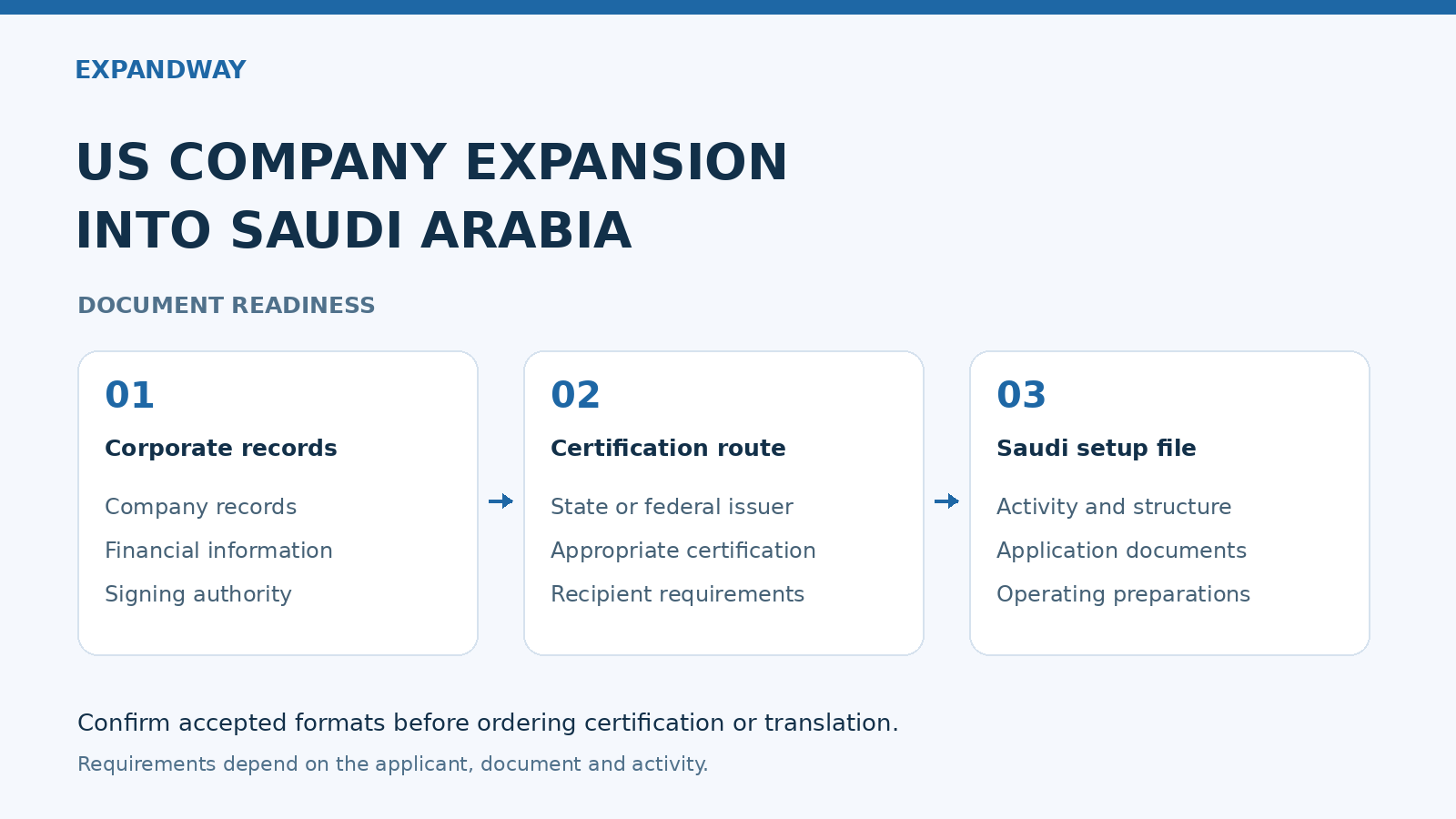
Apostille runs through your state authority and then the US Department of State. Note that the US and Saudi Arabia share no double tax treaty. The two governments signed a Tax Information Exchange Agreement in April 2026, which widens information sharing but delivers no treaty relief. So budget for 20% corporate income tax on the foreign share, withholding tax on payments home, and ask your US adviser about the Foreign Tax Credit position. US firms make up the largest RHQ cohort in Riyadh, and that 30-year 0% package often decides the structure. Money leaves freely too, and the Saudi Central Bank has held the riyal at SAR 3.75 to the dollar since 1986.
Get an Exact Number
Every figure here is a planning range. Your real cost depends on your activity, your city, your headcount and how clean your document pack looks on day one. Compare this with our year-on-year view of the total cost to set up a company in Saudi Arabia, then book a free consultation. We will price your exact structure and itemise the MISA, Ministry of Commerce and municipal lines instead of bundling them.
Frequently Asked Questions
What is the minimum business setup cost in Saudi Arabia in 2026?
A lean foreign-owned service LLC — business-centre address, one visa, one activity — starts near SAR 40,000–45,000 (about USD 11,000–12,000) in year one. Saudi and GCC nationals pay far less, often under SAR 5,000 in government fees, because they skip MISA registration entirely. Any quote promising SAR 5,000 “all inclusive” for a foreign investor leaves lines out.
How much are MISA licence fees in 2026?
MISA no longer publishes a fixed price. Its Investor Guide says the Ministry decides your fee when it approves the application, and you pay within 15 business days. The historic schedule ran to SAR 2,000 a year plus a SAR 10,000 first-year subscription, though many advisers report that MISA has suspended those service fees. Budget SAR 0–12,000, then confirm the live figure on the MISA portal or with Expandway.
Do I need SAR 500,000 capital to open an LLC?
Not by law. The Companies Law sets no minimum for most LLCs, and typical service activities carry no statutory capital floor. In practice, MISA and Saudi banks expect declared capital that matches your plan, and SAR 100,000–500,000 covers most foreign-owned service companies. Trading works differently: 100% foreign trading carries a SAR 30 million capital requirement.
Is Jeddah cheaper than Riyadh?
Yes, on occupancy. Jeddah Grade A rent sat near SAR 1,320 per sqm per year in Q1 2026 against roughly SAR 3,630 for Riyadh prime, with more vacancy and more room to negotiate. Government fees match in both cities. Riyadh only earns its premium if you need ministries, government tenders or an RHQ.
What does it cost to keep a Saudi company running each year?
Budget SAR 90,000–200,000 a year before salaries for a three-person Riyadh office: lease, work permit levies, dependant fees, chamber and municipal renewals, accounting and VAT compliance, plus the annual CR confirmation. That recurring bill, not the setup fee, should drive your structure.
Can a virtual office cut the cost?
Rarely, and not reliably. Saudi entities need a verified national address and an Ejar-registered lease, and inspectors check premises for most licensed activities. A serviced office or business-centre desk usually works as the low-cost route instead. Confirm what your activity allows before you sign, because the wrong address means redoing the registration rather than saving money.
5. FAQ (schema-ready Q&A pairs)
Q1. What is the minimum business setup cost in Saudi Arabia in 2026? A1. A lean foreign-owned service LLC — business-centre address, one visa, one activity — starts near SAR 40,000–45,000 (about USD 11,000–12,000) in year one. Saudi and GCC nationals pay far less, often under SAR 5,000 in government fees, because they skip MISA registration entirely. Any quote promising SAR 5,000 “all inclusive” for a foreign investor leaves lines out.
Q2. How much are MISA licence fees in 2026? A2. MISA no longer publishes a fixed price. Its Investor Guide says the Ministry decides your fee when it approves the application, and you pay within 15 business days. The historic schedule ran to SAR 2,000 a year plus a SAR 10,000 first-year subscription, though many advisers report that MISA has suspended those service fees. Budget SAR 0–12,000, then confirm the live figure on the MISA portal or with Expandway.
Q3. Do I need SAR 500,000 capital to open an LLC in Saudi Arabia? A3. Not by law. The Companies Law sets no minimum for most LLCs, and typical service activities carry no statutory capital floor. In practice, MISA and Saudi banks expect declared capital that matches your plan, and SAR 100,000–500,000 covers most foreign-owned service companies. Trading works differently: 100% foreign trading carries a SAR 30 million capital requirement.
Q4. Is it cheaper to set up a business in Jeddah than in Riyadh? A4. Yes, on occupancy. Jeddah Grade A rent sat near SAR 1,320 per sqm per year in Q1 2026 against roughly SAR 3,630 for Riyadh prime, with more vacancy and more room to negotiate. Government fees match in both cities. Riyadh only earns its premium if you need ministries, government tenders or a regional headquarters.
Q5. What does it cost to keep a Saudi company running each year? A5. Budget SAR 90,000–200,000 a year before salaries for a three-person Riyadh office: lease, work permit levies, dependant fees, chamber and municipal renewals, accounting and VAT compliance, plus the annual commercial registration confirmation. That recurring bill, not the setup fee, should drive your structure.
Q6. Can a virtual office reduce business setup costs in Saudi Arabia? A6. Rarely, and not reliably. Saudi entities need a verified national address and an Ejar-registered lease, and inspectors check premises for most licensed activities. A serviced office or business-centre desk usually works as the low-cost route instead. Confirm what your activity allows before you sign, because the wrong address means redoing the registration rather than saving money.