Business setup in Riyadh in 2026 starts with registering as an investor with the Ministry of Investment (MISA) not with a licence application, as it did before February 2025. You then incorporate through the Ministry of Commerce, collect your Commercial Registration (CR), and switch on your tax, municipal and labour registrations. With a clean, correctly legalised document pack, most foreign-owned companies are open for business within six to ten weeks.
That is the short version. Here is what it costs, what slows people down, and what changes depending on where you are from.
Why Riyadh, and Not Somewhere Else
Riyadh is where the buyers are. It holds the ministries, the sovereign wealth fund, the banks and — since the Regional Headquarters (RHQ) programme took hold — most of the multinationals that matter. The Royal Commission for Riyadh City reports more than 700 international companies had established regional headquarters by the end of 2025, past the 500-by-2030 target.
Three things make the city concrete rather than aspirational:
- Procurement. Government and government-linked entities are the largest customers in most sectors, and Riyadh is where those contracts are decided.
- Infrastructure that already exists. The Riyadh Metro is running. King Salman International Airport, Expo 2030 Riyadh and the 2034 FIFA World Cup give the city a dated, funded pipeline of work.
- Property you can now own. The Law of Real Estate Ownership by Non-Saudis took effect in January 2026, and the Cabinet approved its executive regulations and the designated zones in June 2026. Riyadh zones published by the Real Estate General Authority (REGA) include King Abdullah Financial District, Diriyah Gate, New Murabba, Qiddiya and King Salman Park.
Be realistic too. Foreign direct investment is still below the Vision 2030 target, and several giga-projects have been re-scoped. Riyadh rewards operators with a plan, not a flag on a map.
Business Setup in Riyadh: The Six-Step Process
1. Scope your activities first. Your activity codes are a legal perimeter, not paperwork. They decide what you can invoice, which regulator you trigger the Saudi Food and Drug Authority (SFDA), the Saudi Central Bank, REGA and what your bank will let you book. Too narrow a list is the most expensive common mistake: widening it later means a formal amendment.
2. Register with MISA. The 2025 Investment Law replaced the old foreign investment licence with a single registration covering activities across multiple sectors. You receive an Investment Registration Certificate. Foreign and Saudi investors now sit under one framework, and a short list of excluded activities still requires separate approval.
3. Reserve your trade name and notarise the Articles of Association. Trade names can be registered in Arabic or English. The AoA is notarised digitally through the Ministry of Justice.
4. Get your Commercial Registration. Since April 2025 the CR is a single national register: one CR covers all your activities Kingdom-wide, there are no branch sub-registers, and it has no expiry date. Instead you confirm your data annually. You must link a bank account to the CR and obtain activity licences within 90 days of registration.
5. Switch on the operating stack. National address, Chamber of Commerce membership, the Balady municipal licence, ZATCA registration (VAT registration is mandatory above SAR 375,000 in annual taxable supplies), plus GOSI and Qiwa for payroll and hiring.
6. Open the corporate bank account. This is usually the longest single step, and the one nobody budgets for.
One 2026 item catches people out: new Ultimate Beneficial Owner rules took effect in January 2026. You must keep a UBO register at your head office, confirm it annually against your CR anniversary, and report changes to the Ministry of Commerce within 15 days. Miss it and CR updates, banking and platform access can stall.
What Company Formation in Riyadh Costs
| Item | Typical range (SAR) | Notes |
|---|---|---|
| MISA registration | Waived to ~12,000 | Fee treatment has changed repeatedly since 2025 — confirm live |
| Commercial Registration | ~1,200 / year | Ministry of Commerce |
| Chamber of Commerce | 2,000 – 10,000 / year | Scales with capital tier |
| Balady municipal licence | 1,000 – 10,000 | Varies by activity and space |
| AoA notarisation | 1,000 – 2,000 | Rises with partner count |
| Office (Riyadh) | 20,000 – 120,000 / year | Co-working at the low end; a physical address is required |
| Iqama / visa per person | 10,000 – 15,000 | Includes mandatory medical insurance |
A realistic all-in first year for business setup in Riyadh lands between SAR 45,000 and SAR 150,000. MISA’s fee schedule in particular has moved several times since the 2025 reforms, so treat every figure above as a planning range and confirm current figures with MISA or Expandway before you sign a budget.
On share capital: the Companies Law sets no universal minimum and many service licences require none. In practice MISA and banks often expect around SAR 500,000 for a foreign-owned LLC, and trading structures can require more. Capital is money you deposit into your own account and then spend — it is not a government fee.
How Long Company Setup in Riyadh Takes
With a complete, legalised document pack submitted correctly the first time:
- MISA registration: a few days to two weeks
- Trade name, AoA and CR: one to two weeks
- National address, Chamber, Balady, ZATCA, GOSI, Qiwa: one to two weeks
- Bank account opening: two to eight weeks
Six to ten weeks end to end is fair. Regulated sectors add regulator loops. The delays that hurt are almost never MISA — they are document legalisation done in the wrong order, and banks running enhanced checks on ownership chains.
Sectors Pulling the Most Capital
Technology and AI infrastructure, financial services, healthcare, education, logistics, mining, professional services, tourism and entertainment. Construction sits behind nearly all of it, driven by the Expo and World Cup pipeline. Healthcare and food businesses answer to the SFDA; anything touching payments, lending or insurance answers to the Saudi Central Bank. Check your regulator before your lawyer, not after.
The RHQ Programme: Who It Is Actually For
The RHQ programme, run by MISA with the Royal Commission for Riyadh City, is for multinational groups with a presence in at least two countries besides Saudi Arabia and their home country. The incentives are genuine:
- 0% corporate income tax and 0% withholding tax on eligible RHQ activities for 30 years, subject to renewal
- 10-year exemption from Saudization percentage requirements
- A large automatic work-visa allocation and premium residency routes for senior staff
The obligations are just as real. Within one year you need at least 15 full-time employees including three executives, genuine premises, and economic substance that ZATCA can verify. An RHQ cannot trade — revenue-generating activity has to sit in a separate operating entity.
Since January 2024, multinationals without an RHQ have been largely shut out of government contracts. In 2026 that rule was refined: entities can contract with non-RHQ bidders in defined situations — when only one technically compliant offer arrives, or when the non-RHQ bid is technically best and materially cheaper. Contracts below roughly SAR 1 million remain exempt. The exemptions are narrower than the headlines suggest. If government revenue is in your plan, the RHQ maths usually still works. Our guide to regional headquarters in Saudi Arabia covers the eligibility test.
What Changes Depending on Where You Are Coming From
Most of the process is identical for everyone. These are the parts that genuinely differ.
For US companies
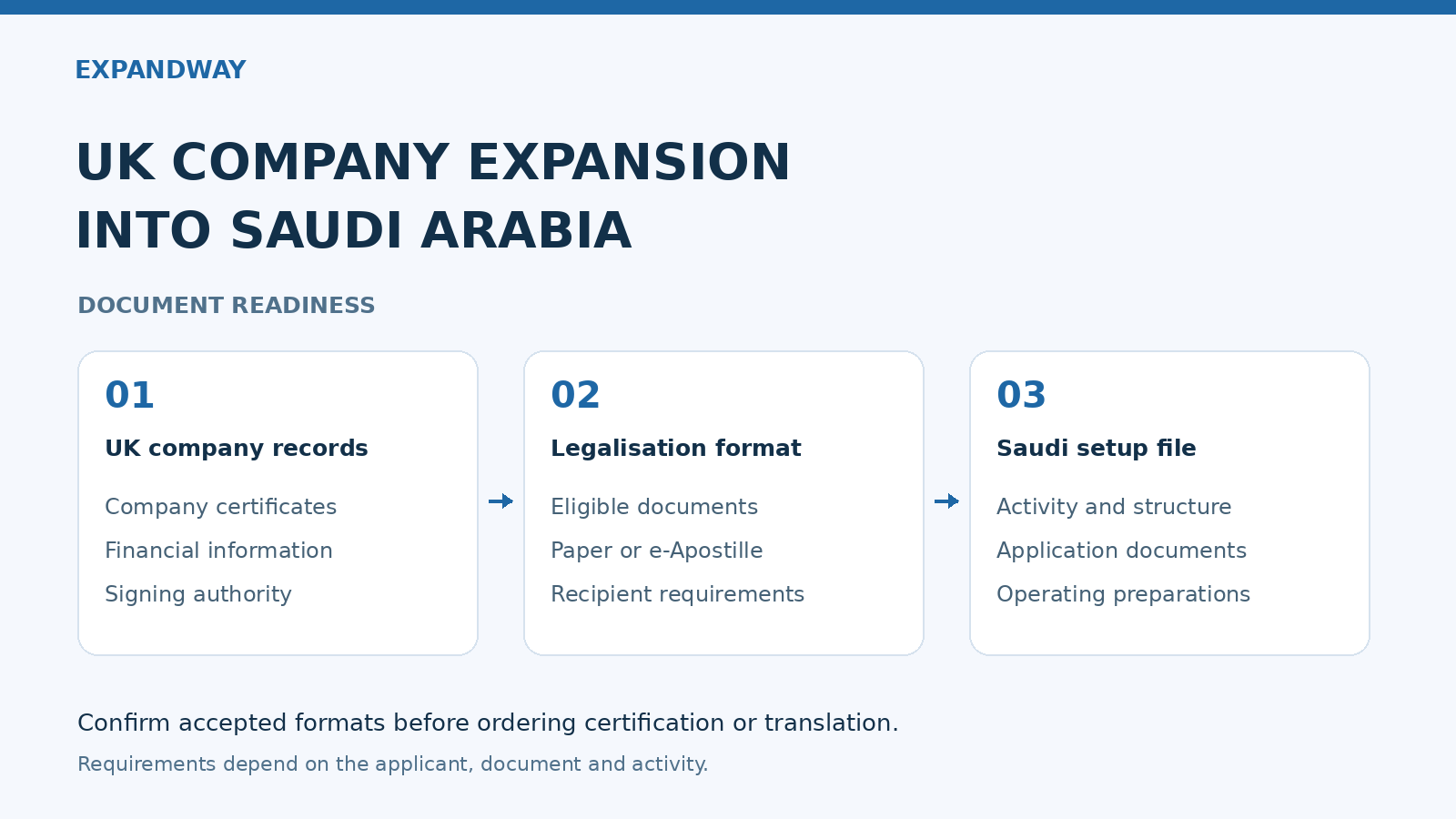
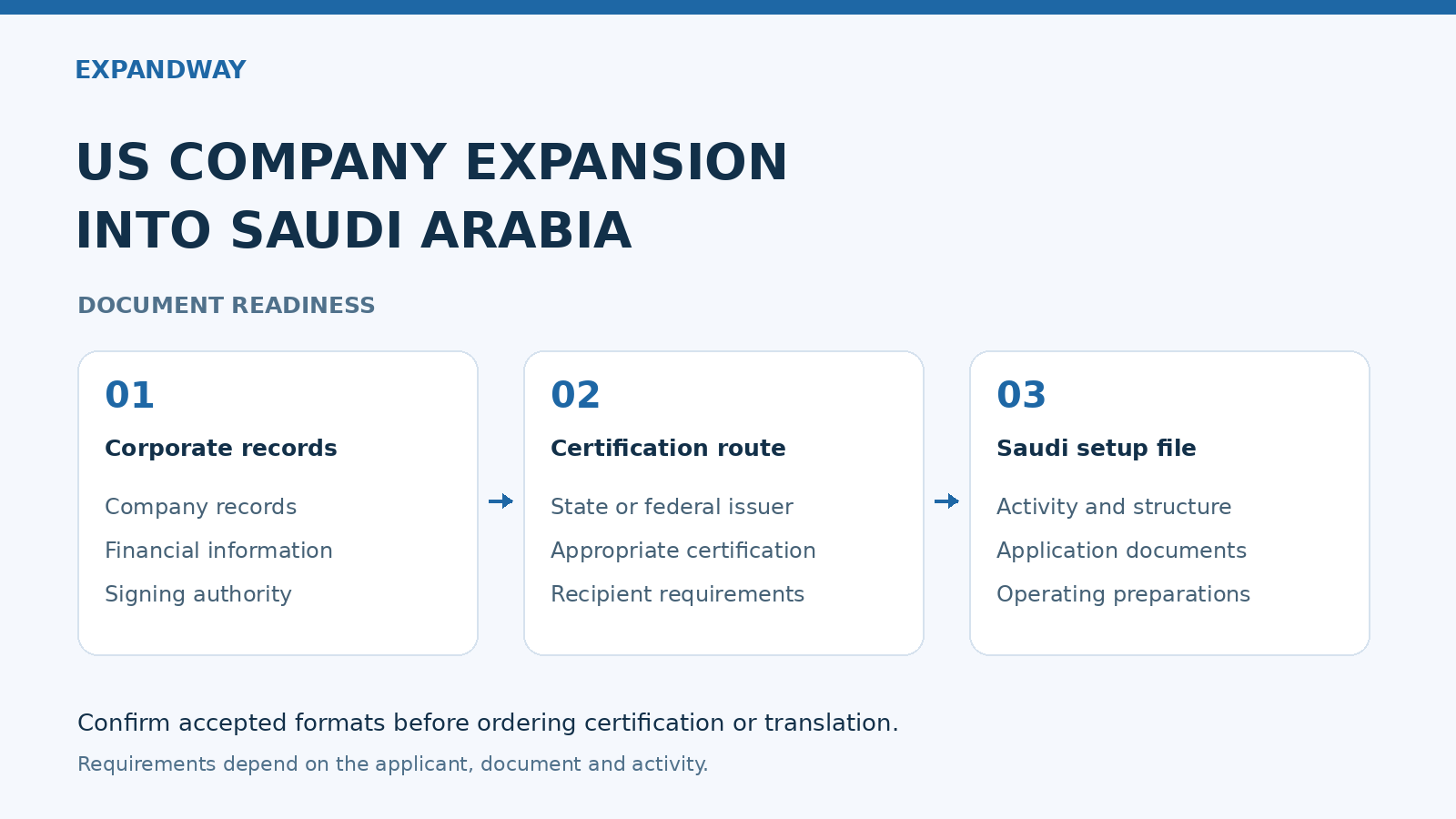
Saudi Arabia joined the Hague Apostille Convention in December 2022, so US corporate documents need a state or federal apostille, then attestation by the Saudi Ministry of Foreign Affairs — no consular legalisation chain. Watch permanent establishment: providing services in the Kingdom beyond roughly 183 days in a 12-month period can create a PE and a 20% tax charge without any entity at all. If you sell to government, read the RHQ section twice.
For UAE-based companies
Your structural advantage is a tax one: the GCC shareholding in your Saudi entity is assessed for zakat at 2.5% rather than 20% corporate income tax, and mixed Saudi/GCC and foreign ownership is split proportionately. Your friction point is documents. The UAE is not a party to the Apostille Convention, so UAE-issued corporate documents generally need the full legalisation chain rather than an apostille. Budget weeks, not days.
For Indian investors
India has been an Apostille Convention member since 2005, so an MEA apostille plus Saudi MOFA attestation is normally the route — the old Saudi embassy chain is no longer required for most corporate documents. Certified Arabic translation is usually still needed, and educational certificates sometimes attract additional verification. Profit and capital repatriation is protected under the Investment Law, but plan your withholding tax: dividends to non-residents attract 5% domestically, and the India–Saudi treaty may reduce it if you hold a tax residency certificate.
For Pakistani nationals
Pakistan joined the Apostille Convention in March 2023, so MOFA Pakistan issues apostilles and the embassy chain is generally no longer needed. Underlying verification still comes first — HEC for degrees, IBCC for school certificates. If you are relocating rather than investing remotely, look at the Premium Residency entrepreneur route: a qualifying funding round from an accredited entity can secure five-year residency without a sponsor, and the venture gets a Nitaqat exemption in its early years.
Attestation practice varies by document type and receiving body, and lists change. Confirm your specific chain before you courier anything.
Start a Business in Riyadh With People Who Have Done It
Riyadh is not a difficult market. It is an unforgiving one for companies that scope activities badly, legalise documents in the wrong order, or underestimate Saudization. Expandway handles the whole sequence — from MISA registration and company formation in Saudi Arabia through CR, banking and ongoing compliance.
Book a free consultation and we will map your activity codes, timeline and first-year budget before you commit a riyal. For the national picture, start with our overview of business setup in Saudi Arabia.
FAQ (Q&A formatted for FAQ schema)
Q1. Can foreigners own 100% of a company in Riyadh? Yes. Most sectors allow full foreign ownership with no Saudi partner, following the 2025 Investment Law. A short list of excluded activities still requires MISA approval or restricts foreign participation, so confirm your specific activity codes before you structure the entity.
Q2. How much does business setup in Riyadh cost in 2026? Plan for SAR 45,000 to SAR 150,000 in the first year, covering MISA registration, Commercial Registration, Chamber of Commerce, the municipal licence, notarisation, office space and visas. Government fee schedules — MISA’s in particular — have changed repeatedly since 2025, so confirm current figures with MISA or Expandway.
Q3. How long does company formation in Riyadh take? Six to ten weeks is realistic with a complete, correctly legalised document pack. MISA registration itself can take days. Bank account opening is usually the longest step, and regulated sectors such as healthcare or financial services add regulator approvals on top.
Q4. Do I still need a MISA licence? Not in the old form. Since February 2025 foreign investors register with MISA and receive an Investment Registration Certificate covering activities across multiple sectors, instead of applying for separate sector licences. Many people still call it “the MISA licence” out of habit.
Q5. What tax will my Riyadh company pay? Corporate income tax is 20% on the non-Saudi and non-GCC share of profits; Saudi and GCC shareholders are assessed for zakat at 2.5% of the zakat base. VAT is 15%. There is no personal income tax. Returns are due within 120 days of your fiscal year end. Qualifying RHQs pay 0% corporate income tax on eligible activities.
Q6. Do I need a physical office in Riyadh? Yes. A verified national address and a real lease are required for your municipal licence, and you cannot hire staff without them. Co-working space is accepted for many activities, but purely virtual addresses generally are not.