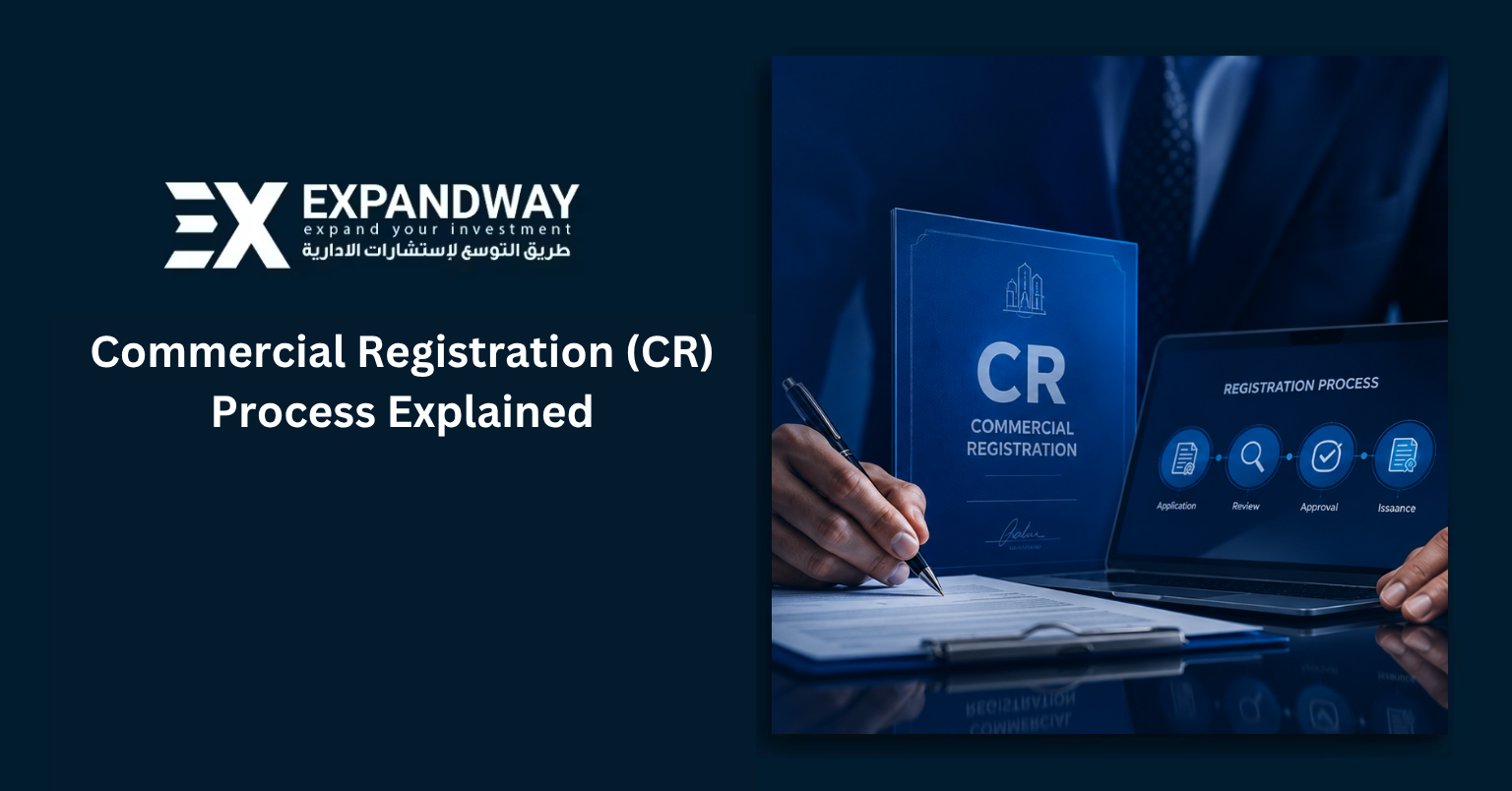
Obtaining a Commercial Registration in Saudi Arabia is one of the most important steps when establishing a legal business presence in the Kingdom.
Commonly known as a CR, this electronic record identifies the business, its legal structure, registered activities, owners and management. Banks, government authorities, suppliers, clients and licensing bodies may use CR information to verify that a business legally exists.
However, receiving a CR does not always mean that a company can immediately begin every type of commercial activity. Depending on its sector and physical location, the business may also need municipal, professional, industrial, healthcare or other regulatory approvals.
Saudi Arabia has also introduced major changes to its Commercial Registry system. Under the current rules, businesses generally maintain one nationwide commercial registration and confirm its information annually instead of renewing a CR with a conventional expiry date.
This guide explains the complete Saudi CR process, including the requirements, government fees, foreign investor procedure and post-registration obligations for 2026.
Important: Requirements can differ by activity, ownership structure and regulatory authority. Businesses should verify their exact requirements before submitting an application.
- What Is a Commercial Registration in Saudi Arabia?
- What Changed Under the New Saudi Commercial Registry System?
- Who Needs Commercial Registration in Saudi Arabia?
- Commercial Registration vs. Commercial License
- Commercial Registration Requirements in Saudi Arabia
- Requirements for Saudi and GCC Investors
- Requirements for Foreign Investors
- How to Get Commercial Registration in Saudi Arabia
- Step 1: Select the Business Activity
- Step 2: Choose the Legal Structure
- Step 3: Reserve the Trade Name
- Step 4: Complete MISA Investor Registration
- Step 5: Prepare the Company Documents
- Step 6: Submit the Incorporation Application
- Step 7: Authenticate the Articles and Pay the Fees
- Step 8: Receive the Commercial Registration
- Commercial Registration Fees in Saudi Arabia
- How Long Does the Saudi CR Process Take?
- What to Do After Receiving the CR
- Register the Official Business Address
- Complete Chamber of Commerce Registration
- Register With ZATCA
- Obtain the Municipal Commercial License
- Open the Corporate Bank Account
- Complete Labour and Social Insurance Registrations
- Apply for Sector Approvals
- Annual Confirmation of Commercial Registration
- Common CR Application Mistakes
- Frequently Asked Questions
- Can a Foreigner Obtain Commercial Registration in Saudi Arabia?
- Is a MISA Registration the Same as a Commercial Registration?
- Does a Saudi Commercial Registration Expire?
- Can One CR Cover Multiple Saudi Cities?
- Is Commercial Registration Enough to Start Trading?
- Can an Online Store Obtain a Saudi CR?
- Can I Add More Activities to an Existing CR?
- Conclusion
- Call to Action
What Is a Commercial Registration in Saudi Arabia?
A Commercial Registration is an official government record containing the primary legal and commercial information of a Saudi business.
Depending on the legal structure, a CR may show:
- The registered trade name
- Commercial registration number
- Legal structure
- Registered business activities
- Owners or shareholders
- Company managers
- Registered address
- Status of the business
- Date of registration
- Annual confirmation status
The Ministry of Commerce oversees the Commercial Registry, while most establishment and CR services are now completed electronically through the Saudi Business Center platform.
A CR provides evidence that an establishment or company has been entered into the Saudi Commercial Registry. Nevertheless, it should not be confused with an operating or municipal license.
What Changed Under the New Saudi Commercial Registry System?
Saudi Arabia’s updated Commercial Registry framework significantly changed how businesses manage their CRs.
One Commercial Registration Across Saudi Arabia
The updated system removed the general requirement to issue separate subsidiary commercial registrations for different branches.
Instead, one commercial registration can cover the entity’s activities across the Kingdom. The law also removed the previous requirement to link the CR to one specific city or administrative region.
Businesses may still need to register business locations and obtain separate municipal or sector-specific approvals for individual premises.
CR Expiry Dates Were Removed
Under the previous system, a commercial registration had an expiry date and had to be renewed.
The current system removes the conventional CR expiry date. Instead, the business must confirm its registered information every year.
Annual Confirmation Is Mandatory
The annual confirmation becomes due one year after the date of registration or the previous confirmation.
Businesses have up to 90 days from the due date to complete the confirmation. If they fail to do so, the registrar may suspend the CR and the government services connected to it.
More Opportunities to Correct Violations
The updated framework introduced alternatives such as warnings and corrective measures alongside, or instead of, immediate financial penalties in certain cases.
Who Needs Commercial Registration in Saudi Arabia?
A Commercial Registration is generally required when an individual or legal entity intends to conduct an eligible commercial activity through a formally registered establishment or company in Saudi Arabia.
It may apply to:
- Sole proprietorships
- Limited liability companies
- Joint-stock companies
- Simplified joint-stock companies
- General partnerships
- Limited partnerships
- Foreign company branches
- Foreign-owned Saudi companies
- Professional companies
- E-commerce businesses
- Retail and wholesale businesses
- Contracting and service companies
Some freelance, home-based or specially regulated activities may follow separate licensing routes. Therefore, entrepreneurs should confirm whether their activity requires a full CR or another type of authorization.
Commercial Registration vs. Commercial License
A Commercial Registration and a commercial operating license serve different purposes.
Commercial Registration
The CR registers the business as a legal commercial entity. It identifies the company, its ownership and its approved activities.
Commercial or Municipal License
The commercial license authorizes the business to operate from a particular location or conduct an activity that requires municipal approval.
For example, a retail store may need both:
- A valid Commercial Registration
- A municipal commercial license for the shop
Balady’s commercial licensing service may also incorporate the relevant Civil Defense safety permit for approved activities. Requirements can include a lease or ownership document, shop photograph, building permit and safety documentation.
Sector-Specific License
Regulated industries may require approval from an additional authority. These can include:
- Healthcare
- Education
- Tourism
- Transport and logistics
- Food services
- Financial services
- Engineering
- Legal services
- Telecommunications
- Industrial manufacturing
- Recruitment services
Therefore, applicants should verify activity-specific requirements before finalizing the company structure.
Commercial Registration Requirements in Saudi Arabia
The exact CR requirements depend on whether the business is Saudi-owned, GCC-owned or foreign-owned.
Requirements for Saudi and GCC Investors
Saudi founders and qualifying GCC investors will generally need to provide or select:
- Founder or shareholder identification
- Proposed trade name
- Legal structure
- Business activities
- Company capital details, where applicable
- Shareholding percentages
- Manager or board information
- Registered business address
- Articles of Association or constitutional documents
- Approval from the relevant authority for restricted activities
Saudi Business Center allows applicants to reserve a trade name for 60 days. The reservation gives the applicant time to complete the remaining establishment procedures.
GCC citizens and companies fully owned by GCC citizens generally receive treatment similar to Saudi investors and apply through the Ministry of Commerce rather than the standard foreign investor route.
Requirements for Foreign Investors
Most non-GCC foreign investors must complete MISA Investor Registration before obtaining their Commercial Registration.
The updated Saudi Investment Law replaced the previous licensing-based approach with an investor registration mechanism. Once MISA confirms the registration, the foreign investor can establish the company, obtain a CR and apply for any additional regulatory licenses.
Common MISA documents can include:
- Authenticated Commercial Registration of the foreign parent company
- Authenticated financial statements for the previous fiscal year
- Identification documents for relevant partners
- Details of the intended Saudi activities
- Ownership and corporate structure information
- Activity-specific approvals or supporting documents
MISA states that the foreign entity’s CR and previous-year financial statements should generally be authenticated by the Saudi Embassy. Premium Residency holders may be exempt from submitting the foreign CR and financial statements in applicable cases.
MISA also distinguishes between available and restricted investment activities. Applications under its Investor Registration tracks can have a review period of up to 10 days, although additional clarification or regulatory approval can extend the total setup timeline.
How to Get Commercial Registration in Saudi Arabia
The following process reflects a typical company registration journey. The exact sequence may change depending on the investor and activity.
Step 1: Select the Business Activity
Start by identifying every activity the company plans to conduct.
This step is critical because the activity determines:
- Whether foreign ownership is permitted
- Whether MISA registration is required
- Whether minimum capital conditions apply
- Which government authority regulates the activity
- Whether a municipal license is needed
- Whether professional qualifications are required
- Which office or facility requirements apply
Avoid selecting activities that the business does not genuinely intend to perform. MISA states that registered activities should actually be practised.
Step 2: Choose the Legal Structure
The legal structure affects ownership, liability, management, compliance and government fees.
Common options include:
Limited Liability Company
An LLC is widely used by local and foreign investors because it provides a separate legal identity and generally limits shareholders’ liability to their capital contributions.
[Internal link: Saudi LLC Setup Guide for Foreign Investors]
Branch of a Foreign Company
A foreign company may establish a Saudi branch to conduct approved activities under the parent company’s ownership.
Joint-Stock or Simplified Joint-Stock Company
These structures may suit larger businesses, investment ventures or companies planning more flexible share ownership and governance arrangements.
Sole Proprietorship
This structure may suit eligible individual Saudi or GCC entrepreneurs, but it does not provide the same liability separation as a limited liability company.
Businesses should select the structure based on long-term operational and investment requirements, not only the lowest initial fee.
Step 3: Reserve the Trade Name
Applicants can reserve a suitable trade name through the Saudi Business Center.
The name should comply with Saudi naming regulations and should not conflict with an existing reserved or registered name.
A standard trade name reservation remains valid for 60 days.
Before submission, check:
- Arabic and English spelling
- Similar existing business names
- Trademark availability
- Domain name availability
- Social media username availability
- Whether the name accurately fits the registered activities
A trade name reservation does not automatically provide trademark protection. Businesses that intend to build a recognizable brand should consider registering their trademark separately.
Step 4: Complete MISA Investor Registration
This step applies primarily to non-GCC foreign investors.
The investor submits the relevant company documents, financial records, ownership information and proposed business activities to MISA.
After MISA confirms Investor Registration, the foreign investor can proceed with company incorporation and Commercial Registration.
Businesses should confirm whether their activity is:
- Open to foreign investment
- Restricted
- Subject to prior approval
- Subject to minimum capital
- Subject to experience or qualification requirements
- Limited to a specific ownership percentage
Step 5: Prepare the Company Documents
The company must prepare its incorporation information and constitutional documents.
For an LLC, this commonly includes the Articles of Association, which normally address:
- Company name
- Registered activities
- Shareholders
- Capital contributions
- Ownership percentages
- Appointment and powers of managers
- Profit and loss distribution
- Share transfer rules
- Decision-making procedures
- Company duration, where applicable
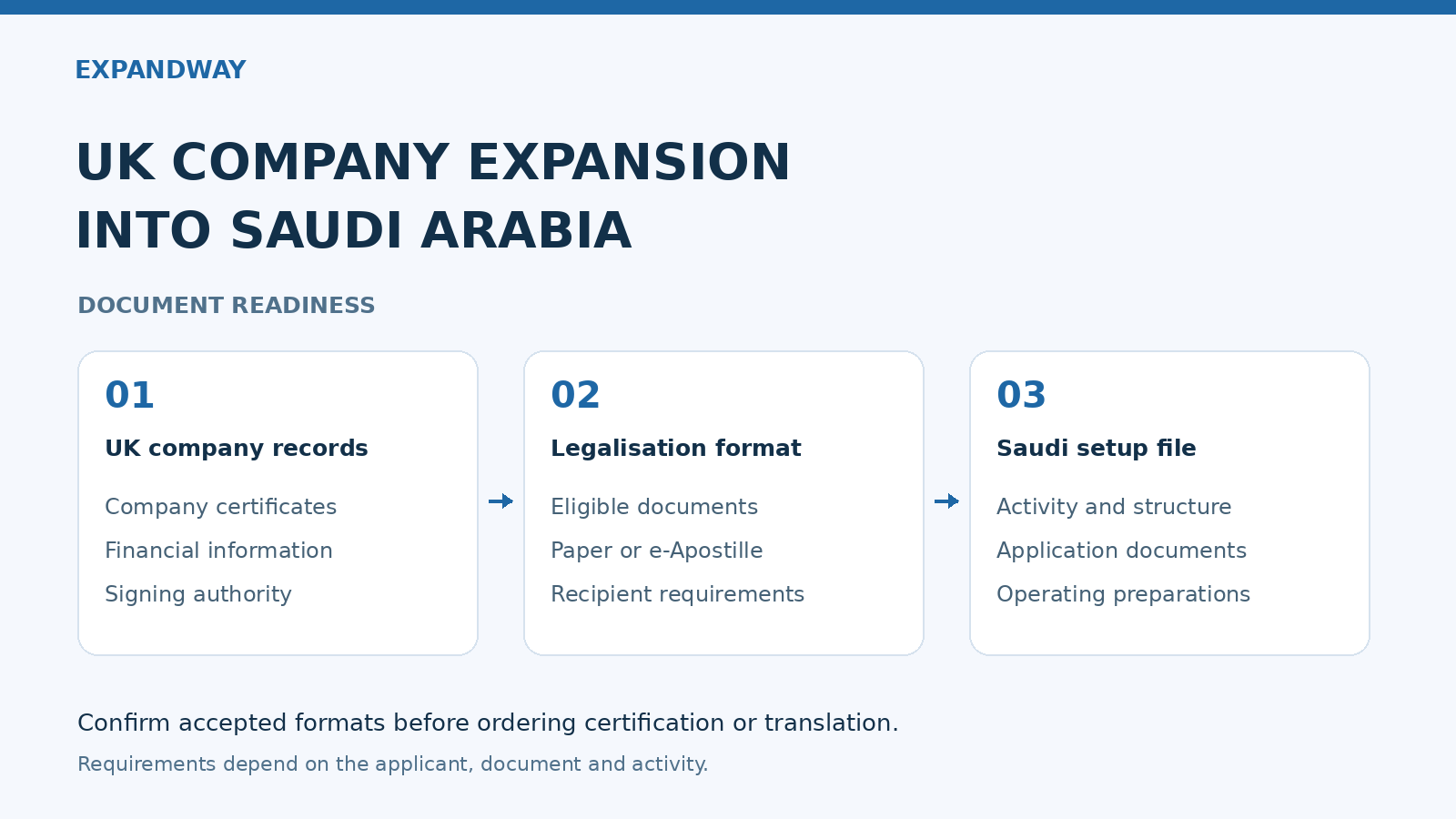
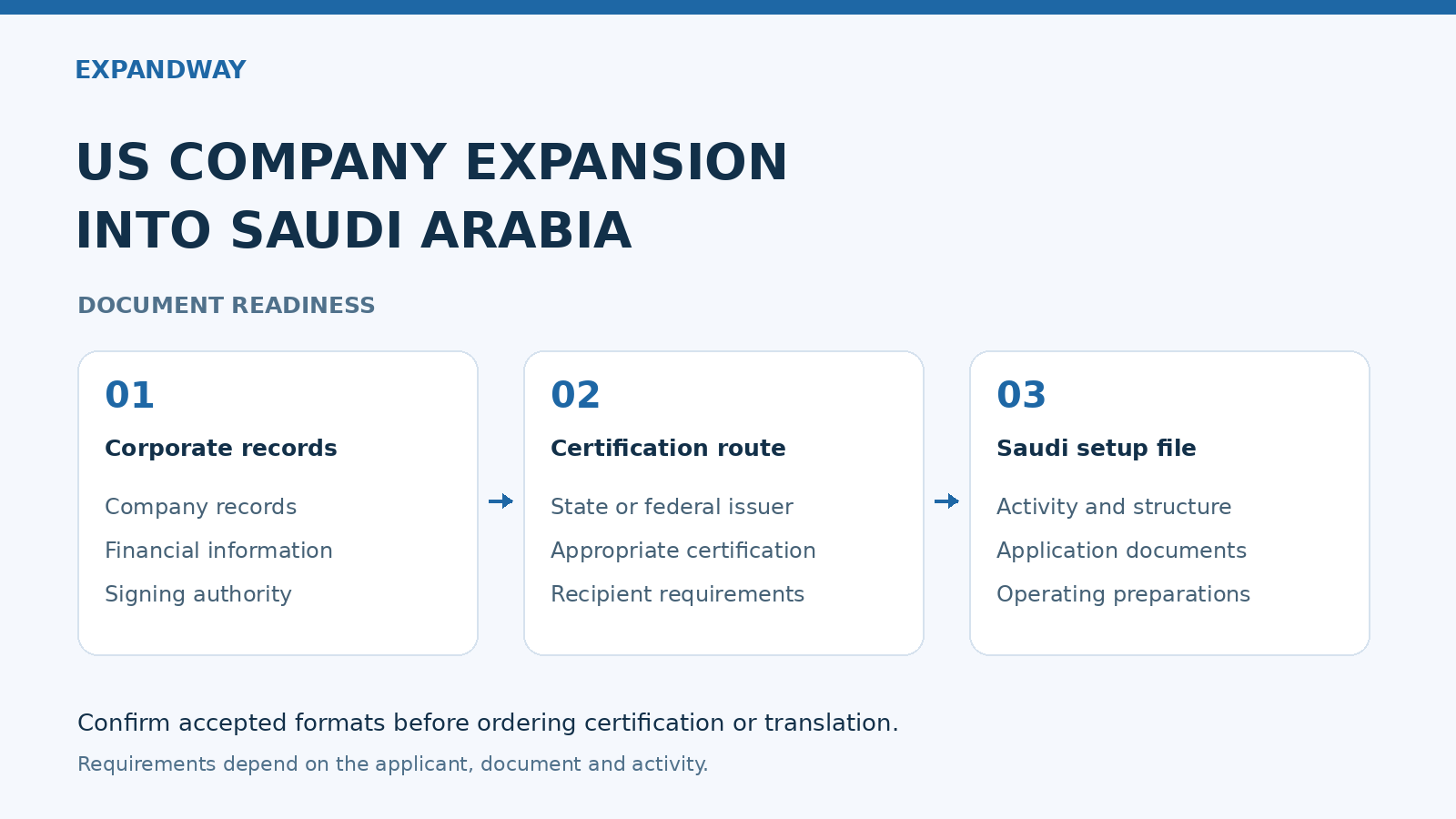
Foreign documents may require authentication, legalization or certified translation depending on the issuing country and receiving authority.
Although MISA states that documents submitted directly to it do not generally need translation, another ministry or authority may request an Arabic translation.
Step 6: Submit the Incorporation Application
The applicant submits the company establishment request through the Saudi Business Center.
The submission generally includes:
- Reserved trade name
- Legal structure
- Registered activities
- Shareholder information
- Management details
- Capital details
- Articles of Association
- Investor Registration information, where applicable
- Regulatory approvals
- Contact information
- Official business address details
The authorities may return the application for correction if documents are inconsistent or information is incomplete.
Step 7: Authenticate the Articles and Pay the Fees
The partners or their authorized representatives approve and authenticate the Articles of Association electronically.
The applicant then pays the applicable government fees, publication fee and VAT.
Once the application is approved and payment is complete, the Commercial Registration can be issued electronically. MISA confirms that Articles of Association authentication and CR issuance for eligible foreign company establishment applications can be completed electronically.
Step 8: Receive the Commercial Registration
After approval, the company receives its electronic Commercial Registration.
Check the CR immediately to confirm that the following information is correct:
- Company name
- CR number
- Legal structure
- Activities
- Ownership
- Management
- Registered address
- Contact information
Correct any error before using the CR for banking, contracts, tax registration or license applications.
Commercial Registration Fees in Saudi Arabia
Government fees differ according to the legal structure.
The Saudi Business Center currently lists the following company establishment fees:
| Legal structure | CR fee | Publication fee | VAT |
| Limited liability company | SAR 1,200 | SAR 500 | 15% |
| Joint-stock company | SAR 1,600 | SAR 500 | 15% |
| Simplified joint-stock company | SAR 1,600 | SAR 500 | 15% |
| General partnership | SAR 1,000 | SAR 500 | 15% |
| Limited partnership | SAR 1,000 | SAR 500 | 15% |
The same Saudi Business Center service for a company established under MISA Investor Registration lists SAR 1,200 for an LLC, SAR 1,600 for a joint-stock or simplified joint-stock company and SAR 1,000 for a partnership, plus SAR 500 publication fees and 15% VAT.
These amounts do not represent the complete cost of setting up a business. Additional expenses may include:
- MISA registration charges
- Chamber of Commerce subscription
- Official Business Address fees
- Municipal licensing fees
- Sector regulator fees
- Document authentication
- Certified translation
- Professional service fees
- Office or warehouse rental
- Civil Defense requirements
- Employee and immigration costs
Chamber of Commerce subscription fees depend on the applicable subscription category.
[Internal link: How Much It Costs to Set Up a Business in Saudi Arabia in 2026]
How Long Does the Saudi CR Process Take?
There is no single timeline that applies to every business.
A straightforward Saudi-owned electronic application may move faster than a foreign-owned company that requires authenticated documents, MISA review and sector approval.
Potential timeline factors include:
- Legal structure
- Founder nationality
- MISA registration
- Document authentication
- Trade name approval
- Accuracy of the Articles of Association
- Restricted business activities
- Capital requirements
- Regulatory approvals
- Municipality requirements
- Office availability
MISA states that Investor Registration applications under its available and restricted activity tracks may have a review period of up to 10 days. Meanwhile, Balady lists a service duration of one to ten days for commercial license issuance, depending on the activity and application.
These periods do not necessarily represent the complete business setup timeline.
What to Do After Receiving the CR
Commercial Registration is a major milestone, but several post-incorporation procedures may still be required.
Register the Official Business Address
Businesses need an official and standardized address for government, legal and commercial communications.
Saudi Post states that the National Address is a mandatory requirement for businesses. It can also be registered through the Saudi Business Center while issuing the Commercial Registration.
Complete Chamber of Commerce Registration
Companies that require Chamber membership can apply after the CR becomes active and its information is complete.
The subscription category determines the applicable charge.
Register With ZATCA
The business must complete the applicable Zakat or corporate income tax registration with the Zakat, Tax and Customs Authority.
Foreign establishments, non-residents earning Saudi-source income and Saudi resident capital companies with non-Saudi ownership may fall within corporate income tax registration requirements.
Businesses conducting VAT-taxable activities must also monitor the VAT registration threshold.
Mandatory VAT registration generally applies when taxable supplies exceed SAR 375,000 over the relevant 12-month period. Voluntary registration may be available from SAR 187,500, subject to the applicable rules.
Obtain the Municipal Commercial License
Businesses operating from an office, shop, restaurant, warehouse or another physical location may need a Balady commercial license.
Depending on the activity, the application may require:
- Lease agreement or ownership deed
- Building permit
- Exterior photograph and signboard
- Location and premises details
- Safety equipment invoice
- Civil Defense safety report
- Sanitation contract
- Sector-specific approvals
Balady states that processing can be instant for qualifying activities or referred to the municipality for review for non-instant activities.
Open the Corporate Bank Account
Banks commonly request the company’s CR and supporting corporate records.
The exact account-opening documents can differ by bank, ownership structure and risk assessment. Foreign-owned businesses may face additional beneficial ownership and source-of-funds checks.
Complete Labour and Social Insurance Registrations
Companies hiring employees may need to activate the relevant employer services and complete labour and social insurance procedures.
GOSI registration applies to qualifying companies, establishments and commercial activities operating in Saudi Arabia. Employers must also register covered employees within the applicable statutory period.
The company may also need Qiwa access, employment contracts, work permits and Saudization compliance.
Apply for Sector Approvals
Do not begin a regulated activity until the responsible authority has issued the required approval.
The CR records the activity, but it does not replace an industry-specific license.
Annual Confirmation of Commercial Registration
A Saudi CR no longer follows the traditional renewal model with a fixed expiry date. However, the company must confirm its registered information every year.
Before confirming the CR, review:
- Ownership information
- Manager and board information
- Business activities
- Registered address
- Contact details
- Company status
- Beneficial ownership records
- Licensing information
The confirmation becomes due one year after the initial registration or previous confirmation.
If the business does not submit the confirmation within 90 days of the due date, the Commercial Registration and connected services may be suspended.
The Saudi Business Center currently lists annual confirmation fees of:
- SAR 1,200 for an LLC
- SAR 1,600 for a joint-stock or simplified joint-stock company
- SAR 1,000 for a general or limited partnership
Businesses should record the confirmation date in their compliance calendar instead of waiting for a suspension notice.
Common CR Application Mistakes
Avoiding the following errors can reduce delays and unnecessary amendments.
Choosing the Wrong Business Activity
An incorrect activity can affect MISA approval, licensing, taxation, office requirements and employee eligibility.
Assuming a CR Is the Only License Required
A CR registers the business. It does not automatically replace municipal, professional or sector-specific approvals.
Submitting Inconsistent Documents
Names, registration numbers, shareholder information and financial details should match across all authenticated records.
Ignoring Foreign Document Authentication
Foreign corporate records may need embassy authentication before they can be accepted.
Selecting the Cheapest Legal Structure
A sole proprietorship or branch may appear less expensive initially, but it may not provide the desired liability protection, investment flexibility or governance structure.
Leasing a Property Before Checking Activity Requirements
A location may not be approved for the intended activity. Confirm municipal and regulator requirements before signing a long-term lease.
Missing the Annual Confirmation Deadline
Failure to confirm CR information within the required period can lead to suspension of the registration and connected services.
Frequently Asked Questions
Can a Foreigner Obtain Commercial Registration in Saudi Arabia?
Yes. A foreign investor can establish a company and obtain a Commercial Registration for activities open to foreign investment.
Most non-GCC foreign investors must first complete MISA Investor Registration. After confirmation, they can establish the company through the Saudi Business Center and obtain the necessary operating licenses.
Is a MISA Registration the Same as a Commercial Registration?
No.
MISA Investor Registration authorizes and records the foreign investor under the Saudi investment framework. The Commercial Registration is issued through the commercial registration and company establishment process.
Foreign investors generally complete MISA registration first and then obtain the CR.
Does a Saudi Commercial Registration Expire?
The current Commercial Registry system does not use the previous conventional CR expiry date.
Instead, the business must confirm its registration information annually. Failure to complete confirmation within 90 days after its due date may result in suspension.
Can One CR Cover Multiple Saudi Cities?
The new framework removed the requirement to issue the CR based on a specific city and generally allows one Commercial Registration at the Kingdom level.
Nevertheless, each physical location may still require address registration, municipal licensing and other location-specific approvals.
Is Commercial Registration Enough to Start Trading?
Not always.
The business may still require:
- A municipal commercial license
- Civil Defense approval
- ZATCA registration
- Chamber subscription
- Sector regulator approval
- Employee registrations
- Import or customs permissions
- Additional operating permits
The exact requirements depend on the activity.
Can an Online Store Obtain a Saudi CR?
Yes, an e-commerce activity can be registered where the applicant and activity meet the applicable requirements.
The business should select the correct e-commerce or trading activity and comply with consumer protection, tax, payment and online selling requirements.
Can I Add More Activities to an Existing CR?
Activities can generally be added or amended through the relevant electronic service, provided that the company meets their regulatory requirements.
MISA states that there is no fixed number of activities for an Investor Registration, but the registered activities should actually be practised.
Conclusion
Obtaining Commercial Registration in Saudi Arabia is now largely an electronic process, but successful registration still depends on choosing the correct activities, legal structure and ownership route.
Saudi and qualifying GCC investors can generally proceed through the Ministry of Commerce and Saudi Business Center. Most foreign investors must first secure MISA Investor Registration before establishing the company and obtaining a CR.
After CR issuance, the company should complete its Official Business Address, ZATCA, Chamber, municipal licensing, labour and sector-specific registrations. It must also confirm its CR information annually to keep the registration and connected government services active.
A well-planned setup prevents costly amendments, licensing delays and compliance problems after incorporation.
Call to Action
Planning to obtain a Commercial Registration in Saudi Arabia?
Expandway can support your complete business setup journey, from activity selection and MISA Investor Registration to company incorporation, CR issuance and post-registration compliance.
Contact Expandway today for a tailored Saudi business setup assessment and a clear step-by-step registration plan.