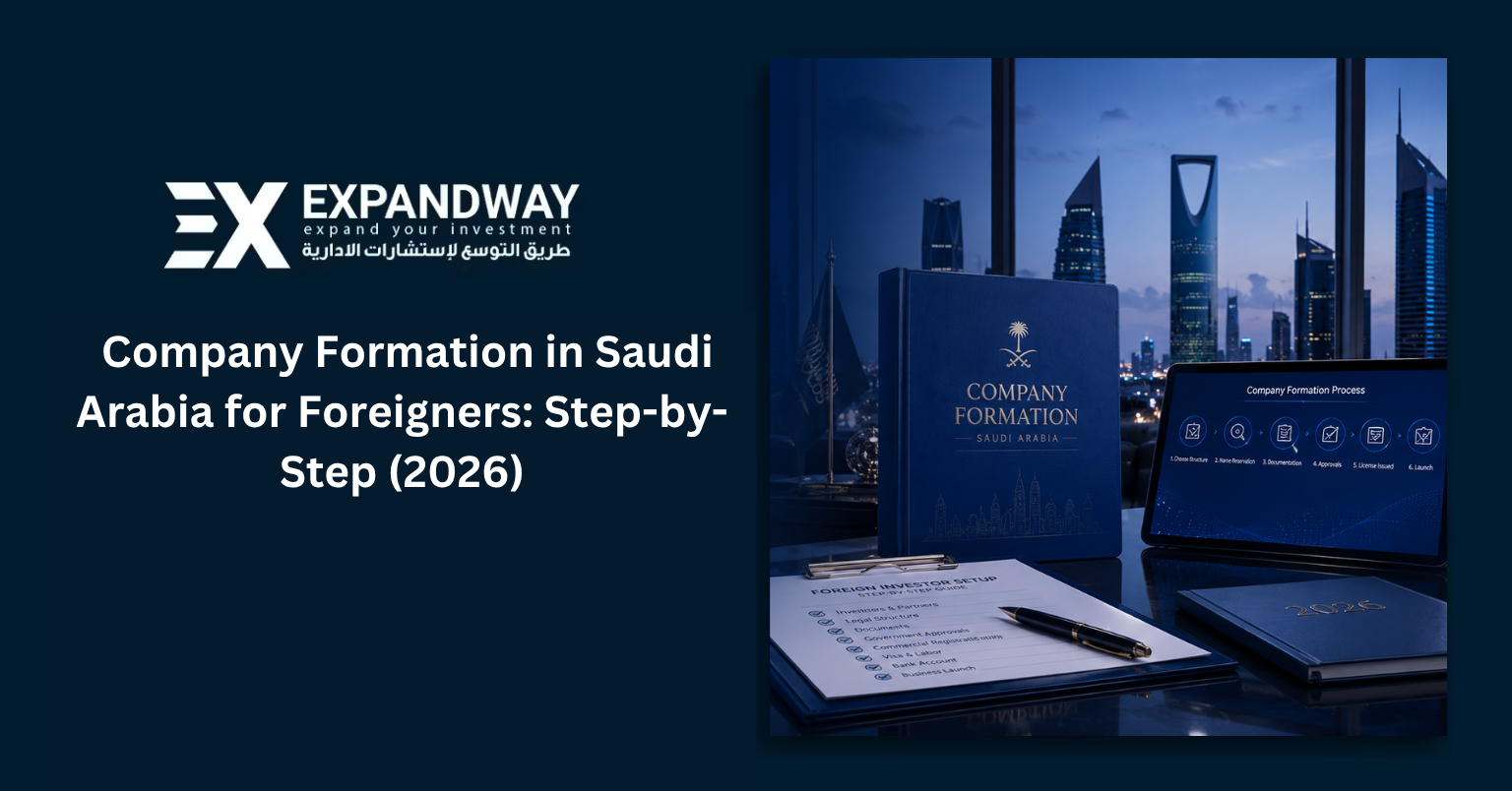
Company formation in Saudi Arabia for foreigners runs through one main gateway: an investment registration from the Ministry of Investment (MISA), followed by a Commercial Registration from the Ministry of Commerce. In most sectors you can hold 100% foreign ownership in Saudi Arabia with no local partner, and a standard limited liability company (LLC) usually starts trading in about four to eight weeks once you attest your documents. This guide covers the entity types, the MISA licence, the six steps, the paperwork, the timeline and the cost.
- What changed in 2026
- Can foreigners own 100% of a company in Saudi Arabia?
- Entity types for foreign investors
- The MISA licence (investment registration)
- Company formation in Saudi Arabia for foreigners: the 6 steps
- Documents you will need
- How long does it take?
- How much does it cost?
- Country notes: what actually differs
- Taxes after you register
- Ready to register?
- Frequently asked questions
What changed in 2026
Saudi Arabia’s new Investment Law took effect in February 2025. It replaced the old foreign investment “licence” with a simpler investment registration and gives local and foreign investors equal treatment. Many advisors — and MISA’s own portal — still say “MISA licence,” so we use both terms below. In short, the process now moves faster and more predictably than it did a few years ago.
Can foreigners own 100% of a company in Saudi Arabia?
Yes in most activities. MISA rules let foreign investors register a company in Saudi Arabia with full ownership across services, consulting, technology, manufacturing, contracting and e-commerce. 100% foreign ownership in Saudi Arabia is the norm, not the exception.
A short “excluded activities” list still applies. It covers areas such as some upstream oil and gas work, certain security and defence activities, and specific real-estate rights in Makkah and Madinah. A few professional fields also expect a qualified local partner. If your activity sits on that list, Expandway can confirm the current rule before you commit.
Entity types for foreign investors
Your structure drives your capital, liability and paperwork, so choose it first. These are the options most foreigners use.
| Entity type | Best for | Ownership | Notes |
|---|---|---|---|
| Limited Liability Company (LLC) | Most SMEs and first-time entrants | Up to 100% foreign | 1+ shareholders; liability stops at your capital; the default choice |
| Single-shareholder LLC | Solo founders, wholly-owned subsidiaries | 100% foreign | An LLC with one owner (a “one-person company”) |
| Closed Joint Stock Company (JSC) | Larger ventures and future fundraising | Up to 100% foreign | Minimum capital around SAR 500,000; needs a board |
| Branch of a foreign company | Running the parent’s activities directly | 100% (parent-owned) | Not a separate legal entity; suits foreign company registration in KSA without a new shareholder structure |
| Regional Headquarters (RHQ) | Multinationals coordinating the region from Riyadh | 100% foreign | Comes with tax incentives; large government contracts often expect it |
For most readers, the LLC is the practical answer. For a deeper comparison, see Expandway’s company formation in Saudi Arabia guide, or the walk-through of foreign company registration in Saudi Arabia if you plan to open a branch.
The MISA licence (investment registration)
MISA — the Ministry of Investment of Saudi Arabia — approves foreign investors to operate. Its investment registration, still widely called the “MISA licence,” unlocks everything that follows: your Commercial Registration, your bank account, your visas and your right to sign contracts.
Registration categories match your activity — service, industrial, trading, contracting, entrepreneurial or RHQ — and each sets its own conditions on capital, experience and documents. For the detail, read Expandway’s Ministry of Investment (MISA) guide for investors.
Company formation in Saudi Arabia for foreigners: the 6 steps
Here is the process in the order you will actually follow it.
Step 1 — Choose your activity and structure
Pick your ISIC business activity and decide between an LLC, a JSC or a branch. This choice sets your MISA category and any minimum capital, so settle it before you file.
Step 2 — Reserve the name and get MISA registration
Reserve the company name, then apply to MISA with your attested corporate or personal documents. Once MISA approves you, you receive your investment registration certificate — the green light to register a company in Saudi Arabia.
Step 3 — Notarise the Articles and get your Commercial Registration
Draft and notarise the Articles of Association, then obtain the Commercial Registration (CR) from the Ministry of Commerce. The CR acts as your company’s birth certificate, and you need it for almost every later step.
Step 4 — Complete post-CR registrations
Register with the Chamber of Commerce, create your National Address, and enrol with ZATCA (Zakat, Tax and Customs Authority) for tax and VAT and with GOSI for social insurance. Add a municipal (Baladi) licence if your activity or premises need one.
Step 5 — Open a bank account and inject capital
Open an account with a Saudi bank and deposit any required share capital. Banks run their own compliance checks, so this step often sets your overall timeline — start it early.
Step 6 — Onboard your manager, visas and sector approvals
Appoint your General Manager, arrange the investor visa and the GM’s Iqama (residency), and secure any regulator sign-off — for example SFDA (food, drugs, medical devices), REGA (real estate) or the Saudi Central Bank (banking, finance, insurance, fintech). Then you can hire, keeping Saudization (Nitaqat) targets in mind.
Documents you will need
Requirements vary by entity and activity. A typical LLC application for a corporate shareholder includes:
- Certificate of incorporation of the parent company
- The parent’s Articles or Memorandum of Association
- A board resolution approving the Saudi investment and appointing the General Manager
- Audited financial statements for the most recent year
- Passport copies of shareholders, directors and the proposed GM
- A Power of Attorney if a consultant files for you
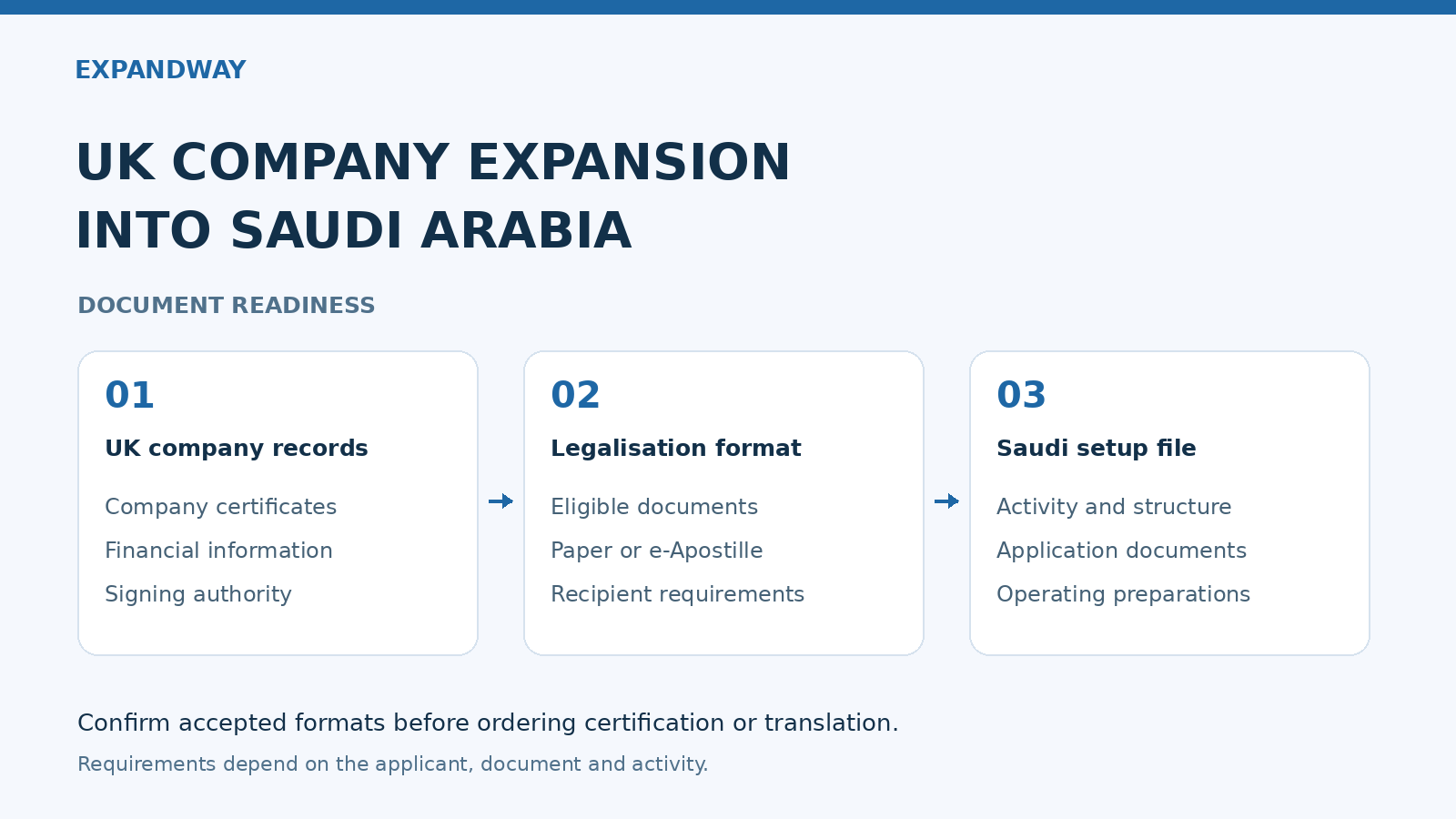
You must legalise every foreign document — by apostille or embassy attestation, depending on your country — and add a certified Arabic translation. Individual investors follow the same route with personal documents. Ask Expandway to review your file before you submit it.
How long does it take?
For a standard LLC with clean, attested paperwork, plan for about four to eight weeks from MISA application to a working company:
- Document attestation and translation: 1–6 weeks (this varies most by country)
- MISA investment registration: a few days to about 2 weeks
- Commercial Registration and post-CR steps: 1–3 weeks
- Bank account: 2–6 weeks, often running in parallel
Home-country attestation and bank onboarding in Riyadh drive most of the wait. Everything else moves quickly.
How much does it cost?
Government charges stay modest; your capital, office and professional fees carry the bigger numbers. Treat the figures below as planning ranges, and confirm current figures with MISA, ZATCA or Expandway, since authorities update fees and categories periodically.
| Cost item | Authority | Indicative amount (SAR) |
|---|---|---|
| MISA investment registration | MISA | ~2,000/year plus a first-year service subscription; the 2025 law cut some legacy fees — confirm current figures |
| Articles of Association + publication | Ministry of Commerce | ~1,200 + ~500 (+ VAT) |
| Commercial Registration (CR) | Ministry of Commerce | ~200 |
| Chamber of Commerce membership | Chamber of Commerce | A few hundred to a few thousand, by category |
| Municipal (Baladi) licence | Municipality | Varies by activity and premises |
| Attestation + certified translation | Home country + MOFA | Varies by country and document count |
| Professional setup fee | Consultant (e.g. Expandway) | Typically USD 5,500–10,000+, by scope |
Minimum capital is money you keep in the business, not a fee. Most service and consulting LLCs carry no statutory minimum, though you should still capitalise realistically. A 100% foreign-owned trading (wholesale/retail) company sits much higher — often around SAR 30 million with added conditions — which is why many retailers bring in a Saudi partner. Confirm the threshold for your exact activity before you plan.
Country notes: what actually differs
The core process stays the same for everyone. These points genuinely change by nationality — attestation, ownership and moving money.
For US companies
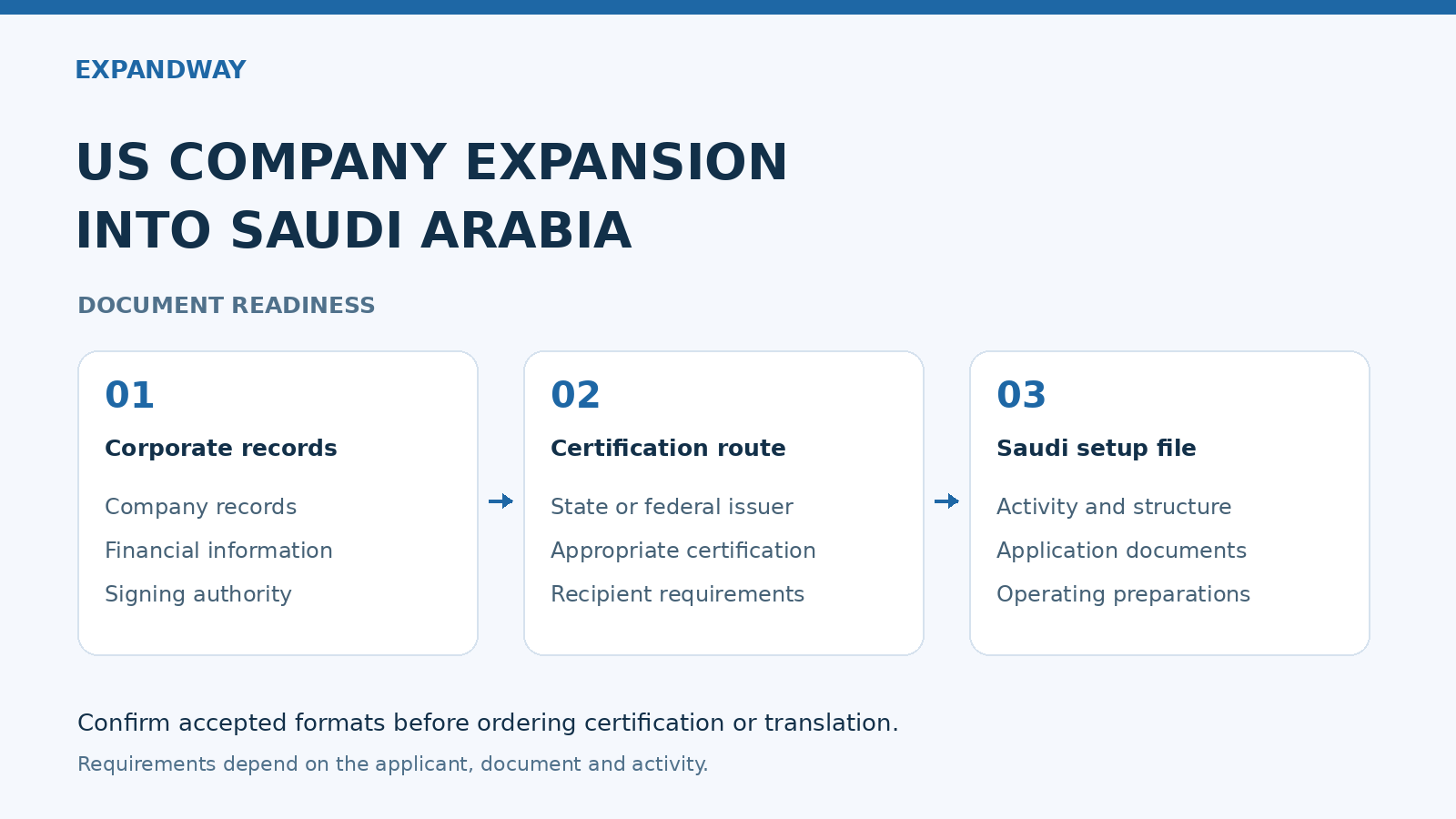
The United States belongs to the Hague Apostille Convention, so you can apostille your incorporation documents and use them in Saudi Arabia without embassy attestation — usually the fastest route. You can own your company outright in most sectors. On tax, remember that US persons report worldwide income and may file for foreign subsidiaries (such as Form 5471); no comprehensive US–Saudi tax treaty exists, so plan cross-border tax with a specialist. Chasing large public-sector contracts? Ask about the RHQ route.
For UAE-based companies
The UAE also belongs to the Apostille Convention, so document legalisation moves quickly. One nuance matters: a UAE company owned by GCC nationals counts as a Saudi investor for many activities and pays Zakat rather than corporate income tax, while a UAE company with non-GCC owners counts as a foreign investor. Capital moves freely from the UAE, which makes it one of the smoothest bases to expand from.
For Indian investors
India sends a large share of investors to the Kingdom, but confirm your attestation route early. In practice, Saudi authorities have often still required the full embassy/consular chain (notary → India’s MEA → Saudi mission → Saudi MOFA), which can take several weeks. Ownership stays open in most sectors. To move capital abroad, you work within RBI/FEMA rules — Overseas Direct Investment for companies, or the Liberalised Remittance Scheme for individuals — so build that time into your plan.
For Pakistani nationals
Pakistani documents usually go through embassy/consular attestation for use in Saudi Arabia, so allow extra lead time and confirm the current requirement. Investors from Pakistan can hold full ownership in most activities. Outward investment and capital transfers usually need clearance under State Bank of Pakistan foreign-exchange rules, which you should arrange before you commit capital in Riyadh.
Taxes after you register
Once you register with ZATCA, the headline rates stay simple. The foreign-owned share of profit pays corporate income tax at 20%, while the Saudi or GCC-owned share pays Zakat at 2.5%; a mixed-ownership company splits between the two. VAT runs at 15%, and you must register once taxable turnover passes SAR 375,000 (voluntary from SAR 187,500). Certain payments abroad carry withholding tax of 5–20%. A qualifying Regional Headquarters can access a long-term corporate-tax and withholding-tax incentive. Confirm your own position with ZATCA or Expandway.
Ready to register?
Company formation in Saudi Arabia for foreigners is very doable in 2026 — the rules read clearer, ownership stays open in most sectors, and setup runs in weeks, not months. Two things trip people up: picking the wrong MISA category and underestimating document attestation.
Book a free consultation with Expandway and we will map your activity, structure and documents so your setup clears the first time.
Frequently asked questions
Can a foreigner own 100% of a company in Saudi Arabia?
Yes. In most sectors, foreign investors hold 100% foreign ownership in Saudi Arabia with no local partner, through a MISA investment registration. The short list of excluded or restricted activities forms the main exception, and a few professional fields still ask for local credentials.
Do I still need a MISA licence in 2026?
Yes. MISA issues the registration that lets a foreign investor operate. Under the 2025 Investment Law the old “foreign investment licence” became an investment registration, but you still need it before you obtain a Commercial Registration or open a bank account.
How long does it take to register a company in Saudi Arabia?
For a standard LLC with attested documents ready, expect about four to eight weeks. Home-country attestation and bank-account opening in Riyadh usually take the longest.
How much does company formation cost?
Government fees stay low — MISA registration, Articles of Association and Commercial Registration together cost modestly. The larger costs come from professional fees (often USD 5,500–10,000+), attestation and translation, office space, and any minimum capital your activity requires. Confirm current figures with MISA, ZATCA or Expandway.
Do I need a Saudi partner or local sponsor?
Not for most activities full foreign ownership is standard. You only need a Saudi partner for specific restricted sectors, or as a commercial choice, for example to lower the high capital threshold on a 100% foreign-owned trading company.
Do my documents need an apostille or embassy attestation?
It depends on your country. Apostille members such as the USA and UAE can usually apostille documents — the faster route. For India and Pakistan, confirm the current requirement, since Saudi authorities often still require the embassy/consular chain. Every document also needs a certified Arabic translation.