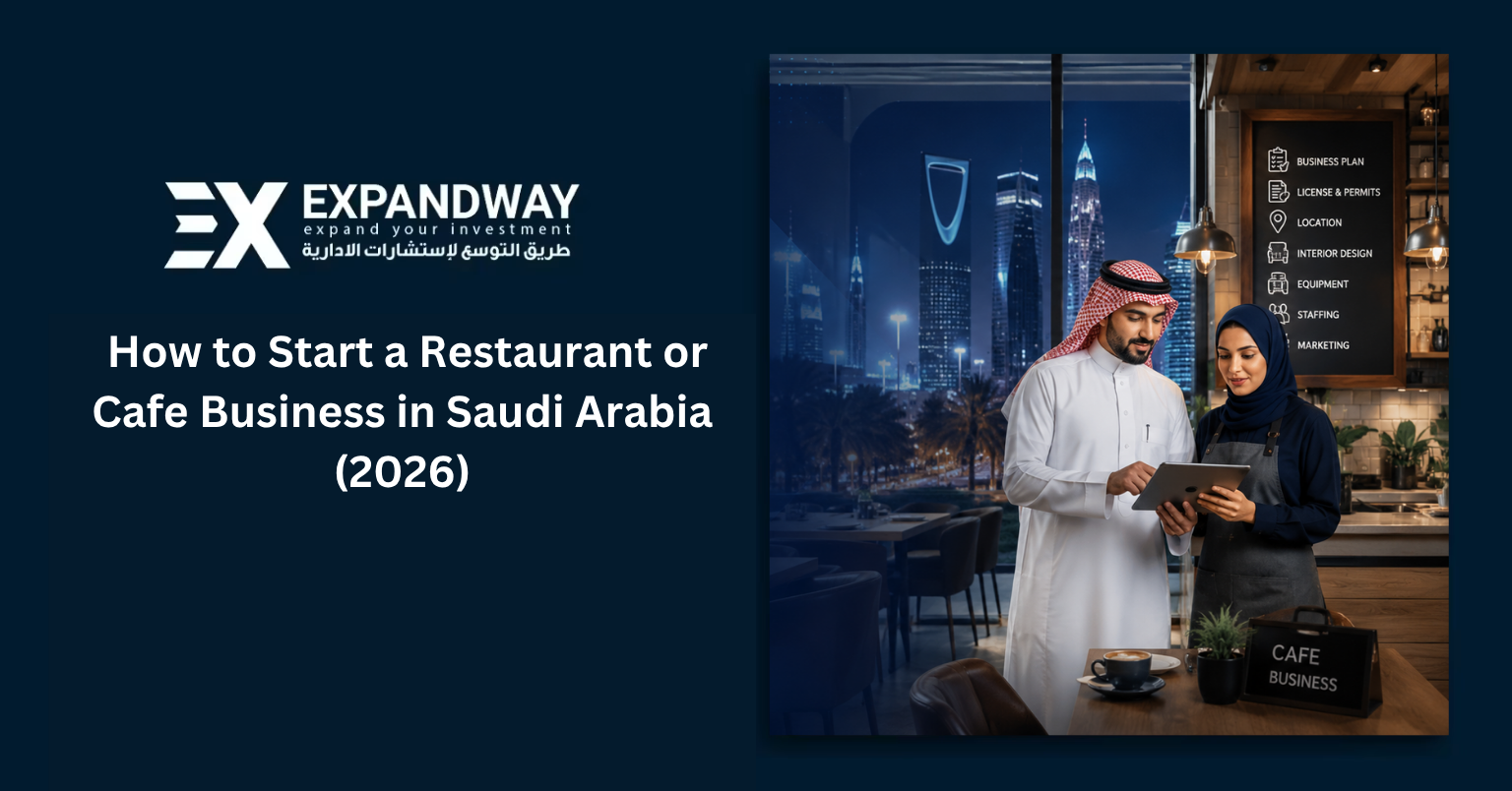
To open a restaurant in Saudi Arabia you need a Commercial Registration (CR) from the Ministry of Commerce, a municipal “Baladi” licence for your premises, and food-safety clearance under the Saudi Food and Drug Authority (SFDA) — plus a MISA investment registration first if you are a foreign investor. A Saudi or GCC owner can often open in a few weeks; a fully foreign-owned restaurant usually takes around three to six months once documents are attested and the venue is fitted out.
That, in short, is how to open a restaurant in Saudi Arabia in 2026 — here is the detail that makes it go smoothly, whether you are launching a fine-dining venue, a quick-service outlet or a small cafe business in Saudi Arabia.
Saudi Arabia runs one of the region’s busiest food-and-beverage markets: eating out is part of daily life, Vision 2030 has opened up tourism, and industry estimates put the Kingdom’s F&B market on track toward roughly USD 30 billion by 2029. Demand for the right concept is real — but the paperwork is specific, so it pays to get it right the first time.
Licences and approvals you need
The restaurant licence in Saudi Arabia is not a single document — it is a stack of approvals from different authorities that all have to line up. Here is what a typical dine-in restaurant or cafe needs.
| Approval | Authority | What it does |
|---|---|---|
| MISA investment registration | Ministry of Investment (MISA) | Lets a foreign investor own and run the business (needed before the CR) |
| Commercial Registration (CR) | Ministry of Commerce | Your core trading licence; unlocks everything else |
| Chamber of Commerce membership | Local Chamber | Required alongside the CR |
| Baladi municipal licence + health certificate | Ministry of Municipalities and Housing (Balady platform) | Authorises your specific premises to trade as a food outlet |
| Civil Defense safety approval | Directorate of Civil Defense | Fire safety: extinguishers, alarms, sprinklers, marked exits |
| Food-safety compliance | Saudi Food and Drug Authority (SFDA) | Food-handler training and health cards; a full licence if you import, make or store food |
| VAT and e-invoicing | ZATCA | 15% VAT once turnover passes SAR 375,000 |
| Social insurance | GOSI | Register your staff |
The three approvals people underestimate most are the Baladi licence, SFDA food safety and Civil Defense — so here is what each involves.
The Baladi (municipal) licence
The Baladi licence, issued through the Balady platform (balady.gov.sa) by the Ministry of Municipalities and Housing, is what legally ties your business to a physical address. For a food outlet you will usually need an active CR, a registered lease, a national “Wasel” address, a building or occupancy certificate, a Civil Defense safety document, shop signage that matches your CR trade name, a sanitation contract and a municipal health certificate.
Annual fees for small and mid-sized outlets commonly fall in the SAR 500–5,000 range, calculated on the platform by activity, size and city, and the licence renews every year. Simple activities can be issued the same day; inspected food activities often take around 16 working days, and some classified activities longer. Confirm current figures with the municipality or Expandway.
SFDA food safety
The SFDA sets the food-safety rules. Every food handler needs an SFDA-accredited hygiene course and a valid health certificate. A full SFDA product licence is mainly required if you import, manufacture or store food — a step many restaurants skip by buying from licensed local suppliers. Running food manufacturing or storage without the right licences can trigger fines reported as high as SAR 10 million, so this is not a corner to cut.
Civil Defense
Before the municipality signs off, Civil Defense checks fire safety: extinguishers and alarm points, sprinklers where required, and clearly marked emergency exits. Their safety document feeds straight into your Baladi licence.
Depending on your concept, you may also need a music licence (recorded music through the municipality; live performance through the General Entertainment Authority), a shisha permit with extra ventilation rules, or specific standards for a food truck or cloud kitchen.
How to open a restaurant in Saudi Arabia: the 8 steps
- Validate the concept and location. Confirm your cuisine, format and a compliant, well-zoned site first — location drives both approvals and revenue.
- Get MISA investment registration (foreign investors). Register with the Ministry of Investment first; it is the gateway that lets a non-Saudi own the business.
- Reserve the name and get your CR. The Ministry of Commerce issues your Commercial Registration through the Saudi Business Center; add Chamber of Commerce membership.
- Sign the lease and register your national address. Lock the premises and register the Wasel address the municipality will check.
- Pass Civil Defense and get the Baladi licence. Clear the fire-safety inspection, then apply on the Balady platform for the municipal licence and health certificate.
- Complete SFDA food-safety steps. Enrol staff in accredited hygiene training, issue health cards, and add a full SFDA licence only if you import or produce food.
- Register with ZATCA and GOSI, and open a bank account. Set up VAT and e-invoicing, enrol staff for social insurance, and get your corporate account running.
- Hire with Saudization in mind, then open. Arrange work permits and craft licences, meet your Nitaqat target, and launch.
What it costs
Government fees for a restaurant are modest; the real money goes into fit-out, kitchen equipment, rent and staff. Treat the table below as planning ranges and confirm live figures with each authority or Expandway.
| Item | Indicative (SAR) | Notes |
|---|---|---|
| Commercial Registration | from ~500 | Ministry of Commerce |
| MISA registration (foreign investors) | ~2,000/yr + first-year service fee | Confirm; the 2025 Investment Law adjusted some fees |
| Chamber of Commerce | a few hundred to a few thousand | By category |
| Baladi municipal licence | ~500–5,000/yr | By activity, size and city |
| Civil Defense + SFDA setup | varies | Training, health cards, safety equipment |
| Fit-out and kitchen equipment | the largest line by far | Depends entirely on your concept |
| Rent / key money | varies widely | Prime Riyadh and Jeddah cost more |
| Professional setup fee | varies by scope | e.g. Expandway |
On minimum capital: most restaurant activities have no fixed sum you must lock away, but MISA and your bank will expect enough working capital to run credibly. Rules differ by licence category, so confirm your activity with MISA or Expandway before you budget.
Saudization (Nitaqat) for restaurants
Every business that hires in Saudi Arabia falls under Nitaqat, the Saudization programme run by the Ministry of Human Resources (MHRSD). Restaurants must employ a share of Saudi nationals; the exact percentage scales with your headcount and activity, and your company is graded into a band Platinum, Green or Red. Green and Platinum unlock smooth visa processing; Red blocks new work permits and renewals.
Key 2026 points for F&B employers:
- A Saudi employee must earn at least SAR 4,000 per month to count as one full Saudi in your ratio; below that, they count as half.
- All Saudi staff need digitally documented contracts on the Qiwa platform (required from 15 April 2026).
- Some roles and regions have added localisation rules (for example, certain food, sales and marketing jobs in the Madinah region).
Practically, budget for Saudi hires from day one — often in cashier, supervisor and administrative roles — and confirm your exact target with MHRSD/Qiwa or Expandway before you commit to leases and visa quotas.
Foreign ownership: who can own a restaurant?
In most cases a foreign investor can own 100% of an F&B business in KSA through a MISA investment registration, with no local partner required. You register with MISA first, then get your CR and the licences above. A few concepts and locations carry extra conditions, so confirm your activity early. Note that since the 2025 Investment Law, MISA issues a “registration” rather than the old “licence,” though many operators still say “MISA licence.”
For UAE brands expanding
As a GCC-owned company you get national treatment: your Saudi/GCC profit share is taxed as 2.5% Zakat rather than 20% corporate income tax, and capital moves freely across the GCC. Many UAE groups expand by opening a Saudi branch or franchising a proven brand, and document attestation is quick by apostille.
For Indian F&B operators
You can own the restaurant outright. Fund it by remitting capital under RBI/FEMA rules (usually the Overseas Direct Investment route), within the Saudi Central Bank framework on this side. Legalise your corporate and personal documents — by apostille or consular attestation, so confirm the route — with certified Arabic translations.
For Pakistani nationals and operators
Full ownership is available. Outward investment from Pakistan needs State Bank of Pakistan clearance, so plan the transfer early; documents are usually attested through the embassy or consular chain. Pakistan already supplies a large F&B workforce here — but Saudization targets count Saudi nationals, not fellow expatriates.
For Lebanese operators
Lebanese restaurant brands have a strong track record in Saudi Arabia. The MISA route and licences are identical; attest documents through the Saudi embassy and plan capital transfers in line with both countries’ banking rules.
Get your restaurant open the right way
Opening a restaurant in Saudi Arabia is very doable in 2026 — the wins come from picking the right MISA category, locking a compliant location, and clearing Baladi, Civil Defense and SFDA in the right order. Expandway handles that end to end, from your business licence in Saudi Arabia to full business setup in Saudi Arabia. Book a free consultation with Expandway and we will map your concept, licences and Saudization before you commit a riyal.
Frequently asked questions
How much does it cost to open a restaurant in Saudi Arabia?
Government fees are modest — a CR from about SAR 500 and a Baladi licence commonly SAR 500–5,000 a year. The big costs are fit-out, kitchen equipment, rent and staff, which vary widely by concept and city. Confirm current figures with each authority or Expandway.
Can a foreigner own 100% of a restaurant in Saudi Arabia?
In most cases, yes. A foreign investor can own an F&B business outright through a MISA investment registration, with no local partner. Confirm your specific activity, as a few concepts carry extra conditions.
What licences do I need to open a restaurant in Saudi Arabia?
At minimum: a Commercial Registration, a Baladi municipal licence with a health certificate, Civil Defense safety approval and SFDA food-safety compliance — plus a MISA registration if you are a foreign investor, and ZATCA and GOSI registration.
Do I need an SFDA licence for a small cafe?
Every cafe needs SFDA-accredited food-handler training and staff health cards. A full SFDA product licence is mainly required if you import, produce or store food yourself; many cafes avoid it by using licensed suppliers. Confirm your setup with the SFDA or Expandway.
How long does it take to open a restaurant in Saudi Arabia?
A Saudi or GCC owner can often register and licence in a few weeks. A foreign-owned restaurant usually takes around three to six months once documents are attested, with the fit-out often the longest part.
What is the Saudization requirement for restaurants?
Restaurants must hire a set share of Saudi nationals under Nitaqat, scaled to headcount and activity. A Saudi must earn at least SAR 4,000 a month to count as a full employee. Confirm your exact quota with MHRSD/Qiwa or Expandway.