Understand the difference between a company’s legal form and its relationship to a parent company when planning Saudi expansion.
Explore our Saudi company formation support. Read the practical branch and LLC setup comparison.
LLC, Subsidiary and Branch in Saudi Arabia: Understanding the Structures
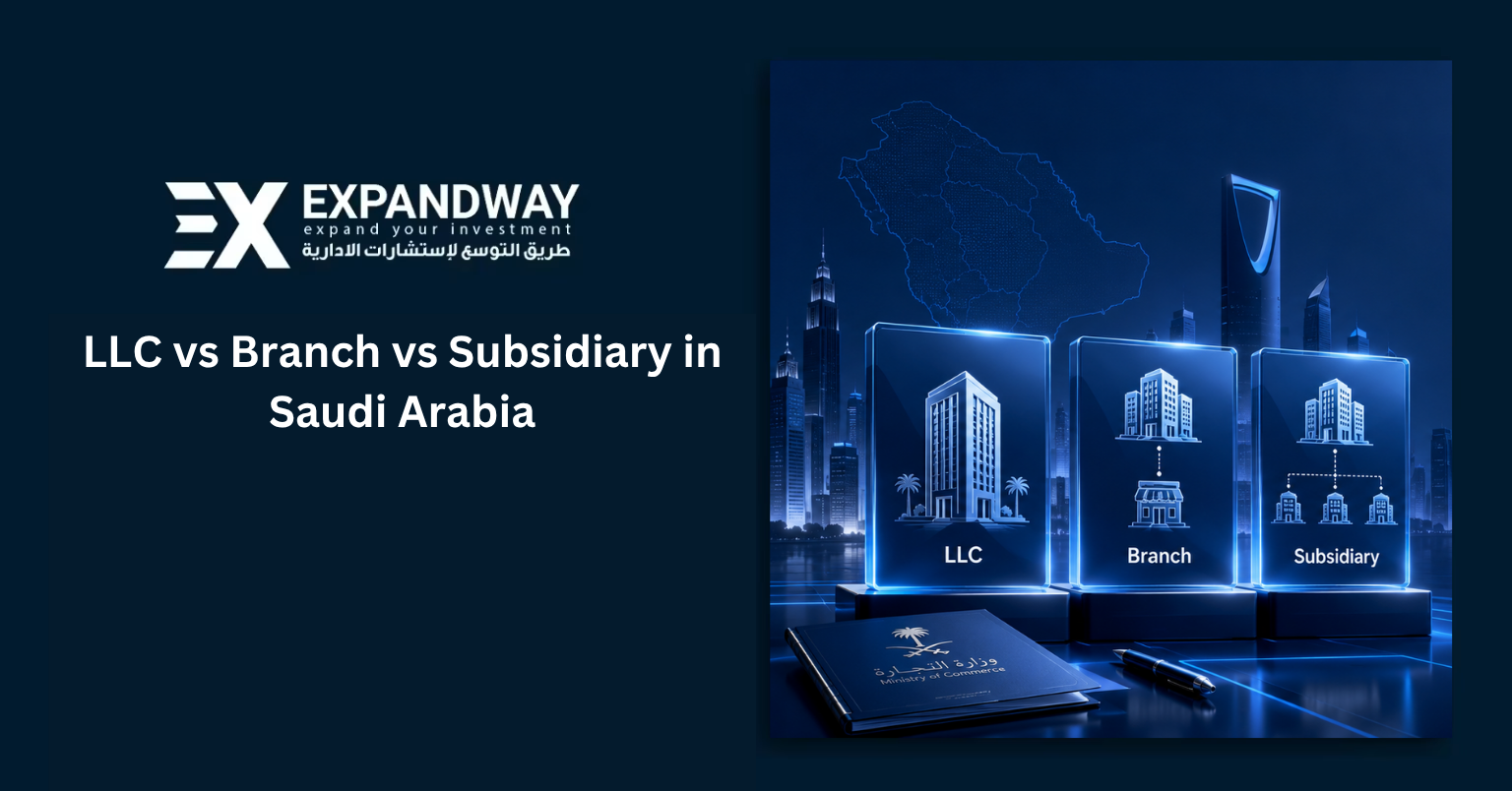
LLC vs branch vs subsidiary in Saudi Arabia is a key comparison for foreign investors planning to enter the Kingdom. Each structure differs in liability, ownership, taxation, business activities, compliance requirements, and long-term flexibility.
Choosing the right legal structure can protect the parent company, simplify operations, and support future expansion. This guide compares all three options to help you select the most suitable structure for your Saudi business.
The structure affects much more than company registration. It can determine:
- Whether the foreign parent is exposed to Saudi liabilities
- Which commercial activities the business may perform
- How contracts and government tenders are handled
- How profits, related-party payments, and taxes are managed
- Whether the Saudi operation can later accept investors or be sold
- How much corporate governance and reporting the business requires
Saudi Arabia’s updated investment framework requires foreign investors to register with the Ministry of Investment before conducting investment activities. After completing the investment registration, the investor can obtain a Commercial Registration and any additional sector-specific approvals. MISA’s June 2026 Investor Guide confirms that registration is available for approved ISIC4 activities, subject to the requirements of each activity category.
This guide explains the practical and legal differences between an LLC, branch, and subsidiary in Saudi Arabia, helping foreign companies select the most suitable market-entry structure.
Important: This article provides general information and does not replace legal, tax, or regulatory advice tailored to your activity and ownership structure.
LLC, Branch, and Subsidiary: The Quick Answer
For most foreign investors planning a long-term commercial presence, a Saudi limited liability company owned by the foreign parent is generally the preferred structure.
A branch may be more suitable when a foreign company:
- Needs to perform a defined project
- Wants to contract directly through the parent company
- Must rely on the parent’s international track record
- Is comfortable exposing the foreign parent to branch liabilities
The provided Perplexity research similarly positions the LLC subsidiary as the more suitable structure for long-term operations, while describing a branch as a strategic option for specific projects and cases where the parent’s credentials are important.
However, one important distinction must be clarified:
An LLC and a subsidiary are not legally identical terms.
An LLC is a legal form. A subsidiary is a company controlled by another company. Therefore, a Saudi subsidiary may be incorporated as an LLC, simplified joint-stock company, joint-stock company, or another permitted form.
In everyday foreign investment discussions, “Saudi subsidiary” usually refers to a Saudi LLC owned by a foreign parent. Nevertheless, investors should understand the technical difference.
What Is an LLC in Saudi Arabia?
A limited liability company is a company incorporated under Saudi law. It has its own legal identity, financial obligations, assets, contracts, and management structure.
The Saudi Ministry of Commerce states that an LLC may be established by one or more individuals or legal entities. The company’s liability is separate from the personal financial liability of its owners or partners. Therefore, the LLC is responsible for its debts and obligations, while an owner’s exposure is generally limited to its investment and any separate guarantees it has provided.
A foreign parent company may own all or part of a Saudi LLC, provided that:
- The activity is open to foreign investment
- MISA registration requirements are satisfied
- Any minimum Saudi participation requirement is met
- Sector-specific approvals are obtained
- The company complies with applicable capital and licensing conditions
Key characteristics of a Saudi LLC
A foreign-owned Saudi LLC generally provides:
- A separate Saudi legal personality
- Limited liability for the foreign shareholder
- One or more individual or corporate shareholders
- Articles of Association
- One or more appointed managers
- A Saudi Commercial Registration
- Greater flexibility for investment, restructuring, and future ownership changes
- The ability to build an independent Saudi balance sheet and operating history
An LLC is often appropriate for businesses that plan to employ people, sign local contracts, develop a Saudi brand, operate continuously, or expand into multiple permitted activities.
What Is a Subsidiary in Saudi Arabia?
A subsidiary is a separate company controlled by another business, known as the parent company.
For example, a British, American, Chinese, or UAE company may establish a Saudi company and own 100% of its shares. The Saudi company would then be a subsidiary of the foreign parent.
The subsidiary remains a separate legal entity even though the foreign parent controls it.
Can a subsidiary be an LLC?
Yes. In most foreign market-entry cases, the Saudi subsidiary is incorporated as an LLC.
However, a subsidiary may also use another legal form, including:
- A simplified joint-stock company
- A joint-stock company
- Another permitted company structure appropriate for the investment
The Ministry of Commerce recognises several company forms, including LLCs, joint-stock companies, and simplified joint-stock companies. Therefore, “subsidiary” describes the ownership relationship rather than one specific legal form.
When might a subsidiary use a structure other than an LLC?
A foreign investor may consider a joint-stock or simplified joint-stock structure when the business expects to:
- Bring in several institutional investors
- Issue different classes of shares
- Raise substantial external capital
- Introduce more formal board governance
- Prepare for a future public offering
- Implement a more complex employee equity structure
For many small and mid-sized foreign investors, however, an LLC remains the more practical subsidiary structure.
What Is a Foreign Company Branch in Saudi Arabia?
A foreign company branch is an extension of a company incorporated outside Saudi Arabia.
Unlike a Saudi subsidiary, a branch does not have independent shareholders. The foreign parent owns the branch directly because the branch forms part of the same legal organisation.
Saudi Arabia’s Companies Law allows a foreign company to operate in the Kingdom through a branch, representative office, or another permitted form. It also treats a foreign company’s Saudi branch or representative office as its domicile for activities and business conducted inside the Kingdom.
Key characteristics of a Saudi branch
A foreign branch generally has:
- No separate shareholding structure
- No independent parent-subsidiary ownership relationship
- A Saudi Commercial Registration for the branch
- A local branch manager or authorised representative
- Activities connected to the foreign parent’s approved business
- Direct liability exposure for the foreign parent
- Parent-company constitutional documents rather than separate Saudi shareholder documents
The Saudi Business Center provides an electronic service for registering the branch of a company headquartered outside Saudi Arabia. A valid investment registration certificate is among the requirements for opening a foreign company branch.
LLC vs Branch vs Subsidiary in Saudi Arabia: Comparison Table
| Factor | LLC | Subsidiary | Foreign Company Branch |
| Meaning | A Saudi legal company form | A company controlled by a parent | An extension of a foreign company |
| Separate legal entity | Yes | Yes | Generally no |
| Typical form | Limited liability company | Usually an LLC, but other forms are possible | Registered foreign company branch |
| Ownership | One or more shareholders | Controlled by the parent company | Directly operated by the foreign parent |
| Parent liability | Generally limited to investment and guarantees | Generally limited to investment and guarantees | Parent is directly exposed to branch obligations |
| Articles of Association | Required | Required according to legal form | Usually operates under parent documents and branch resolutions |
| Activity flexibility | Relatively flexible within approved activities | Depends on the subsidiary’s legal form and licences | Commonly linked to the parent’s registered and approved activities |
| Local investors or JV partners | Can be added | Can be added | No shareholding structure |
| Future sale | Shares can be transferred | Ownership can be sold or reorganised | No shares to sell |
| Local financing | May build an independent Saudi financial profile | May build an independent Saudi financial profile | Lenders may assess both branch and parent |
| Parent track record | May require guarantees or supporting documents | May require guarantees or supporting documents | More directly connected to the parent’s record |
| Best suited for | Long-term operating businesses | Long-term investment and controlled operations | Defined projects and direct parent participation |
1. Legal Personality and Liability
LLC or subsidiary liability
A Saudi LLC has a legal personality separate from its shareholders.
Therefore, a customer, supplier, employee, or creditor would normally make a claim against the Saudi company rather than automatically claiming against the foreign parent.
The foreign parent can still become exposed when it provides:
- A parent-company guarantee
- A performance guarantee
- A bank guarantee
- A letter of support
- Contractual indemnities
- Security over parent assets
Limited liability should not be confused with complete immunity. Directors, managers, and shareholders may still face responsibility in cases involving fraud, misconduct, unlawful distributions, or other statutory violations.
Branch liability
A branch does not provide the same legal separation.
Because the branch is part of the foreign company, the parent may be directly responsible for:
- Commercial debts
- Contractual claims
- Employee obligations
- Regulatory penalties
- Litigation arising from branch activities
- Project-related losses
This is the most important structural risk when comparing an LLC vs a branch in Saudi Arabia.
Liability winner: LLC or subsidiary
An LLC subsidiary is generally stronger when protecting the parent company’s wider international assets is a priority.
2. Ownership and Control
Both an LLC subsidiary and a branch can provide the foreign company with substantial control.
However, the control is structured differently.
Control through an LLC subsidiary
The foreign parent controls the Saudi entity through:
- Share ownership
- Shareholder resolutions
- Reserved matters
- Manager appointments
- Articles of Association
- Shareholders’ agreements, where applicable
The LLC can also admit a Saudi partner, strategic investor, employee shareholder, or joint-venture participant.
Control through a branch
The parent controls the branch directly through:
- A board or shareholder resolution
- Appointment of a branch manager
- Powers of attorney
- Internal parent-company policies
- Direct reporting to the overseas head office
A branch does not issue shares. Therefore, it is less suitable when the group expects to introduce a Saudi joint-venture partner later.
Ownership winner: Depends on the objective
A branch provides direct ownership without a separate shareholding layer. An LLC provides more flexibility for future investment and ownership changes.
3. Permitted Business Activities
A foreign-owned LLC may register approved commercial activities within the scope of its MISA investment registration, Commercial Registration, and sector licences.
A branch’s activities are typically based on:
- The foreign parent’s registered activities
- The activities included in the MISA registration
- The activities shown on the Saudi Commercial Registration
- Approvals from relevant Saudi regulators
A branch may face difficulty adding an unrelated business line if the foreign parent’s documents do not support that activity.
By contrast, an LLC may offer greater flexibility when a group wants to combine several compatible services or develop a wider Saudi operating platform. Nevertheless, an LLC cannot automatically conduct every activity. Each activity must still be open to investment and properly licensed.
MISA’s 2026 Investor Guide divides activities into available and restricted categories and applies specific requirements according to the selected activity.
Activity flexibility winner: LLC subsidiary
An LLC is generally more adaptable for companies planning to expand their Saudi activities over time.
4. Capital Requirements
One common mistake is assuming that every foreign-owned LLC or branch requires the same fixed capital.
There is no universal capital figure that applies to every foreign investment.
Capital requirements may depend on:
- The selected commercial activity
- The foreign ownership percentage
- The investor’s industry
- MISA activity conditions
- Sector regulator requirements
- Whether trading, manufacturing, professional, or regulated services are involved
- Any required Saudi participation percentage
The source document uses SAR 500,000 as an example of a capital benchmark that may apply in certain setups. However, investors should not treat this as a standard requirement for every LLC or branch.
The current MISA Investor Guide specifically provides activity-based requirements, minimum capital conditions, and national participation percentages for relevant categories.
Capital winner: No universal winner
The correct capital structure must be determined after confirming the exact ISIC activity and applicable regulatory category.
5. Tax, Zakat, VAT, and Related-Party Payments
Both an LLC subsidiary and a branch may have Saudi tax obligations.
ZATCA states that corporate income tax registration applies to foreign establishments, non-residents earning Saudi-source income, and resident capital companies in relation to the shares held by non-Saudi partners. Following Ministry of Commerce registration, the taxpayer receives the details needed to complete its foreign establishment income-tax registration.
LLC subsidiary taxation
A Saudi subsidiary may need to consider:
- Corporate income tax on the non-Saudi ownership share
- Zakat treatment for qualifying Saudi or GCC ownership
- VAT registration and filing
- Withholding tax on qualifying payments to non-residents
- Transfer-pricing requirements
- Tax treatment of management fees, royalties, loans, and intercompany services
- Tax implications of dividend distributions
ZATCA has confirmed that income tax generally applies to foreign companies and entities, while Zakat rules primarily apply to qualifying Saudi and GCC ownership. Mixed-ownership companies may therefore have both income tax and Zakat considerations.
Branch taxation
A foreign branch may need to consider:
- Corporate income tax on Saudi-attributable income
- The tax treatment of payments to the head office
- Withholding tax on qualifying payments
- Transfer-pricing or attribution principles
- Deductibility of head-office expenses
- Permanent establishment rules
- Double-tax treaty provisions
ZATCA’s current withholding-tax guidance addresses payments by Saudi permanent establishments to non-residents and the treatment of distributions or transfers to related foreign entities. Therefore, head-office charges and branch remittances should be reviewed before implementation.
VAT
Saudi Arabia’s standard VAT rate remains 15% for applicable taxable supplies. Whether an LLC or branch must register depends on its activities, taxable turnover, residence status, and other VAT rules.
Tax winner: Depends on the group structure
Neither option is automatically more tax-efficient.
The result depends on:
- The parent company’s jurisdiction
- Applicable double-tax treaty
- Intercompany transactions
- Profit-remittance strategy
- Financing model
- Intellectual property ownership
- Expected Saudi profit level
A tax model should be prepared before selecting the legal structure.
6. Governance and Annual Compliance
LLC governance
A Saudi LLC normally requires:
- Articles of Association
- Shareholder and ownership records
- One or more managers
- Corporate resolutions
- Accounting records
- Annual financial statements
- Commercial Registration confirmations or updates
- Tax and labour compliance
- Beneficial ownership information
The Ministry of Commerce has stated that companies, including LLCs, must prepare annual financial statements and submit them within six months after the financial year-end, subject to the applicable Companies Law requirements and exemptions.
Branch governance
A branch normally relies on:
- The foreign parent’s constitutional documents
- A parent resolution authorising the Saudi branch
- Appointment of a branch manager
- Powers of attorney
- Saudi branch records
- Local accounting and tax documentation
- Commercial Registration and investment-registration updates
- Employment and regulatory compliance
Although a branch may have fewer shareholder-level formalities, it should not be considered compliance-free.
2026 beneficial ownership compliance
The Ministry of Commerce’s 2026 Actual Beneficiary Guide includes LLCs and foreign companies among the legal forms subject to beneficial ownership requirements, subject to specific exemptions and conditions. The rules generally require companies to identify the natural person who ultimately owns or controls the company and keep the relevant information updated.
7. Contracts, Tenders, and Parent-Company Experience
A branch may be attractive when a foreign contractor needs to demonstrate:
- The parent’s international project experience
- Group-level financial strength
- Technical qualifications
- Engineering classifications
- Previous government or infrastructure contracts
- Global insurance or bonding capacity
This can make a branch strategically useful for engineering, procurement, construction, infrastructure, and specialised project companies.
However, establishing an LLC does not prevent a foreign parent from supporting the Saudi subsidiary. The parent may provide:
- Corporate guarantees
- Technical support agreements
- Experience certificates
- Seconded personnel
- Performance guarantees
- Financial support documentation
The correct approach depends on the tender terms. Investors should review the tender documents before assuming that either a branch or LLC will automatically qualify.
8. Exit, Sale, and Future Investment
An LLC subsidiary provides clearer options for future ownership changes.
The parent may potentially:
- Sell all or part of its shares
- Add a joint-venture partner
- Introduce an institutional investor
- Reorganise the ownership chain
- Transfer the company within the group
- Convert to another company form
- Prepare for a wider investment or listing strategy
A branch has no shares. Exiting generally involves closing or deregistering the foreign company’s Saudi branch and settling its obligations.
Exit winner: LLC subsidiary
An LLC is generally more suitable when the foreign investor expects a future sale, partial exit, joint venture, or restructuring.
LLC vs Branch: Which Structure Should You Choose?
Choose a Saudi LLC subsidiary when:
- You are planning a long-term presence in Saudi Arabia
- Protecting the foreign parent from operating liabilities is important
- You intend to hire a permanent Saudi team
- You want to build an independent Saudi brand
- You may add investors or partners later
- You expect to expand into additional approved activities
- You want the option to sell the Saudi business
- The business will hold significant local assets
- You want clearer separation between Saudi and international operations
Choose a foreign company branch when:
- You are performing a defined or limited-duration project
- The contract must be signed directly by the foreign company
- The parent company’s balance sheet is important for qualification
- The parent’s technical history must be used directly
- The permitted branch activities closely match the parent’s activities
- The group accepts direct liability exposure
- A future share sale or joint venture is not a major objective
Practical Decision Matrix
| Business Scenario | Usually More Suitable | Reason |
| International SaaS company entering Saudi Arabia permanently | LLC subsidiary | Liability protection and scalable local operations |
| Foreign consultancy serving multiple Saudi clients | LLC subsidiary | Flexible long-term commercial platform |
| EPC company delivering one large infrastructure project | Branch or LLC | Depends on tender and parent qualification requirements |
| Manufacturer building a Saudi production facility | LLC subsidiary | Separate assets, employees, licences, and investment |
| Company forming a joint venture with a Saudi partner | LLC subsidiary | Allows defined share ownership |
| Foreign contractor requiring direct use of parent credentials | Branch | Parent track record is directly connected |
| Business expecting a future sale to an investor | LLC subsidiary | Shares can be transferred |
| Multinational establishing a non-revenue regional headquarters | RHQ structure | Requires a dedicated RHQ analysis |
Is a Regional Headquarters an LLC or Branch?
A Regional Headquarters is a specialised structure and should not be confused with a normal operating LLC or commercial branch.
MISA’s 2026 Investor Guide states that an RHQ may be established as a company or as a registered foreign company branch. However, an RHQ cannot directly perform revenue-generating commercial operations outside its permitted RHQ activities. The guide also requires the RHQ to begin mandatory activities within six months, start at least three optional activities within one year, and employ at least 15 full-time employees within one year, including senior executives.
Therefore, a multinational may require:
- An RHQ for regional management and strategic functions; and
- A separate LLC or branch for revenue-generating Saudi operations.
The structure should be planned as one group model rather than treating the RHQ as an automatic replacement for an operating company.
How to Establish a Foreign-Owned LLC in Saudi Arabia
The exact process depends on the activity, but a typical foreign-owned LLC setup includes the following stages.
Step 1: Confirm the commercial activity
Identify the correct ISIC activity and determine whether it is:
- Open to foreign investment
- Restricted
- Subject to Saudi participation
- Subject to minimum capital
- Regulated by another authority
Step 2: Complete MISA investment registration
The investor generally submits:
- An authenticated foreign Commercial Registration
- The foreign company’s latest financial statements
- Shareholder or corporate information
- Activity-specific supporting documents
- Any sector approvals required at the registration stage
MISA’s June 2026 Investor Guide lists an estimated processing time of 10 working days for regular investment registration, although the complete setup period can be longer depending on documentation, payment, and regulator approvals.
Step 3: Incorporate the LLC
The investor completes the incorporation through the Saudi Business Center, including:
- Company name
- Shareholders
- Capital
- Activities
- Management
- Registered office
- Articles of Association
- Commercial Registration information
The official LLC establishment service allows one or more individuals or legal entities to incorporate the company electronically.
Step 4: Complete post-incorporation registrations
The company may then complete or activate:
- ZATCA registration
- National Address
- Chamber of Commerce subscription
- Ministry of Human Resources file
- General Organization for Social Insurance registration
- Bank account
- Municipality or sector licences
- Employee visa and immigration processes
Step 5: Begin annual compliance
The LLC must maintain its:
- Investment registration
- Commercial Registration
- Accounting records
- Financial statements
- Tax filings
- Labour files
- Beneficial ownership records
- Sector licences
How to Register a Foreign Company Branch in Saudi Arabia
A branch registration generally follows these stages.
Step 1: Confirm that the parent company qualifies
The parent’s activities and constitutional documents should support the intended Saudi activities.
Step 2: Prepare a parent-company resolution
The resolution normally approves:
- Establishment of the Saudi branch
- Branch activities
- Appointment of the branch manager
- Capital or financial allocation
- Powers granted to the Saudi representative
Step 3: Complete MISA investment registration
The foreign parent submits its authenticated documents, financial statements, and activity information.
Step 4: Obtain the branch Commercial Registration
The Saudi Business Center’s branch service allows a foreign company headquartered outside the Kingdom to register its Saudi branch after meeting the applicable requirements.
Step 5: Complete operating registrations
The branch completes tax, labour, social insurance, address, banking, and sector-specific registrations before beginning its activities.
Common Mistakes Foreign Investors Should Avoid
1. Treating “subsidiary” and “LLC” as exact synonyms
A subsidiary describes ownership. An LLC describes the legal form.
2. Selecting a branch only because it appears simpler
A branch may expose the foreign parent to contractual, regulatory, and employment liabilities.
3. Assuming a universal SAR 500,000 capital requirement
Capital and Saudi participation requirements are activity-specific.
4. Using outdated investment-licence terminology
Saudi Arabia’s updated investment framework now focuses on investment registration. However, some government pages and industry professionals may still use the older “investment licence” wording.
5. Ignoring related-party tax consequences
Management fees, royalties, loans, shared costs, guarantees, and head-office allocations require proper tax and transfer-pricing analysis.
6. Choosing the structure before reviewing tender requirements
Some contracts may require a Saudi entity, parent guarantee, specific classification, or evidence of group experience.
7. Ignoring exit strategy
A branch may work for the current project but become inconvenient if the company later wants to introduce an investor or sell its Saudi operations.
8. Overlooking beneficial ownership disclosure
Foreign groups should map their ultimate ownership and control before incorporation or branch registration.
Frequently Asked Questions
Is an LLC the same as a subsidiary in Saudi Arabia?
Not exactly. An LLC is a legal company form, while a subsidiary is a company controlled by another company. A Saudi subsidiary is commonly incorporated as an LLC, but it may use another permitted legal form.
Can a foreign investor own 100% of a Saudi LLC?
Foreign investors may own 100% of companies in many activities. However, foreign ownership, Saudi participation, minimum capital, and licensing requirements depend on the activity and regulator. MISA registration must be completed before the foreign investor begins its investment activities.
Does a branch protect the parent company from liability?
Generally, no. A branch is an extension of the foreign parent, so the parent may be directly exposed to liabilities arising from the Saudi branch.
Is a branch cheaper than an LLC?
A branch may have fewer shareholder-level documents, but that does not always make it cheaper overall. The cost should include registration, licensing, tax advice, guarantees, compliance, banking, employee setup, and liability exposure.
Do both an LLC and branch pay tax in Saudi Arabia?
Both may be subject to Saudi corporate income tax, VAT, withholding tax, and other tax obligations, depending on their activities and transactions. Their tax treatment is not necessarily identical, especially for head-office expenses, dividends, branch remittances, and related-party payments.
Which structure is best for government tenders?
It depends on the tender. An LLC may be preferred when a Saudi legal entity and local operating history are important. A branch may be useful when the foreign parent’s direct experience, financial strength, or technical classification is required.
Can a Saudi branch perform activities unrelated to the foreign parent?
A branch’s activities normally need to be supported by the parent’s documents and included in the approved Saudi investment registration and Commercial Registration. An unrelated activity may require amendments or a different structure.
How long does Saudi company registration take?
MISA’s current guide gives an estimated processing time of 10 working days for regular investment registration. However, the full timeline can be longer because incorporation, document authentication, banking, sector approvals, tax registration, and labour setup are separate stages.
Conclusion: LLC, Branch, or Subsidiary?
For most foreign companies planning a permanent commercial presence, a Saudi LLC subsidiary offers the strongest combination of:
- Limited liability
- Operational flexibility
- Local credibility
- Ownership options
- Long-term scalability
- Future exit opportunities
A foreign company branch may still be the correct choice when the company is performing a defined project, must contract through the overseas parent, or depends heavily on the parent’s financial and technical credentials.
The decision should not be based on registration cost alone. Foreign investors should compare liability, permitted activities, tax exposure, tender requirements, capital conditions, governance, and exit plans before committing to a structure.
Start Your Saudi Business with the Right Legal Structure
Expandway helps foreign investors compare Saudi entity structures, complete MISA investment registration, establish Commercial Registrations, coordinate government approvals, and manage post-incorporation compliance.
Plan your Saudi setup with Expandway
Get an activity-specific eligibility, document and cost check before committing to your setup. Explore our Saudi company formation support, or request a business setup consultation. Government charges are paid to the relevant authorities separately from Expandway’s professional service fee.