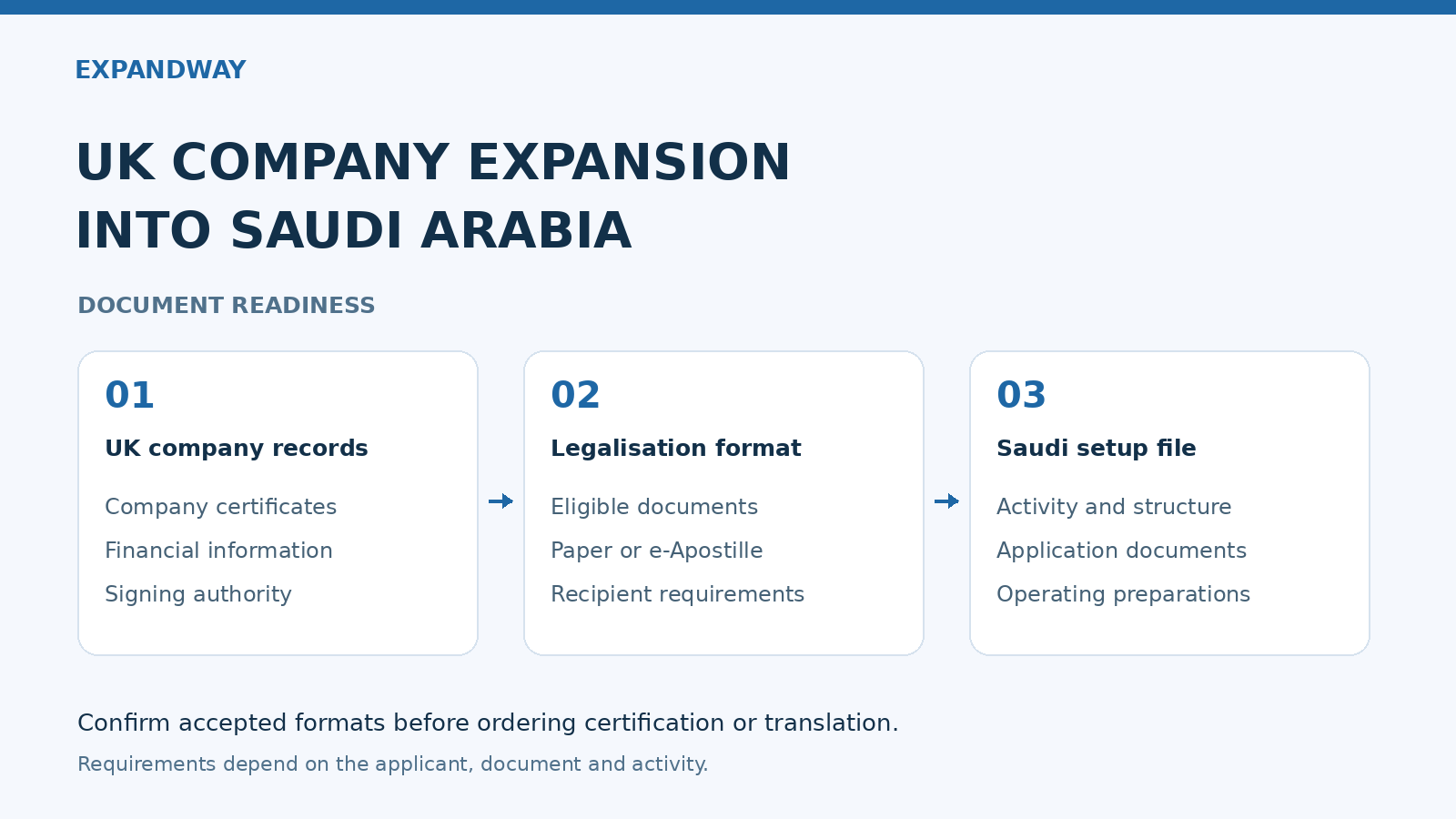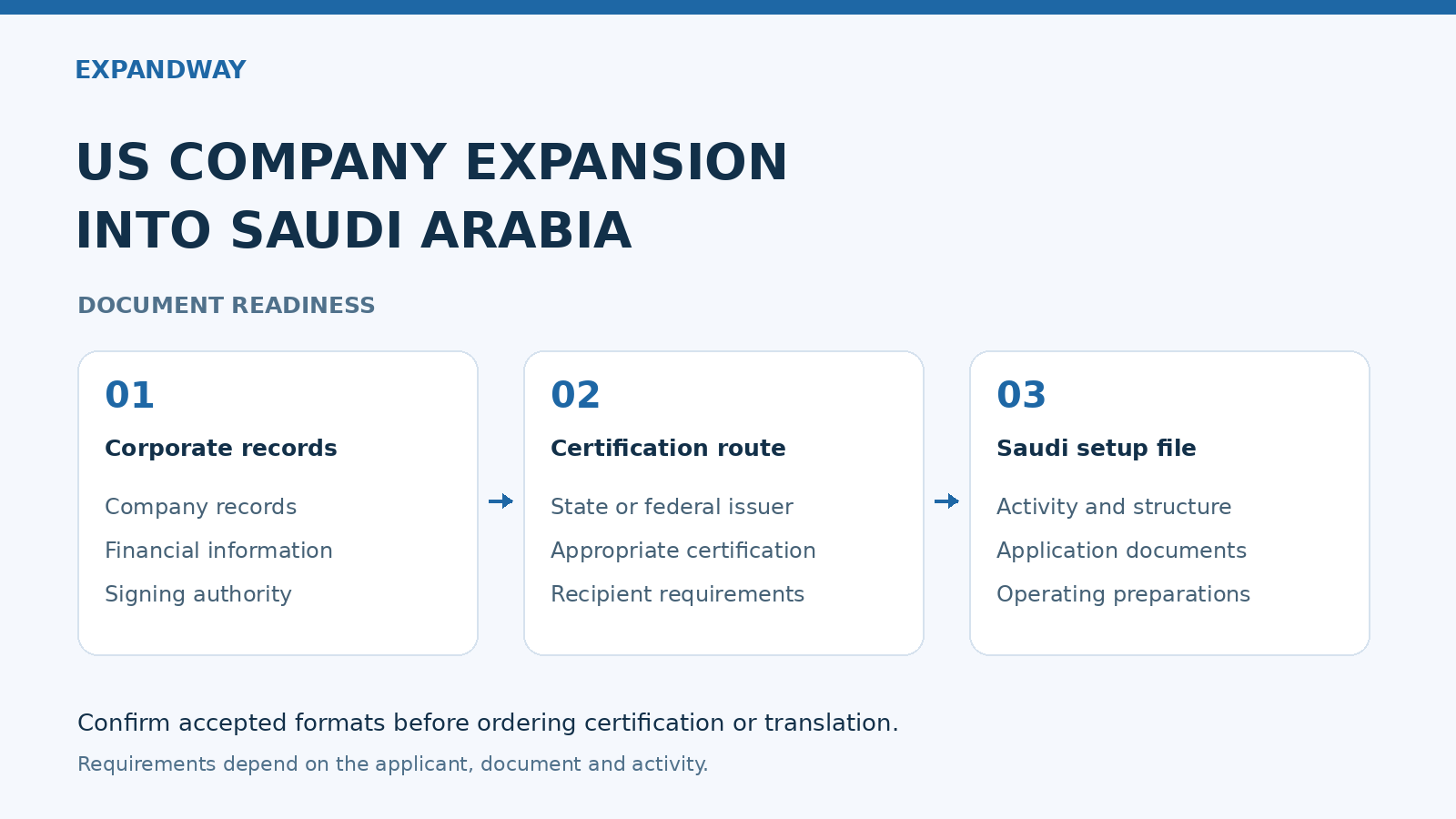
Review the applicant category, activity and required documents before preparing a MISA investment registration application.
Explore our MISA registration and business licensing support. Read the registration fee guide. Read the parent-company document checklist.
MISA License Requirements in Saudi Arabia: Documents and Eligibility
Understanding the MISA license requirements in 2026 is essential for foreign investors planning to establish a company, branch, or subsidiary in Saudi Arabia. The requirements cover investment activity classification, company documents, financial statements, ownership conditions, capital requirements, and regulatory approvals.|
Saudi Arabia continues to attract foreign companies through major projects, economic diversification and business reforms under Vision 2030. However, most foreign investors must complete Ministry of Investment registration before establishing and operating a Saudi company.
Although investors still commonly search for a “MISA license,” the official process in 2026 is generally called investment registration. A successful applicant receives an investment registration certificate and can then move forward with company incorporation, Commercial Registration and operational approvals.
Understanding the MISA license requirements in 2026 before authenticating documents can prevent costly delays, incorrect activity selection and application rejection.
This guide explains who needs MISA registration, the required documents, capital conditions, processing time, fees and the steps that follow approval.
Important: MISA requirements depend on the exact economic activity, ownership structure and regulatory category. Confirm the current ISIC activity and activity-specific conditions before finalising your corporate documents.
What Is a MISA License in Saudi Arabia?
A MISA license was traditionally the approval issued by the Ministry of Investment of Saudi Arabia to foreign investors establishing a business in the Kingdom.
Under Saudi Arabia’s updated Investment Law, the system has shifted from a licensing model to an investment registration mechanism. Therefore, applicants may now see terms such as:
- Investment registration
- MISA registration
- Investment registration certificate
- Foreign investor registration
The familiar term “MISA license” remains widely used by investors, banks and business consultants. However, investment registration certificate is the more accurate current terminology.
The updated Investment Law requires a foreign investor to register with MISA before carrying out an investment activity in Saudi Arabia. Once registration is completed, the investor can apply for Commercial Registration and obtain the licences or permits required by other authorities.
Who Needs MISA Registration in 2026?
MISA registration is generally required when a foreign entity wants to:
- Establish a wholly foreign-owned Saudi company
- Form a Saudi subsidiary with foreign shareholders
- Open a branch of an overseas company
- Establish a Saudi joint venture with foreign participation
- Conduct an investment activity as a qualifying foreign investor
- Enter an activity that requires foreign investment approval
The standard route primarily serves foreign legal entities. MISA also identifies qualifying Premium Residency holders as eligible for investment registration.
GCC nationals and companies wholly owned by GCC nationals generally receive treatment similar to Saudi investors and normally complete their registration through the Ministry of Commerce rather than the standard foreign MISA route.
Can a Foreigner Own 100% of a Saudi Company?
Yes. Saudi Arabia allows 100% foreign ownership across many activities.
However, this does not mean every activity is automatically open without conditions. Some activities may require:
- Minimum capital
- Saudi shareholder participation
- Prior sector approval
- International operating experience
- Operations in multiple countries
- Saudization or employee-training commitments
- Approval to enter a restricted activity
The updated Investment Law generally follows the principle that investment is permitted in activities open for investment. Nevertheless, MISA maintains a list of prohibited and restricted activities, and a foreign investor must obtain approval before entering a restricted activity.
Core MISA License Requirements in 2026
A successful application normally depends on five core areas.
1. Correct Activity Classification
The proposed business activities must be mapped to the correct Saudi economic activity codes based on ISIC Revision 4.
Activity selection affects:
- Whether foreign ownership is permitted
- Whether Saudi participation is required
- The minimum capital
- Sector approvals
- Commercial Registration activities
- Municipality and operational licences
- Saudization requirements
Selecting a broad or inaccurate activity can create inconsistencies between the MISA registration, Articles of Association and Commercial Registration.
MISA’s 2026 Investor Guide confirms that registration is available for approved economic activities open to investment under ISIC 4, subject to the requirements of available or restricted activity categories.
2. Eligible Foreign Investor or Parent Company
For regular registration, the foreign entity must provide evidence that it legally exists outside Saudi Arabia.
The official requirements include the foreign entity’s Commercial Registration or equivalent incorporation extract, certified by the Saudi Embassy.
Regular applicants must also provide financial statements for the foreign company’s most recent fiscal year. Therefore, a foreign parent company with no completed financial year may find the regular route difficult.
However, the official 2026 guide does not state one universal rule that every foreign parent company must be incorporated for at least one year. Eligibility depends on the registration category and activity.
Startups may instead qualify under the separate entrepreneurial registration route.
3. Authenticated Financial Statements
The applicant normally needs the foreign company’s financial statements for its most recent fiscal year.
These statements must be authenticated by the Saudi Embassy according to the official MISA registration requirements.
MISA may use the financial records to assess:
- The foreign company’s operating status
- Financial capability
- Consistency with the proposed investment
- Activity-specific eligibility
- International operating experience, where required
Holders of a Saudi Special Residency Permit may be exempt from submitting the foreign Commercial Registration and financial statements under the conditions described in the official guide.
4. Activity-Specific Capital and Ownership Conditions
Saudi Arabia does not apply one universal minimum capital amount to every MISA registration.
Instead, capital and ownership requirements depend on:
- Economic activity
- Legal structure
- Foreign ownership percentage
- Regulatory authority
- Special investment category
- Saudi shareholder participation
Applicants should confirm the requirement attached to their exact ISIC code before inserting capital into a board resolution or draft Articles of Association.
5. Regulatory Approval Where Required
MISA registration does not replace sector-specific licensing.
A regulated activity may require approval from authorities such as:
- Saudi Central Bank for certain financial activities
- Capital Market Authority for securities and capital-market activities
- Insurance Authority for regulated insurance activities
- Ministry of Health or other health regulators
- Ministry of Justice for certain legal activities
- Communications, Space and Technology Commission for regulated communications activities
- Ministry of Industry and Mineral Resources or MODON for applicable industrial matters
The Saudi Business Center also confirms that licences from authorities such as the Saudi Central Bank, Insurance Authority or Capital Market Authority must be provided when the proposed company activity requires them.
Required Documents for a MISA Application in 2026
Official Core Documents for Regular Registration
According to MISA’s 2026 Investor Guide, the core documents for regular investment registration include:
- Foreign company Commercial Registration
A copy of the participating foreign establishment’s Commercial Registration or equivalent document, certified by the Saudi Embassy. - GCC individual’s identification, where applicable
This applies when a partner is a natural person who holds GCC nationality and their information is not available through Absher. - Latest financial statements
Financial statements for the foreign company’s most recent fiscal year, authenticated by the Saudi Embassy. - Activity-specific documents
Any documents, approvals, experience records or commitments required for the selected economic activity. - Special Residency evidence, where applicable
Special Residency holders may qualify for exemptions from some of the standard foreign-company document requirements.
Additional Documents Commonly Prepared
Although they are not listed as universal core attachments for every regular MISA registration, investors commonly prepare the following for the complete incorporation process:
- Articles or Memorandum of Association of the foreign parent
- Board or shareholder resolution approving the Saudi investment
- Power of attorney or authorised representative document
- Passport or identification copies
- Group ownership chart
- Proposed Saudi company name
- Draft Saudi Articles of Association
- Shareholder and manager details
- Capital contribution information
- Business plan or investment proposal
- Sector approval
- Bank certificate for a cash contribution, where required
- Valuation report for an in-kind contribution, where required
The supplied research also identifies board approval, authority evidence, identity documents and an investment proposal as common parts of the practical application pack.
Are Arabic Translations Required?
This area frequently causes confusion.
MISA’s current FAQ states that document translation is not required for submission to MISA itself. However, it also confirms that other ministries may require translated documents.
In practice, certified Arabic translations may still be needed for:
- Company incorporation
- Notarisation
- Articles of Association
- Ministry of Commerce procedures
- Court or legal documentation
- Sector regulators
- Special MISA registration services
- Banking and compliance reviews
Therefore, foreign investors should not translate every document automatically before confirming the route. At the same time, they should identify the documents that will require certified Arabic translation during the wider incorporation process.
Certain special MISA services expressly require translated and authenticated documents, including registration for non-Saudi companies acquiring real estate without conducting an economic activity.
Is a Business Plan Mandatory for MISA Registration?
A business plan is useful, but it is not listed as a universal core document for every regular investment registration in the official 2026 guide.
MISA may still request additional information when it needs to assess the application. Moreover, a business plan can become essential for:
- Entrepreneurial registration
- A regulated or restricted activity
- Government-project registration
- An economic or technical liaison office
- Industrial approvals
- Bank account opening
- Financing applications
- Demonstrating financial and operational capability
A strong Saudi market-entry business plan should cover:
- Proposed activities and services
- Target customers
- Market-entry strategy
- Saudi operating model
- Staffing and Saudization plan
- Five-year financial projections
- Capital deployment
- Office or facility requirements
- Regulatory approvals
- Local economic contribution
MISA Minimum Capital Requirements in 2026
The official 2026 Investor Guide publishes minimum capital and Saudi participation rules for certain special categories.
| Activity category | Minimum capital | Saudi participation | Selected additional requirements |
| Commercial activity with a Saudi partner | SAR 26,666,667 | 25% | Subject to commercial activity conditions |
| 100% foreign-owned commercial activity | SAR 30,000,000 | None stated | Presence in at least three regional or global markets |
| Communications activities | Activity-specific | 40% | Regulatory requirements apply |
| Supportive communications activities | Activity-specific | 30% | Regulatory requirements apply |
| Professional activity with a Saudi partner | Activity-specific | 25% | Local and foreign professional partners must generally be licensed in the same field |
| 100% foreign engineering consultancy | No general figure shown | None stated | Presence in four countries and at least ten years of experience |
| 100% foreign legal activity | No general figure shown | None stated | Ministry of Justice approval |
These figures apply to the categories shown in the official guide. They should not be treated as universal capital requirements for every service, industrial, technology or consulting company.
Additional Conditions for 100% Foreign Commercial Activity
A 100% foreign-owned commercial company faces substantially higher requirements than a standard service company.
In addition to SAR 30 million in cash capital and a presence in at least three regional or global markets, the official guide includes five-year investment and workforce obligations.
The company must generally follow one of the following investment options:
- Invest at least SAR 300 million over five years, including the SAR 30 million cash capital; or
- Invest at least SAR 200 million over five years, including the cash capital, while meeting one or more additional localisation, manufacturing, research, development, logistics or related standards.
The guide also includes Saudization and annual training commitments for Saudi employees.
Do Service Companies Need SAR 25,000?
The supplied research mentions an indicative minimum of SAR 25,000 for several service, industrial, agricultural, mining and professional activities.
However, the official 2026 Investor Guide does not publish SAR 25,000 as a universal minimum for all such activities.
Capital should instead be confirmed according to:
- The exact ISIC activity
- Company legal form
- Sector regulator
- MISA activity conditions
- Ministry of Commerce incorporation rules
- Practical working-capital requirements
Foreign investors should avoid selecting a nominal capital amount solely because it appears in an older article or advisory price table.
Entrepreneurial Registration for Startups
Innovative startups may qualify for MISA’s entrepreneurial registration category.
This route is intended for entrepreneurs and startups that plan to establish innovative, emerging or scalable technology businesses in Saudi Arabia.
The official guide requires supporting evidence such as:
- A board resolution when the applicant is a company
- A support letter or proof of project approval from a Saudi university or accredited business incubator
- A no-objection letter from the employer when an individual applicant resides in Saudi Arabia
- The relevant activity number in the support letter
Therefore, simply labelling a company as a “startup” does not automatically remove the normal MISA requirements. The applicant must meet the entrepreneurial route’s eligibility conditions and obtain support from an approved entity.
How to Apply for a MISA License in 2026
Step 1: Define the Saudi Business Activity
List the services, products and commercial operations the Saudi entity will perform.
Avoid using overly broad descriptions such as “general business services” or “all trading activities.”
Step 2: Map the Activities to ISIC Codes
Match each proposed activity to the appropriate Saudi ISIC 4 classification.
Then determine whether each activity is:
- Open for foreign investment
- Restricted
- Prohibited
- Subject to Saudi participation
- Regulated by another authority
Step 3: Choose the Legal Structure
Common structures include:
- Saudi limited liability company
- Single-shareholder limited liability company
- Joint-stock or simplified joint-stock company
- Branch of a foreign company
- Professional company
- Entrepreneurial establishment
- Temporary registration for a government contract
The correct structure depends on liability, ownership, tax, capital and operational objectives.
Step 4: Confirm Capital and Ownership Requirements
Check the minimum capital, foreign ownership percentage and Saudi-partner requirement for the selected activity.
Do this before drafting shareholder resolutions or Saudi incorporation documents.
Step 5: Prepare and Authenticate the Documents
Obtain the foreign company’s:
- Commercial Registration
- Latest financial statements
- Supporting activity documents
- Required sector approvals
Complete Saudi Embassy authentication where required.
Step 6: Submit the Application Online
Create an account through the official Invest Saudi electronic services portal and submit the investment registration application.
Include the selected activities and all required supporting documents.
[External link placeholder: Apply for MISA Investment Registration]
Step 7: Respond to MISA Queries
MISA may request:
- A clearer activity description
- Corrected or newly authenticated documents
- Additional financial information
- Proof of international operations
- Sector approval
- Ownership clarification
- A revised activity code
Respond within the deadline shown in the portal. Incomplete applications may be cancelled when an applicant fails to provide requested documents within the prescribed period.
Step 8: Pay the Registration Fee
Once MISA approves the application, the ministry determines the applicable financial consideration.
The applicant must pay within the deadline shown in the approval notification. Failure to pay can cause the registration to become void.
How Long Does MISA Registration Take?
MISA’s 2026 Investor Guide provides an estimated processing time of 10 working days for the standard registration service.
This estimate normally assumes:
- The documents are complete
- Embassy authentication is valid
- The activity is correctly classified
- No restricted-activity approval is needed
- The financial information is consistent
- MISA does not request further clarification
The total company setup timeline can take longer because it may also include:
- Document authentication in the home country
- Saudi Embassy processing
- Sector approval
- MISA clarification requests
- Company incorporation
- Commercial Registration
- Office or address arrangements
- Bank compliance
- Tax and labour registrations
Therefore, investors should distinguish between the MISA processing estimate and the total time required to make the Saudi company operational.
How Much Does a MISA License Cost in 2026?
There is no single published MISA registration fee that applies to every applicant and activity.
The official guide states that MISA determines the registration fee when it approves the application.
Investors should budget separately for:
- MISA registration charges
- Foreign document certification
- Saudi Embassy authentication
- Certified Arabic translations where needed
- Company incorporation
- Commercial Registration
- Articles of Association
- Chamber subscription where applicable
- Registered business address
- Municipality or operating licences
- Sector regulator fees
- Professional advisory fees
- Visa and immigration procedures
Older online guides may show fixed first-year and renewal subscription amounts. However, investors should obtain a current quotation based on their registration category rather than relying on a historical fee figure.
What Happens After MISA Approval?
MISA registration is an important step, but it does not by itself create a fully operational Saudi company.
After receiving the investment registration certificate, the investor generally proceeds with the following stages.
1. Establish the Saudi Company or Branch
Use the Saudi Business Center and Ministry of Commerce procedures to:
- Reserve or approve the trade name
- Prepare the Articles of Association
- Confirm shareholders and managers
- Record capital contributions
- Incorporate the company or register the foreign branch
Saudi Business Center provides dedicated services for establishing a company under an investment registration certificate and registering a branch of a foreign company.
2. Obtain Commercial Registration
The company receives its Commercial Registration after completing the applicable incorporation requirements.
The activities on the Commercial Registration should remain consistent with the MISA investment registration.
3. Complete Tax Registration
Register the company with the Zakat, Tax and Customs Authority.
The company may also need VAT registration depending on its taxable activities and revenue. ZATCA issues a VAT number and certificate after successful VAT registration.
4. Complete Labour and Social Insurance Setup
Register the establishment with the relevant employment and social insurance platforms.
GOSI provides an online employer-registration process for companies and establishments conducting business in Saudi Arabia.
5. Obtain Operational Licences
Depending on the activity, the company may need:
- Municipality approval
- Office or facility licence
- Civil Defence approval
- Industrial licence
- Professional licence
- Health licence
- Communications licence
- Import or product registration
- Sector regulator approval
6. Open a Corporate Bank Account
The bank will usually review the company’s:
- MISA registration
- Commercial Registration
- Articles of Association
- Shareholder documents
- Beneficial ownership
- Source of funds
- Business model
- Expected transactions
The capital requirement stated in the incorporation documents may need to be deposited or evidenced according to the company structure and activity.
Annual MISA Registration Update
Investment registration is not a one-time compliance exercise.
The Implementing Regulations require registered investors to submit an annual update of their declarations and report changes to information recorded in the National Registry of Investors.
The regulations allow investors to submit the update during the 60 working days before the deadline. MISA should notify the investor before the due date and aims to communicate the result of the annual update within five working days after submission.
Investors should report changes involving:
- Shareholders
- Ownership percentages
- Capital
- Managers or authorised representatives
- Economic activities
- Foreign parent-company details
- Contact information
- Registered investment information
Changes involving restricted activities or ownership may require prior MISA approval.
Common MISA Application Mistakes
Selecting the Wrong Activity
An activity selected for MISA registration must match the company’s actual business model and future Commercial Registration.
Authenticating Documents Too Early
Investors sometimes authenticate a complete document pack before confirming the activity code. If MISA requires another entity, activity or ownership structure, the documents may need to be prepared again.
Treating Every Activity as 100% Foreign-Owned
Many activities are open to full foreign ownership, but certain professional, communications and restricted activities still carry Saudi participation or regulator requirements.
Relying on a Universal Minimum Capital
A capital amount suitable for an ordinary consultancy may not satisfy a commercial, recruitment, communications or regulated activity.
Confusing MISA Registration With Company Incorporation
MISA registration allows the foreign investor to proceed. The investor must still establish the company, obtain Commercial Registration and complete operational registrations.
Ignoring Post-Registration Compliance
A company must keep its MISA information accurate and complete its annual registration update.
Serious or unresolved violations of the Investment Law may result in a warning, a fine of up to SAR 300,000, doubling of the fine for repeated violations or cancellation of the investment registration.
Frequently Asked Questions
Is a MISA License Still Required in 2026?
Foreign investors generally must register with MISA before engaging in investment activities in Saudi Arabia. The current legal mechanism is investment registration rather than the former licensing process.
Is a MISA License the Same as Commercial Registration?
No.
MISA registration confirms the foreign investor’s eligibility to invest. Commercial Registration establishes and records the Saudi business with the Ministry of Commerce.
The investor normally completes MISA registration first and then proceeds with company or branch registration.
What Is the Minimum Capital for a MISA License?
There is no single minimum that applies to every activity.
For example, the official guide states SAR 30 million for 100% foreign commercial activity and SAR 26,666,667 for commercial activity with at least 25% Saudi participation. Other activities follow their own conditions.
Does the Foreign Parent Company Need to Be One Year Old?
The regular registration route requires the latest fiscal-year financial statements from the foreign company.
This creates a practical operating-history requirement for many applicants. However, the official guide does not state a blanket one-year incorporation rule for every activity and registration category.
How Long Does MISA Approval Take?
The official estimated processing time for a standard, complete investment registration application is 10 working days.
Authentication, application corrections, restricted activities and sector approvals can extend the total timeline.
Are Audited Financial Statements Required?
The official guide requires financial statements for the foreign company’s most recent fiscal year, authenticated by the Saudi Embassy.
The precise format and audit expectations may depend on the company’s home-country rules and activity category.
Can a Startup Apply Without an Established Foreign Company?
A qualifying entrepreneur may use the entrepreneurial registration route. The project must normally be innovative or scalable and supported by an approved Saudi university, incubator or supervising entity.
Can MISA Reject an Application?
MISA can request corrections or additional information when the application is incomplete or inconsistent.
The applicant should correct the submission within the specified deadline. Otherwise, the application may be treated as cancelled.
Conclusion
Meeting the MISA license requirements in 2026 begins with selecting the correct activity not simply collecting corporate documents.
Foreign investors should confirm:
- The correct ISIC activity
- Whether foreign ownership is permitted
- Capital and Saudi-participation conditions
- Sector approvals
- Foreign-document authentication
- Financial-statement requirements
- The correct company structure
- Post-registration compliance
The updated registration system can make Saudi market entry more efficient. Nevertheless, an incorrect activity, incomplete financial record or unsuitable ownership structure can delay the entire setup.
Call to Action
Planning to establish a foreign-owned company in Saudi Arabia?
Expandway can help you assess your activity, identify the correct ISIC classification, prepare the MISA document pack and manage the process from investment registration to Commercial Registration, tax, labour and operational setup.
Official sources and further reading
Plan your Saudi setup with Expandway
Get an activity-specific eligibility, document and cost check before committing to your setup. Explore our MISA registration and business licensing support, or request a business setup consultation. Government charges are paid to the relevant authorities separately from Expandway’s professional service fee.