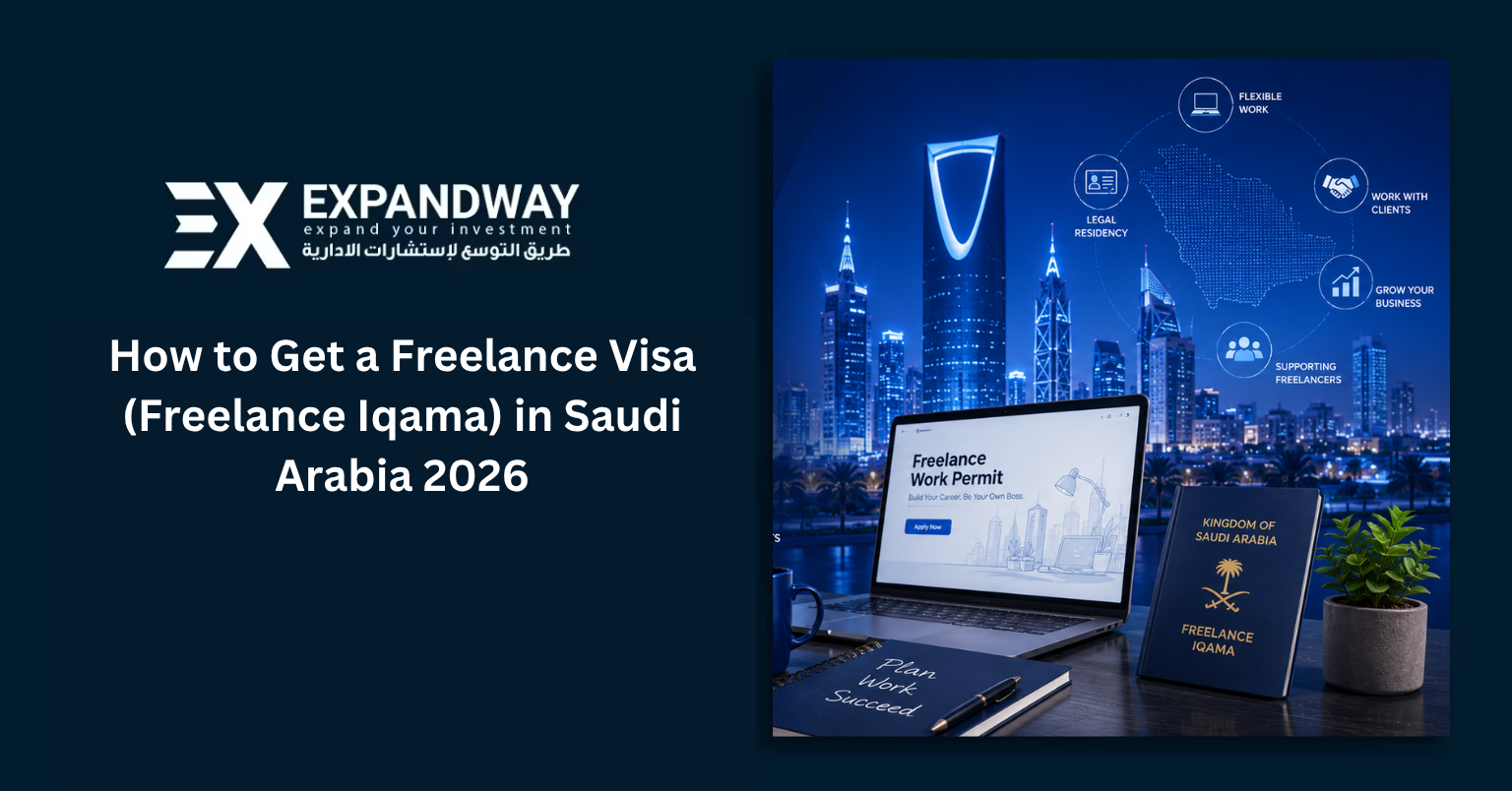
Saudi Arabia does not issue a standalone “freelance visa” the way the UAE does. In 2026, a freelance visa in Saudi Arabia really means one of two things: the free Freelance Work Document (the “freelance iqama”) from the Ministry of Human Resources and Social Development (MHRSD), which is built for Saudi and GCC nationals, or — for most foreigners — a self-sponsored route such as Premium Residency or a company set up through the Ministry of Investment (MISA). Getting this label right matters, because working for yourself without the correct cover can bring a fine of up to SAR 50,000.
- What a "freelance visa" in Saudi Arabia actually is
- Who qualifies for a freelance iqama?
- The freelancer licence (KSA): step by step
- How much does a freelance visa in Saudi Arabia cost?
- Freelance routes for foreigners (the real self-employment visa)
- How to convert your freelance work into a company
- Talk to Expandway before you commit
- Frequently asked questions
What a “freelance visa” in Saudi Arabia actually is
The core tool is the Freelance Work Document (wathiqat al-amal al-hur), issued free by MHRSD through the official portal freelance.sa. It is valid for one year, renews easily, and covers more than 140 approved professions from IT and design to consulting, training and content work.
The document lets you invoice clients, sign contracts with public and private bodies, open a professional bank account, and join GOSI social insurance voluntarily. What it is not is an entry visa. There is no separate “self-employment visa” in Saudi Arabia that lets a foreigner fly in and start working for themselves. You must already hold legal status in the Kingdom before the freelance question even applies.
So when people search for a freelance visa in Saudi Arabia, the honest 2026 answer is: it’s a document plus a residency status, not a single stamp in your passport.
Who qualifies for a freelance iqama?
Eligibility for the freelance iqama splits cleanly by who you are:
- Saudi nationals aged 18–60 with a verified Nafath/Absher account — the quickest path, and free.
- GCC nationals — generally treated like citizens for freelance registration.
- Resident expats — access is limited and tied to your current sponsorship. The freelance system was set up mainly for citizens, so many expats cannot use the document as a standalone route. Confirm your own eligibility with MHRSD or Expandway before you rely on it.
- Foreigners with no Saudi residency — you need a residency route first (see below). No freelance visa exists purely to bring you into the country to freelance.
| You are | Can you get the freelance document? | Best route |
|---|---|---|
| Saudi / GCC national | Yes — free, instant | freelance.sa |
| Expat on a work/family iqama | Sometimes, with limits | Check status first |
| Foreigner living abroad | Not directly | Premium Residency or a company |
The freelancer licence (KSA): step by step
If you qualify (a Saudi or GCC national, or an eligible resident), the freelancer licence in KSA is one of the simplest registrations in the region:
- Sign in to freelance.sa using your Nafath digital identity.
- Choose your profession from the approved activity list.
- Confirm and issue the freelance work document — it is generated instantly and costs nothing.
- Register with ZATCA for e-invoicing (Fatoora) and add VAT once your turnover passes the mandatory threshold of SAR 375,000.
- Join GOSI if you want voluntary social insurance and pension cover.
- Open or update your bank account using the document so you can be paid cleanly.
Keep every invoice and renew the document each year. Freelancing income is still taxable activity, so treat your bookkeeping the way a small company would.
How much does a freelance visa in Saudi Arabia cost?
The document itself is the cheap part; the residency behind it is where the real cost sits.
- Freelance Work Document: free from MHRSD.
- Premium Residency (for foreigners): roughly SAR 100,000 per year for the renewable option, or about SAR 800,000 as a one-time permanent fee. Newer entrepreneur, investor and talent tiers use different criteria and pricing — confirm current figures with the authority or Expandway.
- Company through MISA: government fees are modest, but budget for capital, office and professional setup. Our company formation in Saudi Arabia guide sets out realistic ranges.
- Standard iqama upkeep (if you are sponsored): renewal is around SAR 650 a year, plus any work-permit and dependent fees.
Figures move year to year, so always confirm current numbers before you budget.
Freelance routes for foreigners (the real self-employment visa)
Because the freelance iqama is aimed at citizens, foreigners who want to work independently in Saudi Arabia use one of three legal routes:
- Premium Residency (the Saudi “green card”). This is the closest thing to a self-employment visa in Saudi Arabia. It is self-sponsored, so you can freelance, run a business without a Saudi partner, work for several clients, own property and sponsor your family — no employer needed.
- A company through MISA (investor or entrepreneur licence). Your own company sponsors your iqama, and most sectors now allow 100% foreign ownership under the 2025 Investment Law. Founders of innovative startups can use the entrepreneur license in Saudi Arabia with a support letter from an accredited incubator.
- Ajeer. If you already hold an employer iqama, the Ajeer platform lets you take on approved contract work with your sponsor’s written consent.
A word of caution for remote workers: sitting in Saudi Arabia and earning from a foreign client without the right permit still counts as unauthorised work. Penalties can reach SAR 50,000, with possible detention and deportation, so cover yourself properly.
For Indian, Pakistani and Egyptian freelancers
The core rule is the same for every nationality — there is no special freelance visa, so residency comes first. A few practical differences are worth knowing:
- Indian freelancers. Many already live in the Kingdom on work or family iqamas. If you set up a company, your documents usually need embassy/consular attestation, and money sent home moves through Saudi Central Bank–licensed channels under India’s RBI/FEMA rules.
- Pakistani nationals. The pattern is similar: get your residency sorted first, then attest company documents through the consular chain. Outward remittances follow State Bank of Pakistan rules.
- Egyptian freelancers and remote workers. Egypt has a large professional community in Saudi Arabia. If you are on a family iqama and freelancing or remote-working, you still need proper cover to invoice locally. Company documents are attested through the Egyptian foreign ministry and the Saudi embassy.
For all three, the honest advice is the same: fix your legal status, then freelance — never the other way round.
How to convert your freelance work into a company
Freelancers often outgrow the document. Once you want to hire staff, sign larger contracts, or sponsor your own visa, forming a company is the natural next step.
The path is well worn:
- Register with MISA to get your investment registration (still often called the MISA licence).
- Get your Commercial Registration (CR) from the Ministry of Commerce.
- Complete the follow-on registrations — Chamber of Commerce, National Address, ZATCA for tax and VAT, and GOSI.
- Open a corporate bank account and inject any required capital.
A company also lets you sponsor an iqama through your own entity, which solves the residency question for good. Our guide to launching a consultancy or freelance business in Saudi Arabia compares staying independent with going incorporated, so you can pick the point that fits your income.
Talk to Expandway before you commit
The biggest mistakes we see are foreigners assuming a freelance visa in Saudi Arabia will let them move here, or expats invoicing clients without the right permit. Both are fixable — before they become expensive.
Book a free consultation with Expandway and we will map the right route for your nationality, income and goals, whether that is the freelance document, Premium Residency, or your own company.
Frequently asked questions
Is there a freelance visa in Saudi Arabia in 2026?
Not as a single, standalone visa. Freelancing is legalised through the free Freelance Work Document (mainly for Saudis and GCC nationals) or, for foreigners, through a self-sponsored route such as Premium Residency or a MISA company. There is no entry visa purely for freelancing.
Can expats get a freelance iqama in Saudi Arabia?
Sometimes, but access is limited and tied to your current sponsorship. The freelance system was designed for citizens, so most foreigners rely on Premium Residency or a company instead. Confirm your eligibility with MHRSD or Expandway.
How much does the freelance work document cost?
The document itself is free from MHRSD. Costs appear in the residency behind it — for example Premium Residency (about SAR 100,000 a year renewable, or roughly SAR 800,000 permanent) or a MISA company. Confirm current figures before budgeting.
Can I freelance while on a family or work iqama?
Only with the correct permit. Freelancing or remote-working without proper cover is treated as unauthorised work and can bring fines of up to SAR 50,000, plus possible deportation. Regularise your status first.
Can I turn my freelance licence into a company?
Yes. Register with MISA, obtain a Commercial Registration from the Ministry of Commerce, then complete ZATCA, GOSI and banking steps. Your company can then sponsor your own iqama.