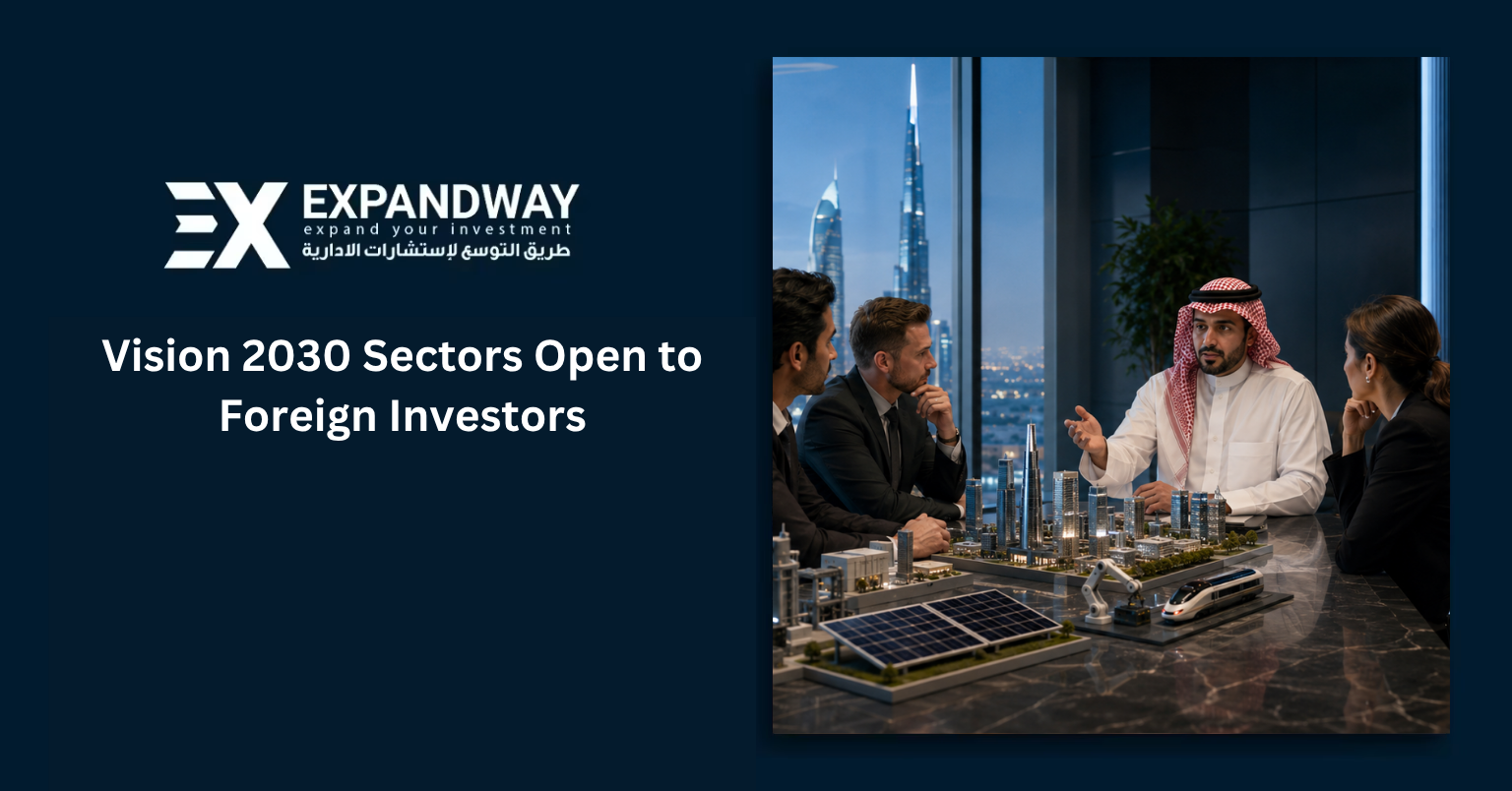
Vision 2030 foreign investment is creating new opportunities for international businesses across Saudi Arabia. In 2026, foreign investors can enter sectors such as technology, manufacturing, healthcare, tourism, logistics, mining, renewable energy, and professional services, subject to activity-specific regulations.
Saudi Arabia’s transformation under Vision 2030 has created one of the Middle East’s most active investment environments for international companies.
From technology and advanced manufacturing to tourism, logistics, healthcare, renewable energy and mining, foreign investors can participate in a wide range of economic activities. In many available activities, a foreign company can establish a wholly foreign-owned business, although ownership rules, capital requirements and regulatory approvals can vary according to the exact activity.
The Perplexity research provided for this guide identifies a broad group of sectors available to foreign investors, including IT, manufacturing, healthcare, retail, professional services, construction, education, tourism, logistics, renewable energy, mining, financial services, agriculture and real estate.
Saudi Arabia’s current Investment Law has further modernised the framework. The law establishes freedom of investment, subject to excluded or restricted activities, and provides for equal treatment of local and foreign investors under similar circumstances.
For international companies assessing the Saudi market in 2026, the opportunity is therefore broader than simply entering a large consumer economy. Vision 2030 is directing investment toward sectors that are central to the Kingdom’s long-term economic diversification.
- Major Vision 2030 Sectors Open to Foreign Investors
- Vision 2030 Giga-Projects Create Opportunities Across Multiple Sectors
- Which Activities Are Restricted for Foreign Investors?
- How Foreign Investors Enter Saudi Arabia in 2026
- MISA Registration vs Sector Licence: What Is the Difference?
- What Changed Under Saudi Arabia's Updated Investment Law?
- Which Vision 2030 Sectors Offer the Strongest Opportunities?
- Key Questions Foreign Investors Should Ask Before Entering Saudi Arabia
- Why Vision 2030 Is Important for Foreign Investors
- Frequently Asked Questions
- Conclusion: Choosing the Right Vision 2030 Investment Sector
Are Foreign Investors Allowed 100% Ownership in Saudi Arabia?
100% foreign ownership is available in many Saudi business activities, but investors should not assume that every activity automatically qualifies under identical conditions.
The research brief identifies most mainstream economic sectors as open to full foreign ownership, subject to standard regulatory conditions and additional approvals where required. For example, a technology company may face a relatively straightforward investment-registration process, whereas healthcare, financial services, mining or transport businesses may need separate approvals from their respective regulators.
Under the updated Saudi Investment Law, the broader principle is that investors may engage in any sector or activity available for investment, unless the activity appears on the list of excluded or restricted activities. The law also states that foreign and local investors should receive equal treatment under similar circumstances.
This means foreign investors should evaluate three separate questions before entering the Saudi market:
- Is the proposed business activity available to foreign investors?
- Does the activity have a foreign ownership or capital condition?
- Does a specialist regulator require an additional licence or approval?
This activity-level assessment is particularly important when planning a Saudi company formation.
Suggested internal link: How to Start a Company in Saudi Arabia
Major Vision 2030 Sectors Open to Foreign Investors
Saudi Arabia’s Ministry of Investment currently highlights 15 priority sectors as part of the Kingdom’s investment ecosystem. Official Invest Saudi resources promote opportunities across areas including technology, energy, manufacturing, tourism, entertainment, healthcare, mining, agriculture, financial services, logistics and real estate.
Below are some of the most relevant Vision 2030 sectors for foreign investors in 2026.
1. Information Technology and Digital Economy
Saudi Arabia’s technology sector represents one of the clearest opportunities created by Vision 2030.
Foreign investors can explore activities such as:
- Software development
- SaaS platforms
- Artificial intelligence
- Cloud computing
- Cybersecurity
- Data centres
- IT consulting
- Systems integration
- Digital platforms
The Perplexity research specifically identifies software, SaaS, cloud computing, cybersecurity, AI, data centres and system integration among activities open to foreign participation.
Technology also supports almost every other Vision 2030 priority, from fintech and smart logistics to healthcare, tourism and advanced manufacturing.
For international technology companies, Saudi Arabia can therefore offer opportunities not only through direct consumer services but also through enterprise contracts, government digitalisation programmes and partnerships with major Saudi organisations.
Related keyword: technology investment in Saudi Arabia
2. Manufacturing and Industry
Industrial development is central to Saudi Arabia’s strategy for reducing economic dependence on hydrocarbons and expanding domestic production.
Foreign investors can participate in manufacturing activities including:
- Automotive products
- Electronics
- Pharmaceuticals
- Chemicals
- Food and beverages
- Consumer products
- Building materials
- Industrial equipment
- Advanced manufacturing
The provided research identifies automotive, electronics, food and beverage, chemicals, pharmaceuticals, building materials and consumer goods among the manufacturing opportunities available to foreign investors.
Manufacturers may also benefit from industrial zones, logistics infrastructure and government programmes designed to increase localisation.
For overseas industrial companies, Saudi Arabia can serve both as a substantial domestic market and as a potential manufacturing and export base connecting the Gulf, Asia, Africa and Europe.
Suggested internal link: Manufacturing Company Setup in Saudi Arabia
3. Healthcare and Life Sciences
Saudi Arabia continues to expand and modernise its healthcare system, creating opportunities for private and international investors.
Potential activities include:
- Hospitals
- Specialist clinics
- Diagnostic centres
- Medical laboratories
- Medical devices
- Healthcare technology
- Healthcare consulting
- Pharmaceutical businesses
The Perplexity report identifies hospitals, clinics, diagnostics, medical devices and healthcare consulting among the healthcare activities available to foreign investors. However, healthcare facilities can require approvals from authorities such as the Ministry of Health and the Saudi Commission for Health Specialties.
Therefore, foreign ownership availability does not eliminate the need for professional or facility-level licensing.
Companies entering the Saudi healthcare industry should map their exact activity before establishing the legal entity.
4. Retail, Wholesale and E-Commerce
Saudi Arabia’s large consumer market and rapid digital adoption make retail and e-commerce important sectors for foreign businesses.
Opportunities can include:
- Physical retail stores
- Online stores
- E-commerce platforms
- Franchising
- Import and distribution
- Wholesale businesses
The research notes that physical retail, e-commerce, franchising and import/distribution activities are available to foreign investors, although certain trading activities may carry additional capital or regulatory conditions.
That distinction is important.
An international e-commerce brand, for example, may face different establishment requirements from a company conducting large-scale wholesale and import operations.
Foreign companies should therefore confirm the classification of their proposed activity before deciding on their ownership and company structure.
Suggested internal link: How to Start an E-Commerce Business in Saudi Arabia
5. Professional and Business Services
Saudi Arabia’s economic expansion is generating demand for specialised professional services.
Foreign businesses can explore areas such as:
- Management consulting
- Marketing and public relations
- Accounting
- Engineering
- Architecture
- Project management
- Business advisory
- Certain legal advisory activities
The source document specifically identifies management consulting, accounting, engineering, architecture, project management, marketing/PR and certain legal advisory activities among the professional services open to investment.
However, some professional activities may require professional qualifications, local regulatory approvals or specific ownership structures.
Investors should therefore check both MISA investment requirements and the rules of the relevant professional regulator.
6. Construction, Contracting and Infrastructure
Saudi Arabia’s infrastructure pipeline continues to create substantial opportunities for international construction and engineering companies.
Available areas include:
- General contracting
- Mechanical, electrical and plumbing services
- Infrastructure construction
- Project management
- Engineering services
- Specialist contracting
The provided research specifically identifies general contracting, MEP, infrastructure and project management as relevant activities for foreign investors.
Demand is being supported by major developments and Vision 2030 projects across housing, tourism, entertainment, logistics and urban infrastructure.
The Perplexity research highlights projects such as NEOM, Red Sea Global, Qiddiya, Diriyah and ROSHN, noting that these developments create additional entry points for capital and businesses across construction, tourism, technology and renewable energy.
7. Education and Training
Education is another sector where foreign companies can participate in Saudi Arabia’s economic transformation.
Potential activities include:
- Private schools
- Universities
- Vocational institutes
- Corporate training
- Professional education
- Edtech businesses
According to the research provided, educational institutions and training companies can participate in the market, although institutional activities generally remain subject to approval from relevant education authorities.
A digital corporate-training platform, for example, may face a different regulatory framework from an international company seeking to establish a physical university or school.
8. Tourism, Hospitality and Entertainment
Tourism and entertainment have become highly visible components of Saudi Arabia’s diversification strategy.
Investment opportunities include:
- Hotels
- Resorts
- Tourism businesses
- Travel agencies
- Tour operators
- Theme parks
- Entertainment venues
- Live events
- Cinema
- Gaming
The Perplexity research identifies all of these areas among the sectors available to foreign investors.
Saudi Vision 2030 documentation also identifies tourism and other non-oil industries as important components of the Kingdom’s diversification strategy.
Large developments including Red Sea destinations, Qiddiya and Diriyah are also helping create ecosystems involving hospitality operators, technology suppliers, consultants, contractors, food businesses and service providers.
As a result, investors do not necessarily need to develop a major hotel or resort to participate in Saudi tourism growth. Opportunities also exist throughout the tourism supply chain.
9. Transportation and Logistics
Saudi Arabia’s location between Asia, Europe and Africa makes logistics strategically important to Vision 2030.
Foreign investment opportunities can include:
- Freight forwarding
- Third-party logistics
- Warehousing
- Last-mile delivery
- Cold-chain logistics
- Distribution centres
- Supply-chain technology
The research lists freight forwarding, warehousing, 3PL, last-mile delivery and cold-chain services among available activities. However, certain land, air or maritime transportation operations may require additional approvals.
Invest Saudi also identifies logistics as one of the Kingdom’s key investment sectors.
This creates opportunities not only for traditional logistics providers but also for companies specialising in automation, warehouse systems, fleet technology and supply-chain software.
10. Renewable Energy and Sustainability
Saudi Arabia’s energy transformation is creating new opportunities beyond its traditional oil and gas industry.
Areas highlighted in the source include:
- Solar energy
- Wind energy
- Green hydrogen
- Energy services
- Sustainability projects
Renewables also intersect with construction, advanced manufacturing, technology, infrastructure and industrial localisation.
Consequently, foreign businesses can enter the sector through project development as well as engineering, equipment supply, technology and specialist services.
11. Mining and Minerals
Mining has become one of Saudi Arabia’s strategic economic diversification industries.
Foreign companies can participate in:
- Mineral exploration
- Extraction
- Mineral processing
- Mining technology
- Mining equipment and services
The Perplexity research identifies exploration, extraction and processing as open areas but notes that investors need a mining licence in addition to their investment establishment requirements.
Official Invest Saudi guidance also expressly states that 100% foreign ownership is allowed for mining investment entities and highlights programmes designed to encourage exploration investment.
This makes mining one of the more clearly defined Vision 2030 investment opportunities for international operators and specialist suppliers.
12. Financial Services and Fintech
Saudi Arabia’s financial sector presents significant opportunities, but it is also one of the more heavily regulated industries.
Potential areas include:
- Fintech
- Payment services
- Insurance
- Asset management
- Capital markets
- Financial technology platforms
The Perplexity research identifies these activities as available to foreign investors but notes that they can require approval from the Saudi Central Bank (SAMA) and/or the Capital Market Authority (CMA).
Therefore, foreign investors should distinguish between:
Investment registration, which relates to establishing the foreign investment, and
financial regulatory licensing, which gives the business permission to conduct the regulated financial activity.
Both may be necessary depending on the business model.
13. Agriculture, Food and Agri-Tech
Food security and agricultural technology also form part of Saudi Arabia’s wider diversification strategy.
Potential investment areas include:
- Aquaculture
- Protected farming
- Food processing
- Agri-tech
- Agricultural technology
- Controlled-environment agriculture
The research identifies these areas as available to foreign investment while noting that certain marine fishing activities remain restricted.
Technology-driven agriculture can be particularly relevant in Saudi Arabia because of the need for efficient water, climate and resource management.
14. Real Estate Development
Foreign investors can also participate in Saudi real estate development and investment, subject to the Kingdom’s applicable property ownership and geographic regulations.
The source specifically identifies real estate development and investment outside the holy cities of Makkah and Madinah as a foreign investment opportunity.
Because Saudi property rules are evolving and can depend on the investor, location and purpose of ownership, real estate investors should obtain current advice before acquiring property or structuring a development company.
Vision 2030 Giga-Projects Create Opportunities Across Multiple Sectors
One reason foreign investors should assess Saudi Arabia by ecosystem rather than individual sector is the scale of Vision 2030-linked developments.
The source highlights projects including:
- NEOM
- Red Sea Global
- Qiddiya
- Diriyah
- ROSHN
These projects generate opportunities across tourism, construction, hospitality, technology, renewable energy and related services.
For example, a hospitality development may simultaneously create demand for:
- Construction companies
- Architects
- Interior suppliers
- Hotel operators
- SaaS providers
- Security technology
- Transport businesses
- Food suppliers
- Marketing agencies
- Facility-management companies
For international businesses, this creates potential entry points even without making a direct investment in the underlying giga-project.
Which Activities Are Restricted for Foreign Investors?
Saudi Arabia remains highly open to international investment, but foreign investors should not interpret that as unrestricted access to every economic activity.
The provided research identifies several areas that may be prohibited, restricted or subject to special conditions, including:
- Certain upstream oil and gas activities
- Certain security and defence activities
- Certain real estate activities in Makkah and Madinah
- Specific Hajj and Umrah services
- Recruitment and labour-supply activities
- Certain media and publishing activities
- Certain marine fishing activities
Furthermore, sectors such as finance, telecommunications, transportation and parts of the media industry may remain open but require additional regulatory approvals or operating conditions.
The updated Investment Law uses the concept of a List of Excluded Activities. Some activities on that list may be prohibited, while restricted activities may potentially be undertaken after obtaining prior approval. MISA is responsible for publishing the applicable list.
Therefore, investors should check the exact activity code, rather than relying only on the broad sector name.
How Foreign Investors Enter Saudi Arabia in 2026
This is one area where investors should be aware of an important recent regulatory change.
Historically, foreign investors commonly referred to obtaining a MISA investment licence.
However, under Saudi Arabia’s updated Investment Law, the general licensing mechanism has been replaced by an investment registration mechanism. MISA expressly confirms that foreign investors must register before conducting investment activities and can then proceed with Commercial Registration and other required licences.
Step 1: Determine the Exact Business Activity
First, define exactly what the Saudi company will do.
For example:
“technology” is too broad.
The actual activity may be:
- Software development
- Cybersecurity consulting
- Cloud services
- E-commerce technology
- Data-centre operations
Each activity may have different requirements.
Step 2: Complete MISA Investment Registration
A foreign investor generally completes investment registration with the Ministry of Investment before beginning investment activities in Saudi Arabia.
MISA’s current e-services platform specifically provides a “Registering for Investment” service under the Investment Law.
This is an important terminology update for businesses still using older guides that refer only to a “MISA licence.”
Suggested external link: Ministry of Investment – Investment Registration
Step 3: Establish the Legal Entity and Obtain Commercial Registration
Following investment registration, the company generally proceeds with its legal establishment and Commercial Registration (CR).
MISA’s updated Investment Law guidance confirms that a foreign investor can issue the Commercial Registration after completion of the Ministry’s registration process.
The exact company structure may include options such as an LLC or branch, depending on the investor and activity.
Suggested internal link: LLC Company Formation in Saudi Arabia
Step 4: Obtain Sector-Specific Licences
Depending on the industry, additional licences may be required.
Examples identified in the source include:
- Healthcare: Ministry of Health and relevant healthcare authorities
- Education: Ministry of Education and/or TVTC
- Finance and fintech: SAMA and/or CMA
- Mining: relevant Ministry of Industry and Mineral Resources approvals
- Transport: appropriate transport, aviation or maritime authorities
The precise regulator depends on the activity.
Step 5: Complete Tax and Operational Registrations
Once the business becomes operational, additional registrations can include:
- ZATCA registration
- VAT registration where applicable
- E-invoicing compliance
- Labour registrations
- Social insurance requirements
- Municipality or premises licences
- Employee and visa registrations
The Perplexity source specifically highlights ZATCA, VAT and e-invoicing obligations as part of the post-establishment process.
MISA Registration vs Sector Licence: What Is the Difference?
This distinction is important for foreign investors.
MISA Investment Registration
Investment registration establishes the foreign investor within Saudi Arabia’s investment framework.
Commercial Registration
The Commercial Registration establishes the company’s commercial presence and registered activities.
Sector Licence
A sector licence allows the company to perform an activity regulated by a specialist government authority.
For example, establishing a fintech company does not automatically authorise it to operate a regulated payment service.
The company may still need a licence from SAMA.
Likewise, establishing a healthcare company does not automatically authorise the operation of a hospital without healthcare facility approvals.
What Changed Under Saudi Arabia’s Updated Investment Law?
Saudi Arabia’s updated Investment Law represents an important change for foreign investors.
According to MISA, key changes include:
- Replacing the general investment licensing mechanism with registration
- Applying the investment framework to both local and foreign investors
- Supporting equal treatment under similar circumstances
- Strengthening investor rights and protections
- Establishing a clearer framework for investment incentives
- Allowing alternative dispute-resolution methods
- Applying the principle of freedom of investment except for excluded or restricted activities
The law states that foreign investors must register with the Ministry before engaging in investment activity unless a specific exception applies.
This shift is intended to make Saudi Arabia’s investment framework more straightforward while preserving sector-specific regulatory oversight.
Which Vision 2030 Sectors Offer the Strongest Opportunities?
The right sector depends on the investor’s expertise, capital and commercial strategy.
However, several areas have particularly strong alignment with Saudi Arabia’s current economic priorities:
Technology
Strong potential in AI, cloud computing, cybersecurity, SaaS and digital infrastructure.
Tourism and Hospitality
Opportunities linked to destination development, hotels, experiences, entertainment and supporting services.
Manufacturing
Strong alignment with localisation and industrial development.
Mining
A strategic diversification sector with clear foreign investment opportunities.
Logistics
Growth linked to Saudi Arabia’s ambition to strengthen its position as a global trade and logistics hub.
Renewable Energy
Opportunities across solar, wind, green hydrogen and energy services.
Healthcare
Demand for private healthcare, medical technology and specialist services continues to create opportunities.
These sectors also overlap closely with the areas currently promoted through Invest Saudi.
Key Questions Foreign Investors Should Ask Before Entering Saudi Arabia
Before establishing a business, investors should confirm:
- What is the exact economic activity?
- Is that activity available to foreign investors?
- Is 100% foreign ownership permitted for that activity?
- Is a Saudi partner required?
- Is there a minimum capital requirement?
- Does the business need approval from another regulator?
- Which legal structure is most suitable?
- What Saudization obligations apply?
- Does the company need physical office premises?
- What tax and ZATCA registrations will apply?
- Are any municipality or professional licences required?
- Does the chosen activity fall within an excluded or restricted category?
Answering these questions before incorporation can prevent costly restructuring later.
Why Vision 2030 Is Important for Foreign Investors
Vision 2030 is not simply a collection of government projects. It represents a broader restructuring of the Saudi economy toward greater private-sector participation, investment and diversification.
MISA now promotes investment opportunities across 15 priority sectors, while the updated Investment Law establishes a more unified investment framework for both Saudi and foreign investors.
As a result, international companies can find opportunities across both established sectors and rapidly developing industries.
The strongest opportunities often sit at the intersection of several Vision 2030 priorities.
A technology business may serve tourism operators.
A manufacturer may supply construction projects.
A logistics company may support e-commerce.
An engineering company may participate in renewable-energy development.
For foreign investors, understanding those connections can be just as important as selecting the sector itself.
Frequently Asked Questions
Can foreigners own 100% of a company in Saudi Arabia?
Yes. 100% foreign ownership is available for many business activities in Saudi Arabia, subject to the classification of the activity and any applicable regulatory, ownership or capital requirements.
Some activities remain restricted or require additional approvals.
Which sectors are open to foreign investment in Saudi Arabia?
Foreign investors can participate in a wide range of sectors, including technology, manufacturing, healthcare, retail and e-commerce, professional services, construction, education, tourism, logistics, renewable energy, mining, financial services, agriculture and real estate, subject to activity-specific requirements.
Do foreign investors still need a MISA licence in 2026?
The terminology and framework have changed.
Under the updated Investment Law, the general foreign investment licensing mechanism has been replaced by investment registration with MISA. After completing registration, the investor can proceed with Commercial Registration and any licences required by specialist regulators.
What is the MISA negative list?
The current Investment Law refers to a List of Excluded Activities.
Activities may be prohibited or restricted for foreign investors. Restricted activities can require prior approval from MISA and the relevant competent authority.
Can foreign investors enter Saudi fintech?
Yes, foreign investors may establish businesses in financial services and fintech, but regulated activities may require approval or licensing from SAMA, CMA or another financial regulator depending on the business model.
Can foreigners invest in Saudi mining companies?
Yes. Mining is a major Vision 2030 sector, and Invest Saudi states that 100% foreign ownership is allowed for mining investment entities. Mining operations still require the appropriate sector licences.
Is Saudi real estate open to foreign investors?
Foreign investment in Saudi real estate is possible, but rules can depend on the property’s location, purpose and ownership structure.
The source identifies development and investment outside the holy cities of Makkah and Madinah as an available area while noting restrictions affecting certain property activities in the holy cities.
Investors should verify the latest real estate ownership rules before purchasing or developing property.
Conclusion: Choosing the Right Vision 2030 Investment Sector
Saudi Arabia’s Vision 2030 has expanded the range of opportunities available to international businesses.
Foreign investors can now participate across technology, manufacturing, healthcare, e-commerce, consulting, construction, education, tourism, logistics, renewable energy, mining, fintech, agriculture and real estate.
However, sector availability is only the first step.
The exact activity determines whether 100% foreign ownership is permitted, what capital requirements apply and which additional government approvals are needed.
Furthermore, Saudi Arabia’s updated Investment Law means foreign companies should now think in terms of MISA investment registration, Commercial Registration and sector-specific licences rather than relying on older guidance referring only to an investment licence.
Planning to Invest in Saudi Arabia?
Choosing the correct activity, ownership structure and licence pathway before incorporation can save considerable time and prevent regulatory complications later.
Expandway can help international investors identify the correct business activity, complete Saudi investment registration, establish the appropriate legal entity and coordinate the licences required to begin operations.
Contact us today for a personalised Saudi Arabia company formation and foreign investment assessment.