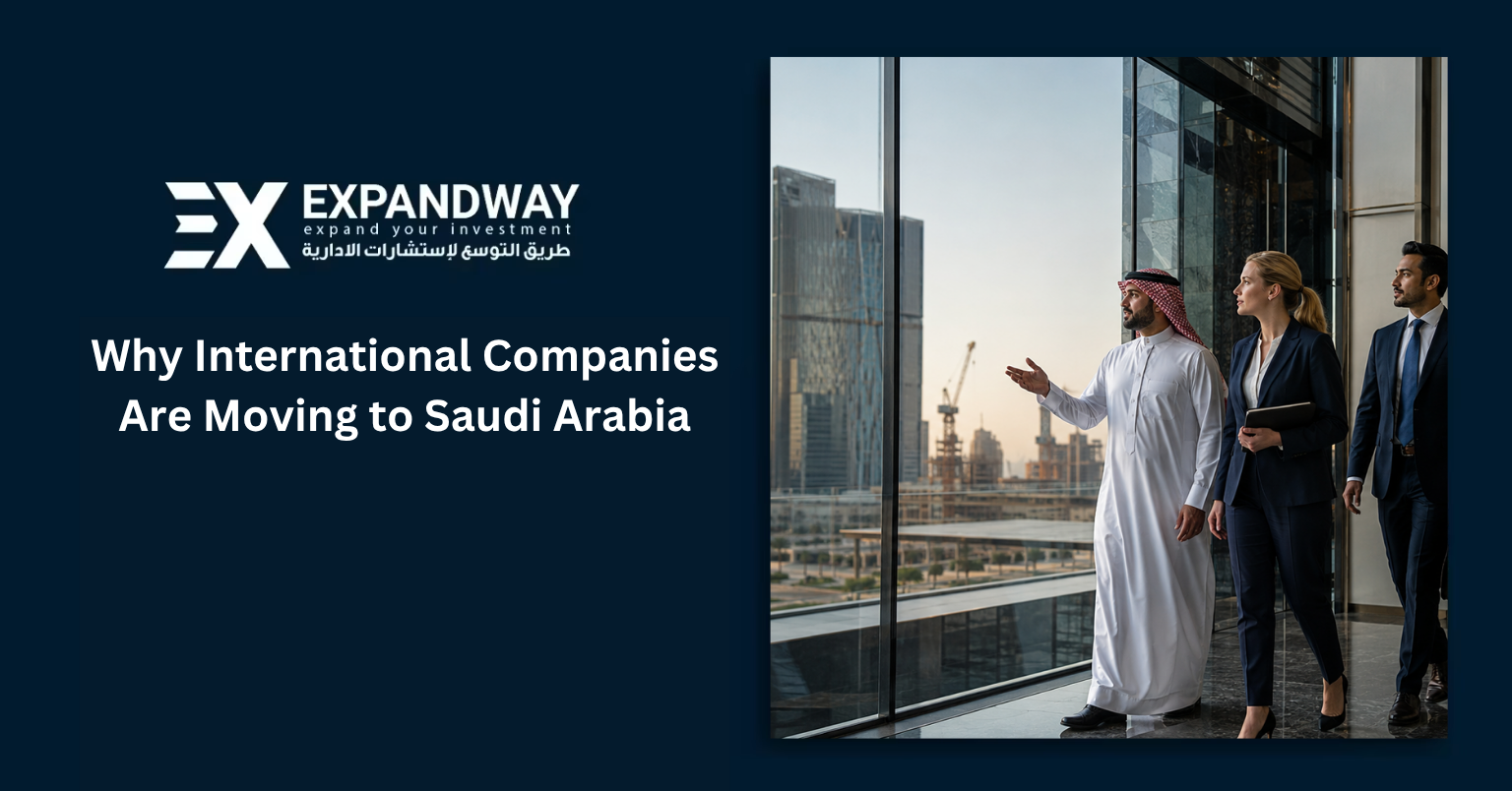
Companies moving to Saudi Arabia are responding to one of the most significant economic transformations in the Middle East. Through Vision 2030, the Kingdom is attracting global businesses with major projects, investor-friendly reforms, regional headquarters incentives and access to a growing market.
Previously, many international companies served Saudi clients from offices elsewhere in the Gulf. Today, however, more businesses are building a direct presence in Riyadh and other Saudi cities. A local entity can bring companies closer to customers, regulators, partners and government opportunities.
Nevertheless, entering the Saudi market requires careful planning. Tax incentives are conditional, licensing requirements vary by activity and every company structure serves a different purpose. Therefore, foreign investors should understand both the opportunities and the obligations before moving.
This guide explains why companies are moving to Saudi Arabia, what benefits are available and how international investors can choose the right market-entry route.
- Vision 2030 Is Creating New Business Opportunities
- The Regional Headquarters Program Attracts Multinationals
- Government Contracts Encourage a Local Presence
- Saudi Arabia Has a Major Project Pipeline
- Special Economic Zones Support Key Industries
- Saudi Arabia Offers a Strategic Location
- Technology and AI Investment Is Accelerating
- Saudi Arabia's Financial Ecosystem Is Expanding
- Quality of Life Supports Executive Relocation
- Choosing the Right Saudi Company Structure
- What to Check Before Moving to Saudi Arabia
- Why Companies Are Moving to Saudi Arabia Now
- Frequently Asked Questions
Vision 2030 Is Creating New Business Opportunities
Saudi Vision 2030 is the main force behind the Kingdom’s economic transformation. Its objectives include economic diversification, private-sector growth and increased foreign investment.
As a result, Saudi Arabia is investing in tourism, technology, logistics, healthcare, manufacturing, entertainment, financial services and renewable energy. These investments create opportunities not only for large contractors but also for advisers, suppliers, software companies and specialist service providers.
In addition, the Ministry of Investment of Saudi Arabia, known as MISA, has developed licensing and investor-support services for foreign businesses. Many permitted activities now allow 100% foreign ownership. However, requirements still depend on the business activity, sector and legal structure.
A long-term national investment strategy
Vision 2030 is more than a temporary stimulus program. Instead, it is a long-term national strategy supported by government entities, regulators and sovereign investment. Consequently, international companies can plan around a multi-year pipeline of projects and private-sector demand.
The Regional Headquarters Program Attracts Multinationals
The Regional Headquarters Program is another major reason for companies moving to Saudi Arabia. It encourages multinational groups to manage their Middle East and North Africa operations from the Kingdom.
An RHQ usually performs strategic, management and support functions for a multinational group. For example, it may oversee regional planning, coordination, finance, marketing or corporate services. However, an RHQ is not automatically a replacement for an operating company that sells products or provides services in Saudi Arabia.
Thirty-year RHQ tax incentives
The official MISA Regional Headquarters service promotes a 30-year incentive package. It includes:
- 0% corporate income tax on qualifying RHQ income
- 0% withholding tax on qualifying payments under the RHQ rules
These benefits are important, but they do not automatically apply to every source of Saudi income. Instead, they apply to qualifying RHQ activities and remain subject to compliance requirements. Therefore, companies should obtain activity-specific tax advice before relying on the incentive.
Visa and employment support
The RHQ framework also helps eligible companies relocate international talent. For instance, the program offers employment and visa-related support for RHQ teams. MISA also states that dependants of RHQ employees may work through the AJEER framework.
Moreover, qualifying RHQ entities may receive flexibility relating to localization requirements. This support can make it easier to build a regional management team while gradually developing local talent.
Government Contracts Encourage a Local Presence
Government procurement is a powerful commercial reason for international businesses to establish themselves in Saudi Arabia.
Saudi rules generally restrict government entities from contracting with multinational companies that do not have a qualifying regional headquarters in the Kingdom. However, defined controls and exceptions can apply.
As a result, an RHQ may be strategically important for companies that depend on government contracts or government-backed projects. The attached 2026 Perplexity research report estimates the annual Saudi government procurement market at about $180 billion. Nevertheless, companies should treat this as an indicative market estimate rather than guaranteed addressable revenue.
Questions to ask before establishing an RHQ
Before applying for an RHQ license, a multinational company should ask:
- Will Saudi government entities become important clients?
- Do the relevant procurement rules apply to the group?
- Can the company meet the RHQ activity and substance requirements?
- Will the group also require a separate Saudi operating company?
Therefore, the decision should be based on the company’s commercial strategy, not only on the advertised tax rate.
Saudi Arabia Has a Major Project Pipeline
International companies are also following the scale of demand created by Saudi Arabia’s development plans. Major projects include NEOM, Qiddiya, Diriyah and King Salman International Airport. In addition, many smaller projects are developing tourism, housing, transport, sports and urban infrastructure.
Consequently, business opportunities extend across complete supply chains. Companies that may benefit include:
- Construction and engineering firms
- Technology and cybersecurity providers
- Legal, tax and management advisers
- Hospitality and tourism operators
- Healthcare and education providers
- Logistics and supply-chain companies
- Manufacturers and industrial suppliers
- Media, entertainment and event businesses
Moreover, a local Saudi presence can improve client access, tender readiness and partnership development. It also shows long-term commitment to the market.
Special Economic Zones Support Key Industries
Saudi Arabia has introduced special economic zones for selected activities and investment models. According to the official Economic Cities and Special Zones Authority, the network includes King Abdullah Economic City, Ras Al-Khair, Jazan and the Cloud Computing SEZ.
These zones target sectors such as:
- Automotive manufacturing
- Consumer goods
- Pharmaceuticals and medical technology
- Logistics and distribution
- Shipbuilding and maritime services
- Cloud computing and data infrastructure
Depending on the zone and activity, eligible investors may receive preferential tax treatment, customs advantages, employment benefits or specialized regulation. For example, the Perplexity report cites a 5% corporate tax rate for up to 20 years in some zones.
However, SEZ incentives are conditional. Therefore, an investor must confirm the latest rules for the selected zone, activity and customer market before establishing the entity.
Saudi Arabia Offers a Strategic Location
Saudi Arabia connects markets across the Middle East, Africa and Asia. Furthermore, its position between the Red Sea and the Arabian Gulf supports trade, logistics and manufacturing.
The official Saudi SEZ portal states that 13% of global trade passes through the Red Sea. At the same time, the Kingdom is investing in ports, airports, industrial facilities and transport corridors.
Therefore, Saudi Arabia can be attractive to companies that require:
- Regional distribution and fulfilment
- Access to Red Sea shipping routes
- Proximity to Gulf customers
- Industrial infrastructure and utilities
- A base for serving African and Asian markets
Technology and AI Investment Is Accelerating
Saudi Arabia is investing heavily in artificial intelligence, cloud computing, data centres, cybersecurity and digital government. As a result, international technology companies increasingly view the Kingdom as a core growth market.
For example, opportunities are developing in enterprise software, fintech, e-commerce, data infrastructure and digital professional services. In addition, government and large Saudi companies continue to invest in digital transformation.
However, technology companies must evaluate Saudi data, cloud, cybersecurity and sector-specific rules before launching. Consequently, regulatory planning should begin before incorporation rather than after it.
Saudi Arabia’s Financial Ecosystem Is Expanding
Saudi Arabia’s financial sector is developing alongside the wider economy. The Public Investment Fund and other institutions finance projects, build industries and support new companies.
Meanwhile, international banks, advisers and asset managers are expanding their presence in Riyadh. The Perplexity report notes that several major financial institutions have increased local teams or obtained RHQ licenses.
As a result, foreign companies can access a growing network of banks, investors, advisers and project partners. Nevertheless, they should model corporate tax, transfer pricing, banking and profit-repatriation requirements before moving regional functions.
Quality of Life Supports Executive Relocation
Companies cannot relocate without people. Therefore, executives also consider housing, education, healthcare, transport, safety and employment options for spouses.
Riyadh’s international schools, hospitality sector, entertainment options and urban infrastructure continue to expand. In addition, RHQ-related visa and dependant employment provisions can reduce relocation barriers for eligible teams.
However, companies still need realistic workforce budgets. For example, housing, schooling and competition for experienced employees can increase relocation costs.
Choosing the Right Saudi Company Structure
The correct structure depends on what the business will do in Saudi Arabia. Therefore, investors should compare the following options before applying.
Limited liability company
An LLC can suit a business that wants to trade, invoice customers, hire employees and operate locally. However, ownership, capital and approval requirements depend on the licensed activity.
Foreign company branch
A branch can suit an established foreign parent that wants to perform approved commercial activities in Saudi Arabia. In this case, the parent company generally remains responsible for the branch’s obligations.
Regional headquarters
An RHQ can suit a multinational group that will manage and support regional entities from Saudi Arabia. Nevertheless, it may not perform every revenue-generating activity. Consequently, some groups need both an RHQ and a separate operating entity.
Read our related guide: LLC vs Branch vs Regional Headquarters in Saudi Arabia.
What to Check Before Moving to Saudi Arabia
Before establishing a company, international investors should complete the following checks:
- Define the exact business activity and target customers.
- Confirm foreign ownership and capital requirements.
- Compare an LLC, branch, RHQ and relevant special economic zones.
- Review corporate tax, withholding tax, VAT and transfer pricing.
- Assess Saudization, payroll, visa and employment obligations.
- Check government procurement and tender requirements.
- Calculate office, staffing, compliance and renewal costs.
- Prepare a licensing and post-incorporation timeline.
Most importantly, businesses should choose the correct licensed activity from the beginning. Otherwise, banking, hiring, invoicing and regulatory approvals may become more difficult later.
Why Companies Are Moving to Saudi Arabia Now
Companies are moving to Saudi Arabia because the Kingdom combines Vision 2030 investment, RHQ incentives, government opportunities, special economic zones and growing regional demand.
However, successful market entry requires more than company registration. Investors must select the right structure, confirm the available incentives and prepare for tax, employment and regulatory compliance.
Expandway helps international companies evaluate their options, secure the required approvals and establish the right structure in Saudi Arabia.
Planning to enter the Saudi market? Book a consultation with Expandway for a tailored company formation and licensing roadmap.
Frequently Asked Questions
Why are companies moving to Saudi Arabia?
Companies are moving to access Vision 2030 projects, public and private demand, RHQ incentives, modern infrastructure and opportunities across growing non-oil sectors.
Can a foreign company own 100% of a Saudi business?
Many permitted activities allow 100% foreign ownership. However, restrictions and special requirements still apply to certain sectors and professional activities.
What is the Saudi Regional Headquarters Program?
It is a framework for multinational companies that manage and support regional operations from Saudi Arabia. Qualifying entities may receive tax, visa and employment-related incentives.
Does a Saudi RHQ pay 0% corporate income tax?
Qualifying RHQ income can receive a 0% corporate income tax rate for 30 years. However, the incentive does not automatically apply to every operating activity or source of income.
Do companies need an RHQ for government contracts?
Saudi rules generally restrict government contracting with multinational groups that do not have a qualifying RHQ in the Kingdom. Nevertheless, specific controls and exceptions apply.
How long does Saudi company formation take?
The timeline depends on the activity, structure, approvals and documents. Although a license may be issued quickly, tax registration, banking, office and employment steps can extend the complete setup timeline.