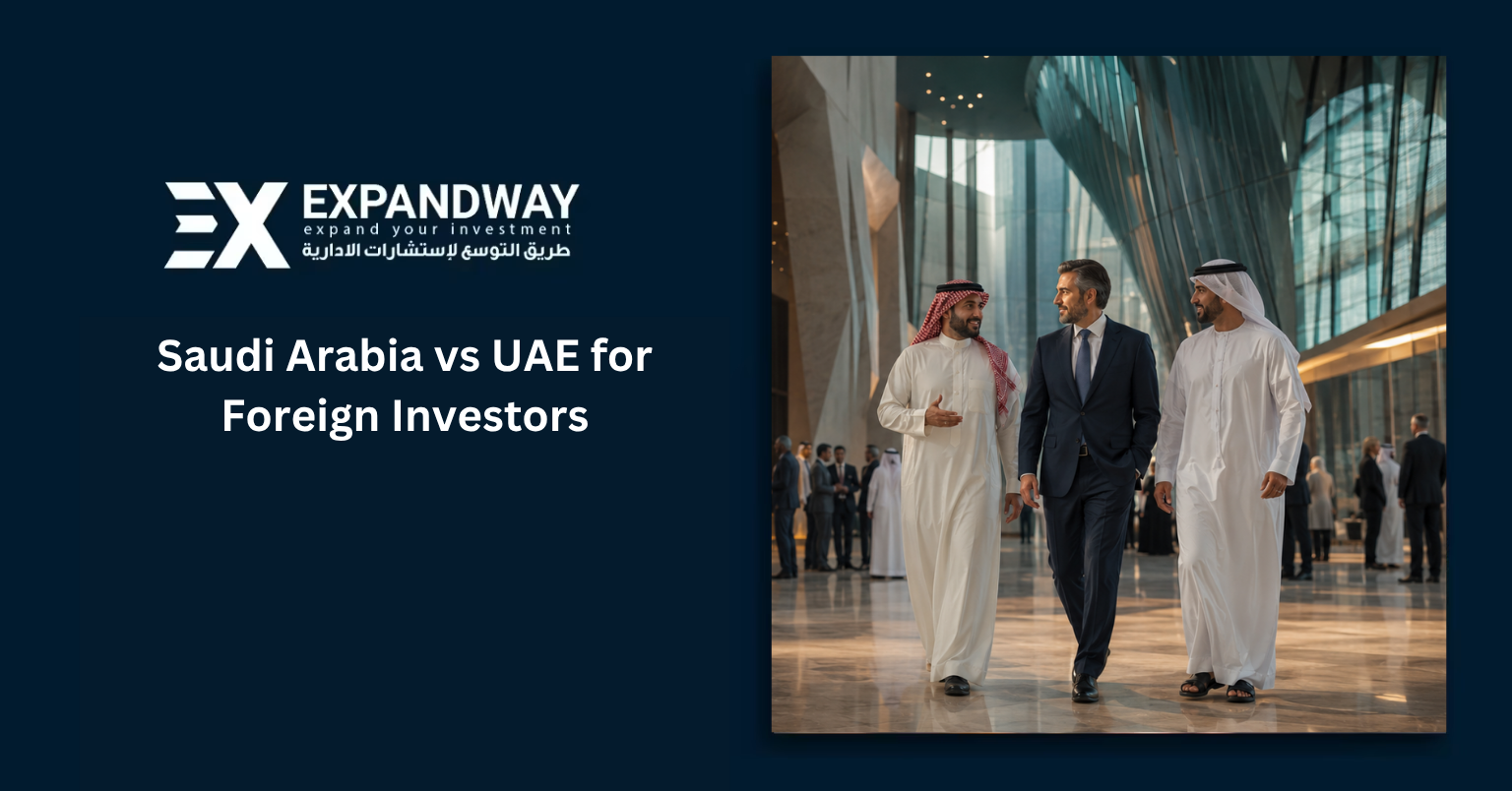
Saudi Arabia vs UAE for foreign investors is an important comparison for companies entering the Middle East. Saudi Arabia offers a larger domestic market and major Vision 2030 opportunities. However, the UAE provides faster business setup, lower headline taxes and stronger international connectivity.
Choosing between Saudi Arabia and the UAE is an important decision for any company entering the Gulf market. Although both countries welcome international businesses, they offer different advantages.
Saudi Arabia vs UAE for foreign investors is mainly a choice between market access and operational flexibility. Saudi Arabia provides access to the GCC’s largest economy, major government projects and fast-growing domestic demand. The UAE, meanwhile, offers faster company formation, lower headline taxes and an established international business environment.
Saudi Arabia is often more suitable for businesses targeting local customers, government contracts, manufacturing and Vision 2030 projects. In contrast, the UAE can be a better base for regional trading, professional services, technology companies and international operations.
Therefore, investors should not make this decision based only on tax rates or setup costs. They must also consider their target customers, industry, workforce and long-term expansion plans.
- Saudi Arabia vs UAE for Foreign Investors: Quick Comparison
- Saudi Arabia vs UAE: Which Has the Better Market?
- Foreign Ownership in Saudi Arabia and the UAE
- Company Formation Process
- Saudi Arabia vs UAE Tax Comparison
- Saudi Regional Headquarters Program
- Saudi Arabia vs UAE Business Setup Costs
- Employment and Localization Rules
- Best Sectors for Investment in Saudi Arabia
- Best Sectors for Investment in the UAE
- Should Foreign Investors Choose Saudi Arabia or the UAE?
- Can You Establish Companies in Both Countries?
- Frequently Asked Questions
- Conclusion
- Call to Action
Saudi Arabia vs UAE for Foreign Investors: Quick Comparison
| Factor | Saudi Arabia | UAE |
|---|---|---|
| Main advantage | Large domestic market and Vision 2030 opportunities | Fast setup and international connectivity |
| Foreign ownership | 100% ownership is generally available for approved activities | 100% ownership is available for most mainland and free-zone activities |
| Corporate tax | Generally 20% on the foreign shareholder’s taxable share | 9% above the applicable taxable-income threshold |
| Standard VAT | 15% | 5% |
| Setup process | More documentation and regulatory requirements | Generally faster, especially in free zones |
| Local hiring policy | Saudization | Emiratization |
| Government contracts | Strong opportunities for locally established companies | Mainland companies are generally more suitable |
| Regional headquarters | Dedicated Saudi RHQ incentive program | Established international headquarters ecosystem |
| Best for | Manufacturing, infrastructure, healthcare and Saudi market access | Trading, technology, consulting and regional operations |
These figures represent general rules. However, the final requirements will depend on the company’s licensed activities, ownership structure and operating location.
Saudi Arabia vs UAE: Which Has the Better Market?
Market potential is one of the biggest differences between Saudi Arabia and the UAE.
Saudi Arabia offers a larger domestic market
Saudi Arabia has the largest economy and consumer market in the GCC. Moreover, it has a young population and significant demand for housing, healthcare, entertainment, technology and consumer services.
Vision 2030 is also creating opportunities across the non-oil economy. As a result, foreign investors can participate in industries that previously depended heavily on government delivery.
Key growth sectors include:
- Tourism and hospitality
- Construction and infrastructure
- Manufacturing
- Mining
- Renewable energy
- Healthcare
- Education
- Technology
- Entertainment
- Transport and logistics
The International Monetary Fund reported that Saudi non-oil real GDP grew by approximately 4.2% in 2024. Furthermore, the IMF expected domestic demand and continued Vision 2030 investment to support further non-oil expansion.
Source: IMF Saudi Arabia Article IV Mission
Saudi Arabia may therefore be the stronger choice if your business relies on:
- Saudi consumers
- Government spending
- Infrastructure development
- Industrial production
- Local distribution
- Long-term Saudi contracts
The UAE offers stronger international connectivity
The UAE has a smaller domestic population. Nevertheless, Dubai and Abu Dhabi are highly connected international business centers.
The country provides access to advanced ports, airports, financial institutions and logistics networks. Consequently, many international companies use the UAE to serve clients across the Middle East, Africa, Asia and Europe.
The UAE may be more suitable for:
- International trading
- Import and re-export businesses
- Professional services
- Technology companies
- Financial services
- Regional consulting firms
- E-commerce operations
- International holding structures
In short, Saudi Arabia usually offers greater local market potential. The UAE, however, often provides a more flexible platform for regional and global operations.
Foreign Ownership in Saudi Arabia and the UAE
Both countries allow full foreign ownership across many business activities. However, investors must still check whether their chosen activity has additional restrictions.
Foreign ownership in Saudi Arabia
Foreign investors can generally own 100% of a Saudi company if the proposed business activity is open to foreign investment.
Saudi Arabia’s updated Investment Law introduced a registration-based framework for both local and foreign investors. Under this system, foreign establishments register with the Ministry of Investment before completing the remaining incorporation procedures.
The official MISA Investor Guide states that foreign investment registration is available for approved activities under the ISIC4 classification. However, restricted or regulated activities may require additional documents and approvals.
Depending on the activity, a foreign investor may need:
- MISA investment registration
- Commercial registration
- Articles of association
- A registered national address
- Municipal approval
- ZATCA registration
- Labor authority registration
- Social insurance registration
- Sector-specific licenses
- A physical office or commercial facility
In addition, MISA may request authenticated company documents and financial statements from the foreign shareholder.
Source: MISA Investor Guide
Therefore, 100% foreign ownership does not mean that every activity follows the same process. Investors should first confirm the licensing requirements for their specific business.
Foreign ownership in the UAE
The UAE also permits 100% foreign ownership for most business activities.
Previously, many mainland companies required a UAE national to hold the majority of company shares. Legal reforms have since removed that general requirement. Nevertheless, strategic-impact and regulated activities may still have additional conditions.
Foreign investors can usually choose between:
- A mainland limited liability company
- A free-zone company
- A branch of a foreign company
- A professional company
- A suitable holding structure
A mainland company generally provides broader access to the local UAE market. Meanwhile, a free-zone entity may offer simpler registration, flexible office options and industry-specific benefits.
Source: UAE Government foreign-ownership guidance
Company Formation Process
The UAE usually provides a faster company formation process. Saudi Arabia, on the other hand, requires more preparation for many foreign-owned businesses.
How to set up a company in Saudi Arabia
A standard Saudi business setup may involve the following steps:
- Select the appropriate business activity.
- Confirm that the activity is open to foreign investment.
- Complete investment registration with MISA.
- Reserve the company’s trade name.
- Prepare the articles of association.
- Obtain commercial registration.
- Secure an approved office or facility.
- Complete municipal licensing.
- Register with ZATCA.
- Register with labor and social insurance authorities.
- Obtain any required sector approval.
- Open a Saudi corporate bank account.
The exact process depends on the company type and licensed activities. For example, a consulting company will not have the same requirements as a manufacturing facility.
Furthermore, regulated industries such as healthcare, education, finance and transportation may need approval from additional government authorities.
How to set up a company in the UAE
A typical UAE company setup includes:
- Selecting a mainland or free-zone jurisdiction.
- Choosing the required business activities.
- Reserving a trade name.
- Submitting shareholder documents.
- Obtaining initial approval.
- Signing the incorporation documents.
- Securing an approved office or flexi-desk.
- Receiving the business license.
- Completing immigration registration.
- Applying for investor and employee visas.
- Opening a UAE business bank account.
The UAE Government’s Basher platform also allows eligible investors to complete several mainland establishment procedures online.
Source: UAE mainland business setup guidance
As a result, the UAE can be more attractive to businesses that prioritize speed. Saudi Arabia may still deliver more value when direct access to its domestic market is essential.
Saudi Arabia vs UAE Tax Comparison
Tax is another major factor in the Saudi Arabia vs UAE for foreign investors comparison.
Corporate tax and VAT in Saudi Arabia
Foreign-owned businesses in Saudi Arabia are generally subject to:
- 20% corporate income tax on the taxable share attributable to foreign ownership
- 15% standard VAT
- Withholding tax on certain payments to non-residents
- Zakat treatment for qualifying Saudi or GCC ownership interests
The Zakat, Tax and Customs Authority confirms that net profits subject to Saudi income tax are generally taxed at 20%.
Source: ZATCA income-tax guidance
Saudi Arabia also applies a standard VAT rate of 15%. However, selected transactions may receive zero-rated or exempt treatment.
Source: ZATCA VAT guidance
Corporate tax and VAT in the UAE
The UAE generally applies:
- 0% corporate tax on taxable income up to AED 375,000
- 9% corporate tax on taxable income above AED 375,000
- 0% corporate tax on qualifying free-zone income, subject to conditions
- 5% standard VAT
- No general personal income tax on employment income
The UAE therefore offers a lower headline corporate tax rate. Additionally, its standard VAT rate is lower than the Saudi rate.
Still, investors should not assume that every UAE free-zone company pays 0% corporate tax.
To receive the 0% rate, a company must qualify as a Qualifying Free Zone Person. It must also meet the applicable requirements relating to qualifying income, economic substance, transfer pricing and regulatory compliance.
Source: UAE Federal Tax Authority free-zone guidance
The standard UAE VAT rate remains 5%.
Source: UAE Federal Tax Authority VAT guidance
Overall, the UAE has a lighter headline tax environment. Nevertheless, investors should compare the complete tax position rather than focusing on one advertised rate.
Saudi Regional Headquarters Program
Saudi Arabia’s Regional Headquarters Program is especially important for multinational companies.
A regional headquarters, or RHQ, manages and supports a multinational group’s operations across the Middle East and North Africa. It is not simply a standard trading or operating company.
Qualifying RHQ entities may receive:
- A 0% corporate income tax rate on qualifying RHQ activities
- A 0% withholding-tax rate on qualifying RHQ payments
- A 30-year incentive period
- Visa and employee-relocation support
- Selected exemptions from Saudization requirements
- Support with establishing regional management functions
These incentives can significantly improve Saudi Arabia’s appeal for multinational groups. However, they may not cover all commercial or revenue-generating activities.
A company may therefore need one Saudi entity for RHQ functions and another for commercial operations.
Source: Invest Saudi incentives
The Saudi RHQ Program may be suitable for companies that want to:
- Manage regional operations from Riyadh
- Access major Saudi government contracts
- Establish senior management in Saudi Arabia
- Participate in giga-project supply chains
- Build a permanent regional presence
Saudi Arabia vs UAE Business Setup Costs
Business setup costs vary significantly in both countries. Therefore, investors should avoid making decisions based only on promotional license prices.
UAE company formation costs
The research provided for this article identified basic UAE free-zone licenses starting from approximately AED 5,750. However, entry-level prices usually cover only selected registration and licensing services.
Additional expenses may include:
- Immigration establishment cards
- Investor and employee visas
- Medical examinations
- Emirates ID applications
- Office or flexi-desk costs
- Regulatory approvals
- Corporate tax registration
- Bookkeeping and accounting
- Bank-account support
- Annual license renewal
A mainland company can also cost more than a basic free-zone structure. Moreover, regulated activities normally require additional approvals and fees.
Saudi company formation costs
Saudi setup costs are generally more variable because they depend heavily on the business activity.
A foreign investor may need to budget for:
- Investment registration
- Commercial registration
- Articles of association
- Office or warehouse rent
- Municipal licensing
- Professional and legal fees
- Sector-specific approvals
- Employee visas
- Medical insurance
- Saudization-related recruitment
- ZATCA and accounting compliance
- Activity-specific capital requirements
Consequently, investors should request an activity-specific quotation. A basic UAE free-zone license should not be compared directly with a fully operational Saudi company.
The two structures may provide completely different market access, visa capacity and operating rights.
Employment and Localization Rules
Both countries require companies to support local employment. However, the structure and impact of their localization programs differ.
Saudization requirements
Saudi Arabia uses the Nitaqat program to determine local employment requirements.
Saudization ratios can depend on:
- Company size
- Business sector
- Employee positions
- Salary levels
- Business classification
- Total workforce
Foreign investors should plan for Saudi recruitment from the beginning. Otherwise, the company may face difficulties with visas, labor services or business expansion.
At the same time, hiring Saudi employees can strengthen local market knowledge and improve relationships with customers and government stakeholders.
Emiratization requirements
The UAE applies Emiratization requirements to qualifying private-sector companies.
Although these requirements have expanded, the UAE continues to provide a highly international employment market. Businesses can recruit expatriate professionals from a wide range of industries and experience levels.
Therefore, the UAE may be more suitable for a company that needs a flexible international workforce. Saudi Arabia may be the better option for a business prepared to invest in a permanent local team.
Best Sectors for Investment in Saudi Arabia
Saudi Arabia is particularly attractive in industries supported by domestic demand and Vision 2030.
Manufacturing
Saudi Arabia is encouraging local manufacturing and supply-chain development. Opportunities exist in automotive components, machinery, pharmaceuticals, food processing and advanced industrial products.
Construction and infrastructure
Major urban, transport, housing and tourism projects continue to create demand for contractors, consultants and specialist suppliers.
Tourism and entertainment
Destinations and developments such as the Red Sea, Qiddiya and Diriyah are generating opportunities in hospitality, events, leisure and supporting services.
Mining and energy
The Kingdom is developing its mineral resources while investing in renewable energy and downstream production.
Healthcare and education
Population growth and economic transformation are increasing demand for hospitals, clinics, medical technology, training and private education.
Suggested internal link:
[Top Industries for Foreign Investment in Saudi Arabia]
Best Sectors for Investment in the UAE
The UAE remains highly competitive in industries that depend on international connectivity.
Trading and logistics
Dubai’s airports, ports and free zones support import, export and re-export operations across multiple regions.
Financial services
Dubai and Abu Dhabi provide developed ecosystems for banking, investment, insurance, fintech and professional services.
Technology
The UAE offers dedicated environments for software, artificial intelligence, digital assets and online businesses.
Professional services
International consulting, marketing, legal and corporate-service firms can access a diverse regional client base.
Regional operations
Companies serving several markets may use the UAE as a central management, sales or logistics hub.
Should Foreign Investors Choose Saudi Arabia or the UAE?
Choose Saudi Arabia if your business needs:
- Direct access to Saudi customers
- Government and semi-government contracts
- Vision 2030 opportunities
- Manufacturing or industrial facilities
- A substantial local workforce
- Long-term participation in the Saudi economy
- A qualifying Saudi regional headquarters
Choose the UAE if your business needs:
- Faster company formation
- Lower headline corporate tax
- An established free-zone ecosystem
- International trading access
- Flexible expatriate recruitment
- A multi-country customer base
- A regional services or management hub
Ultimately, the right choice depends on where your business will generate revenue.
Can You Establish Companies in Both Countries?
Yes. In fact, many international groups can benefit from operating in both markets.
A typical structure may include:
- A UAE free-zone or mainland company for trading, holding or regional services
- A Saudi subsidiary or branch for direct Saudi operations
- A Saudi RHQ for qualifying multinational management activities
This approach can combine the UAE’s international connectivity with Saudi Arabia’s domestic market access.
However, investors must assess:
- Transfer-pricing requirements
- Intercompany agreements
- Permanent establishment risks
- Economic-substance requirements
- Withholding tax
- Corporate tax
- Local licensing restrictions
Professional legal and tax advice is essential before implementing a dual-country structure.
Frequently Asked Questions
Is Saudi Arabia or the UAE better for foreign investors?
Saudi Arabia is often better for businesses targeting local demand, government projects, manufacturing and Vision 2030 sectors. Meanwhile, the UAE may be better for international trading, professional services and regional operations.
Can a foreigner own 100% of a Saudi company?
Yes, foreign investors can generally own 100% of companies engaged in approved activities. However, restricted and regulated activities may have additional requirements.
Can foreigners own 100% of a UAE mainland company?
Yes, the UAE permits full foreign ownership for most mainland activities. Nevertheless, strategic-impact activities may remain subject to special controls.
Which country has lower corporate tax?
The UAE generally has the lower headline rate. It applies a 9% corporate tax rate above the relevant taxable-income threshold. In comparison, the foreign taxable share of a Saudi business is generally subject to 20% corporate income tax.
Is every UAE free-zone company tax-free?
No. A company must meet the Qualifying Free Zone Person requirements to benefit from the 0% rate on qualifying income.
Is it cheaper to start a business in Saudi Arabia or the UAE?
A basic UAE free-zone company is generally cheaper and faster to establish. However, actual costs depend on visas, office requirements, activities, regulatory approvals and operating needs.
Is Saudi Arabia suitable for a regional headquarters?
Yes. Saudi Arabia offers a dedicated RHQ Program for qualifying multinational companies. The program includes tax and administrative incentives for eligible regional-headquarters activities.
Conclusion
The Saudi Arabia vs UAE for foreign investors decision should not depend only on taxes or initial setup costs.
Saudi Arabia offers a large domestic market, government-backed opportunities and direct access to Vision 2030 growth. By contrast, the UAE provides faster setup, international connectivity, mature free zones and a lower headline tax environment.
For some businesses, Saudi Arabia will provide the strongest commercial opportunity. For others, the UAE will offer a more efficient regional base. In many cases, operating in both countries may create the best long-term structure.
Call to Action
Planning to establish or expand your business in Saudi Arabia?
Expandway can help you evaluate your market-entry options, understand Saudi investment requirements and select the right legal structure for your operations.