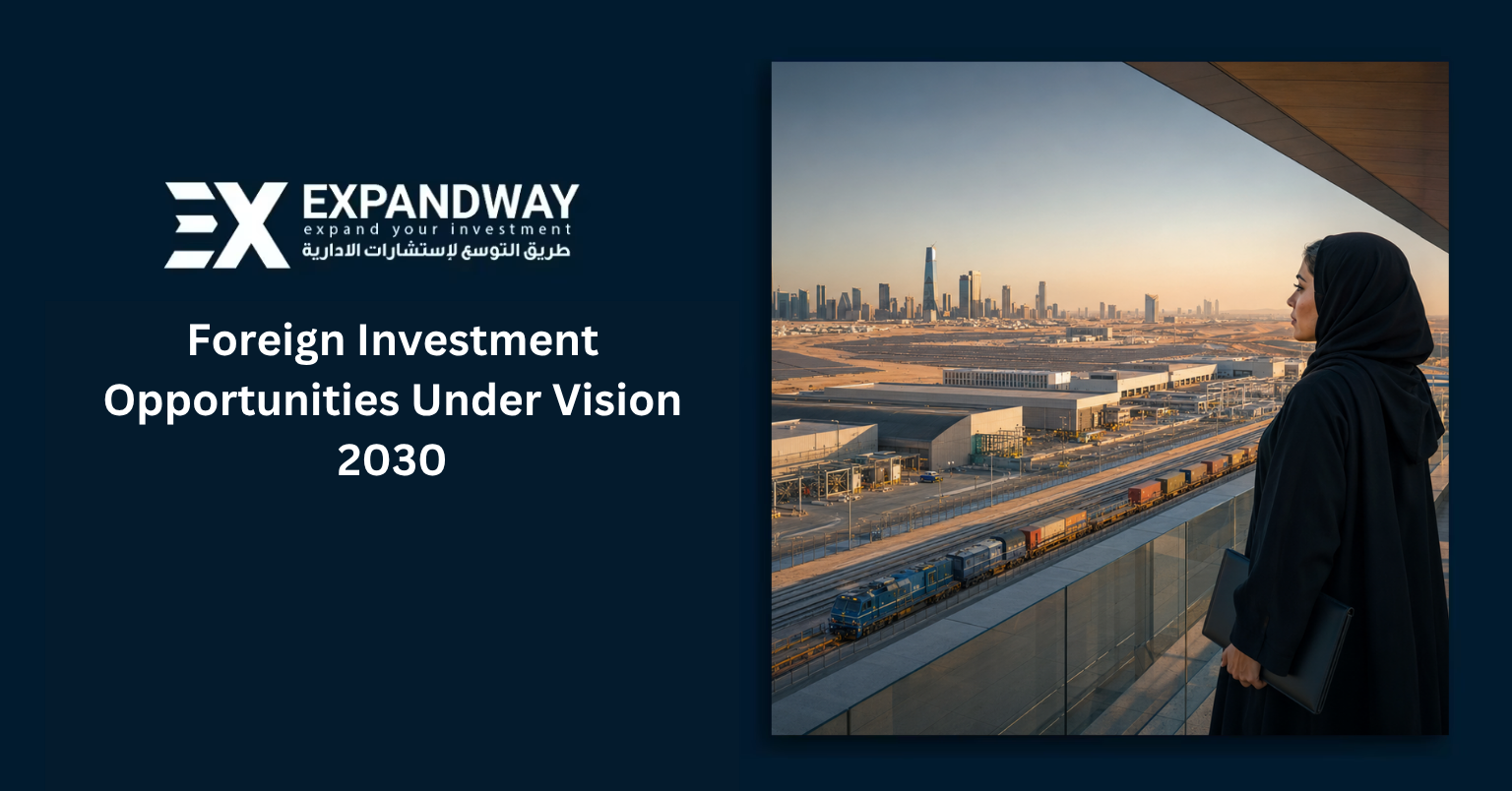
Vision 2030 aims to build a more diversified, private-sector-led economy. Its long-term targets include raising the private sector’s contribution to 65% of GDP, increasing non-oil exports to 50% of non-oil GDP and lifting foreign direct investment to 5.7% of GDP.
Moreover, recent results show that diversification is already changing the economic base. The Saudi Vision 2030 Annual Report 2025 states that non-oil activities accounted for 55% of GDP and that real GDP grew by 4.5% in 2025. As a result, demand now extends across business services, infrastructure, consumer markets and industrial supply chains not only hydrocarbons.
Meanwhile, the Ministry of Investment of Saudi Arabia (MISA) presents 15 priority sectors to investors. Consequently, companies have a clearer route to projects, partners, incentives and market-entry support.
- Top Foreign Investment Opportunities Under Vision 2030
- How the Updated Saudi Investment Law Changes Market Entry
- Investment Incentives and Special Regimes
- Vision 2030 Giga-Projects and Supply-Chain Opportunities
- How to Invest in Saudi Arabia: A Practical 2026 Route
- What Foreign Investors Should Evaluate Before Entering Saudi Arabia
- Common Mistakes to Avoid
- Conclusion: Turn Vision 2030 Opportunity Into a Practical Entry Plan
Top Foreign Investment Opportunities Under Vision 2030
The best opportunity depends on an investor’s expertise, capital, technology and preferred entry model. However, the following sectors show strong strategic alignment and commercial potential.
1. Technology, AI and the Digital Economy
Saudi demand is expanding across cloud services, artificial intelligence, cybersecurity, fintech, e-commerce infrastructure and data centres. Government digitisation, enterprise transformation and a young, connected population support this growth.
Foreign companies can pursue enterprise software, managed cloud services, cybersecurity solutions, payments technology, data infrastructure and sector-specific digital platforms. Businesses that localise delivery, train Saudi talent and protect data in line with local rules can build a stronger market position.
2. Advanced Manufacturing and Industrial Localisation
Saudi Arabia wants more products, components and industrial capabilities to be produced locally. Opportunities include automotive supply chains, pharmaceuticals, medical products, food processing, aerospace components, machinery and renewable-energy equipment.
Therefore, manufacturers should assess industrial land, utilities, customs treatment, local-content requirements and potential financing support. In addition, a local production strategy may improve access to major procurement programmes.
3. Tourism, Hospitality and Entertainment
Tourism is one of the most visible pillars of Vision 2030. Major destinations and events are generating demand for hotels, resorts, attractions, food and beverage concepts, destination management, travel technology and specialist operators.
For example, projects connected to destinations such as the Red Sea, Diriyah and Qiddiya create opportunities throughout the value chain. However, operators must confirm tourism licensing, municipality requirements, property arrangements and staffing rules before launch.
4. Healthcare and Life Sciences
Population growth, healthcare transformation and demand for specialised care are supporting investment in hospitals, clinics, diagnostics, medical devices, pharmaceuticals, digital health and healthcare operations.
Therefore, investors should plan early for professional licensing and approvals from the relevant health authorities. In addition, product-based businesses may need Saudi Food and Drug Authority registration.
5. Renewable Energy and Green Hydrogen
Saudi Arabia is investing in solar, wind, energy storage and hydrogen as it develops a more diversified energy system. This creates openings for developers, engineering firms, equipment manufacturers, software providers and operations specialists.
Consequently, the strongest propositions often combine technical capability with local supply-chain development, long-term maintenance and workforce training.
6. Logistics and Supply Chain Services
Saudi Arabia’s location between Asia, Europe and Africa supports its ambition to become a global logistics hub. Opportunities include ports, warehousing, bonded logistics, cold chain, freight technology, fulfilment, last-mile delivery and regional distribution.
Therefore, investors should compare locations based on customer access, port or airport connectivity, customs processes, land costs and any special-zone benefits.
7. Mining and Metals
The Kingdom is expanding exploration and downstream processing as it develops mineral resources. International firms can participate in geological services, mining technology, equipment, processing, environmental services and metals-based manufacturing.
However, mining opportunities require careful due diligence on concessions, permits, infrastructure, water, environmental obligations and offtake demand.
8. Financial Services and Fintech
Payments, lending technology, insurance, asset management, capital markets and business-to-business financial infrastructure are developing rapidly. The Saudi Central Bank and Capital Market Authority regulate different parts of this ecosystem.
Therefore, foreign investors must identify the correct regulator before incorporating or marketing a regulated service. Furthermore, in January 2026, the Capital Market Authority issued updated Rules for Foreign Investment in Securities, reflecting continued reform of access to the Saudi capital market.
9. Education and Workforce Development
Economic diversification needs technical, managerial and vocational skills. Opportunities therefore exist in private education, professional qualifications, corporate training, digital learning and sector-specific academies.
As a result, providers that align programmes with employer demand and Saudi workforce development priorities can create a clearer commercial case.
10. Real Estate, Construction and Infrastructure
Housing, commercial development, tourism destinations and public infrastructure create demand for developers, contractors, engineering consultancies, project managers, proptech firms and facility-management providers.
However, foreign investors must verify ownership, location and activity rules. In particular, real-estate rights remain subject to the applicable Saudi law and designated restrictions; they should not be assumed from general investment rules.
How the Updated Saudi Investment Law Changes Market Entry
One of the most important recent changes is the shift from a foreign-investment licensing model to an Investment Registration mechanism. MISA states that a foreign investor must register before conducting investment activities. After receiving confirmation, the investor can obtain a Commercial Registration and the required approvals from other authorities.
Moreover, the law gives local and foreign investors a more unified framework. It also confirms important protections, including equality of treatment in comparable circumstances and safeguards against unlawful confiscation or expropriation.
However, foreign ownership is not identical across every activity. MISA confirms that some activities can be conducted without a local partner, while others remain restricted or require prior approval. Therefore, investors should validate the exact activity code and ownership conditions before finalising a structure.
Investment Incentives and Special Regimes
Although Saudi incentives can improve project economics, they are conditional. Therefore, eligibility depends on the activity, location, investment commitment and compliance with the relevant programme.
- Regional Headquarters programme: qualifying multinational groups may access a 30-year package that includes a zero rate of corporate income tax and withholding tax on eligible RHQ activities, subject to the applicable rules.
- Special Economic Zones: zone-specific packages may offer reduced tax rates, customs benefits and tailored employment rules. Investors must examine the exact zone regulations and qualifying activities.
- Industrial support: eligible manufacturers may access industrial land, financing, customs relief or other support through the relevant Saudi entities.
- Project and procurement opportunities: giga-projects and national programmes create supplier, operator, technology and partnership opportunities, although prequalification and local-content requirements may apply.
Ultimately, investors should treat incentives as part of the business case not as a substitute for customer demand, regulatory fit or a workable operating model.
Vision 2030 Giga-Projects and Supply-Chain Opportunities
NEOM, Red Sea Global, Qiddiya, Diriyah and ROSHN are frequently associated with Vision 2030 investment. Yet the opportunity is broader than direct construction contracts.
In addition, these developments can create demand for:
- Engineering, construction and project-management services
- Hospitality operations, food service and destination experiences
- Smart-city software, cybersecurity and digital infrastructure
- Energy, water, waste and environmental solutions
- Furniture, fixtures, equipment and local manufacturing
- Transport, warehousing and specialised logistics
- Facilities management, maintenance and workforce services
Therefore, foreign suppliers should monitor official procurement channels and confirm vendor registration, prequalification, insurance, local-content and contracting requirements.
How to Invest in Saudi Arabia: A Practical 2026 Route
A typical foreign company setup process includes the following steps. The sequence can change by activity and legal structure.
Stage 1: Confirm the Activity and Entry Structure
- Define the commercial activity. Map the intended services or products to the correct Saudi activity classifications and identify restricted activities.
- Choose the entry structure. Compare a limited liability company, branch, subsidiary, joint venture or Regional Headquarters based on liability, governance, tax and commercial goals.
- Apply for MISA Investment Registration. MISA’s current guidance describes two tracks available and restricted activitiesand states that application review can take up to 10 days.
Stage 2: Register and Obtain Approvals
- Complete Ministry of Commerce incorporation. Establish the entity, approve the constitutional documents and obtain the Commercial Registration.
- Secure sector and operational approvals. Depending on the activity, these may involve the Saudi Central Bank, Capital Market Authority, Communications, Space and Technology Commission, Saudi Food and Drug Authority, tourism authorities, municipalities or other bodies.
Stage 3: Prepare for Compliant Operations
- Register for tax and e-invoicing. Complete the required ZATCA registrations and assess corporate income tax, VAT, withholding tax, transfer pricing and e-invoicing obligations.
- Prepare employment and Saudization compliance. Register with the relevant labour and social-insurance systems, then build a hiring plan that accounts for Nitaqat and role-specific requirements.
- Open banking and launch operations. Complete bank, lease, address, insurance, customs and operational registrations relevant to the business.
What Foreign Investors Should Evaluate Before Entering Saudi Arabia
A strong market-entry decision should answer five questions:
- Demand: Who will buy, how long is the sales cycle and is demand driven by government, business or consumers?
- Regulation: Is the activity available, restricted or regulated by a specialist authority?
- Ownership and structure: Can the activity be wholly foreign owned, and which entity supports contracts, tax and future expansion?
- Localisation: What Saudization, local-content, data, manufacturing or procurement commitments affect the model?
- Economics: Do tax, customs, staffing, premises, financing and compliance costs support the expected margin?
Consequently, this due diligence helps investors separate a promising sector story from a bankable Saudi business model.
Common Mistakes to Avoid
- Using outdated “MISA licence” terminology without checking the new Investment Registration process.
- Assuming 100% foreign ownership applies to every activity.
- Incorporating before confirming sector approvals and activity codes.
- Treating an incentive headline as guaranteed without reviewing eligibility conditions.
- Ignoring Saudization, local-content or data-residency obligations in the financial model.
- Choosing a legal structure only for speed rather than contracts, tax, liability and long-term growth.
Conclusion: Turn Vision 2030 Opportunity Into a Practical Entry Plan
Foreign investment opportunities under Vision 2030 span some of the world’s fastest-developing sectors. The strongest prospects sit where national priorities, real customer demand and an investor’s capabilities meet.
However, success depends on execution. Investors need the right activity classification, legal structure, Investment Registration, sector approvals, tax setup and localisation plan. Once those elements align, Saudi Arabia can provide a platform for long-term growth across the Kingdom and the wider Middle East.
Therefore, if you plan to establish or expand your company in Saudi Arabia, speak with Expandway. Our team can provide a tailored market-entry assessment covering your activity, ownership options, required approvals, documents and expected setup route. Contact Expandway