
Saudi market entry offers major opportunities for international service businesses. However, success requires the right company structure, MISA registration, compliance plan and local commercial strategy.
Saudi Arabia continues to diversify its economy under Vision 2030. This transformation is generating demand for specialist services across areas such as:
- Digital transformation and information technology
- Cybersecurity, cloud services and data solutions
- Financial technology and professional advisory
- Healthcare and health technology
- Education and workforce development
- Tourism, hospitality and entertainment
- Logistics and supply-chain services
- Engineering, environmental and project-management services
In addition, MISA describes its role as building a business-friendly investment ecosystem and helping investors access opportunities created by the Kingdom’s economic transformation. Even so, commercial success still depends on local relevance, compliant delivery and a credible Saudi presence.
Therefore, businesses should not treat company registration as the market strategy itself. In other words, registration gives the company a legal vehicle. By contrast, the market strategy determines how that vehicle will win clients, deliver services and scale.
- Choose the Right Saudi Market Entry Model
- LLC vs Branch vs RHQ: Quick Comparison
- The 2026 Licensing and Registration Sequence
- Capital, Tax and Budget Planning
- Saudization and Workforce Planning
- Align the Offer With Vision 2030 - Without Using Generic Claims
- Build a Commercial Market Entry Strategy
- A Practical First 90-Day Market Entry Plan
- Common Market Entry Mistakes to Avoid
- Frequently Asked Questions
- Start With the Right Structure and Sequence
Choose the Right Saudi Market Entry Model
First, the right legal structure affects ownership, liability, hiring, contracting, banking and future expansion. Accordingly, service businesses usually compare three main options.
1. Wholly Foreign-Owned Limited Liability Company
For example, a new Saudi LLC is often the most practical choice for a service company planning a lasting local presence.
It may suit businesses that want to:
- Hire employees locally
- Invoice Saudi clients through a Saudi entity
- Build a standalone Saudi operation
- Bid for private or eligible public-sector work
- Add services and scale over time
- Separate the Saudi entity’s liability from the foreign parent
Many service activities allow 100% foreign ownership. However, MISA confirms that ownership conditions depend on the selected activity. As a result, restricted activities may require additional approval or local participation.
As a result, an LLC can strengthen market credibility because clients, banks and vendors deal with an incorporated Saudi entity. It also offers more operational independence than a representative arrangement.
2. Branch of a Foreign Company
On the other hand, a foreign company branch may work well when an established international company wants to trade under the parent company’s identity in Saudi Arabia.
This option may suit:
- Project-based market entry
- Consulting or technology companies with existing Saudi contracts
- Businesses that require close continuity with the parent company
- Companies that do not need a separate shareholder structure
Furthermore, Saudi Business Center provides a formal service for registering the branch of a company headquartered outside the Kingdom. Because a branch is an extension of its parent, the parent company’s documents, approvals and liability position deserve careful review before filing.
3. Regional Headquarters
By contrast, the Regional Headquarters (RHQ) programme is designed for multinational groups coordinating activities across the Middle East and North Africa from Saudi Arabia. Therefore, it is not simply a substitute for an operating company.
An RHQ may be relevant when a multinational business:
- Manages entities or operations across several countries
- Needs a regional management and governance base
- Wants to align its structure with Saudi government contracting rules
- Can meet the programme’s operational and staffing requirements
In contrast, for a single-market service provider or a smaller consultancy, an LLC or branch will usually be more proportionate.
LLC vs Branch vs RHQ: Quick Comparison
| Entry model | Best suited to | Ownership | Main advantage | Key consideration |
|---|---|---|---|---|
| Saudi LLC | Long-term operations and scalable local delivery | Often 100% foreign for permitted activities | Separate Saudi legal entity | Requirements depend on the licensed activity |
| Foreign company branch | Existing foreign companies delivering Saudi work | Foreign parent | Direct continuity with the parent company | Parent documentation and exposure require review |
| Regional headquarters | Multinationals managing a wider region | Foreign-owned | Regional coordination and strategic positioning | Programme obligations are more substantial |
Therefore, before choosing, compare more than setup cost. In addition, consider client expectations, tender eligibility, liability, tax treatment, staffing and the services the business may add during the next three years.
The 2026 Licensing and Registration Sequence
Next, a coordinated sequence reduces rework. Although the exact path varies by activity, most foreign service businesses should plan for the following stages.
Step 1: Define the Exact Business Activities
First, start by mapping every service the company intends to sell. The selected activities influence:
- Whether foreign ownership is permitted
- Whether the activity is available or restricted
- Which regulator must approve it
- The documents and professional credentials required
- Commercial Registration wording
- Saudization classification and workforce planning
Consequently, avoid choosing a broad or convenient activity code that does not match the real service. Otherwise, a mismatch can affect invoicing, banking, tax treatment, visas, tenders and future renewals.
Step 2: Complete MISA Investment Registration
Saudi Arabia’s updated Investment Law establishes a national investor register and requires a foreign investor to register with MISA before engaging in an investment. Moreover, applications can be submitted electronically; an in-person visit to MISA is not required.
In addition, MISA’s current FAQ identifies two tracks: available activities and restricted activities. Furthermore, it states that application review may take up to 10 days. Nevertheless, actual completion depends on the activity and the quality of the submission.
The document pack may include:
- The foreign company’s Commercial Registration or equivalent
- Articles of association or constitutional documents
- A board or shareholder resolution
- Audited financial statements, where requested
- Passport and shareholder information
- Ultimate beneficial owner information
- Power of attorney for the authorised representative
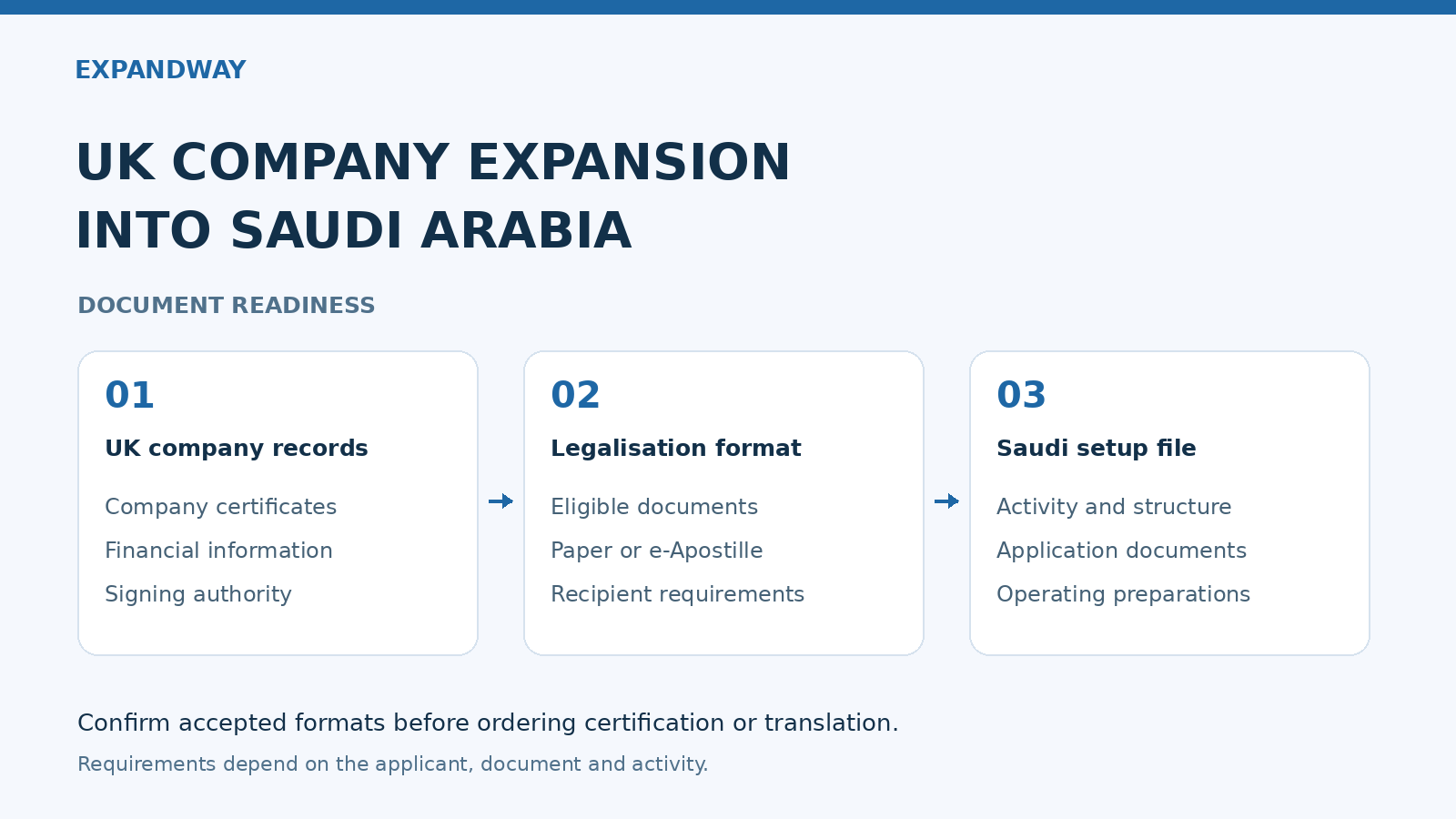
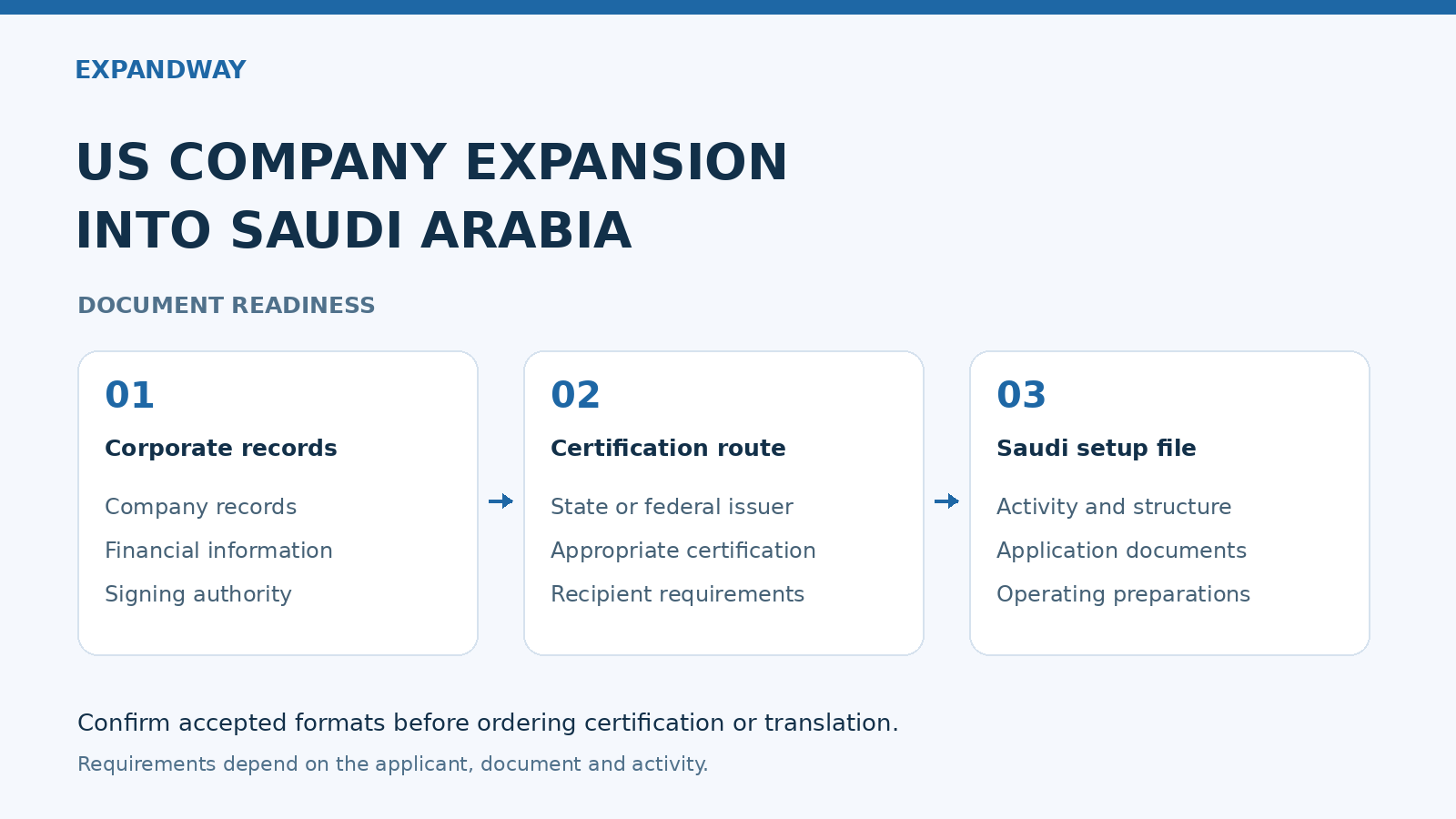
- Legalisation or attestation required by the receiving authority
However, document requirements vary by registration type and selected activity. Therefore, businesses should use the requirements displayed in the official application journey rather than relying on a generic checklist alone.
Step 3: Establish the Entity and Obtain Commercial Registration
Afterwards, establish the company or branch through the relevant Ministry of Commerce and Saudi Business Center procedures once the necessary investment registration is available.
This stage can include:
- Reserving the trade name
- Preparing and approving the articles of association
- Registering the company or foreign branch
- Issuing the Commercial Registration (CR)
- Recording managers and authorised signatories
- Completing beneficial ownership disclosures
Therefore, the CR should accurately reflect the approved business activities.
Step 4: Complete Tax and Operational Registrations
Next, the entity must complete the registrations relevant to its activities and workforce. For additional setup guidance, review our Saudi company formation guide. These registrations may include:
- Zakat, Tax and Customs Authority (ZATCA)
- Value-added tax registration, when the applicable threshold or other rule is met
- Corporate income tax and withholding-tax compliance
- National address
- Municipality or premises licensing
- Chamber of Commerce requirements
- Qiwa and Ministry of Human Resources processes
- General Organization for Social Insurance (GOSI)
ZATCA states that the standard income-tax rate on the tax base of a foreign-owned business is generally 20%. Saudi Arabia’s standard VAT rate is 15%. However, mixed ownership, permanent establishment issues, withholding tax, transfer pricing and the nature of a service can change the analysis. Obtain tax advice before finalising intercompany agreements or pricing.
Step 5: Obtain Sector-Specific Approvals
In addition, some services require approval beyond MISA and the Commercial Registration. For example, this can apply to regulated fields such as engineering, healthcare, education, financial services, legal services and certain technology activities.
Therefore, build these approvals into the critical path. Otherwise, the company may exist legally but still be unable to deliver or advertise the intended service.
Step 6: Open the Corporate Bank Account
Finally, banks normally conduct know-your-customer and beneficial ownership checks. Prepare a clear file containing:
- Corporate documents
- Ownership chart
- Source-of-funds information
- IDs for owners and authorised signatories
- Business model and expected transaction profile
- Contracts, proposals or evidence of commercial activity
As a result, a well-organised submission can reduce repeated questions. Nevertheless, bank timing varies and should not be promised as part of a guaranteed setup schedule.
Capital, Tax and Budget Planning
Importantly, there is no single capital figure that applies to every foreign service business. Instead, capital requirements may depend on the activity, legal structure and applicable investment conditions. Separately, a company may choose a higher practical capital amount to fund hiring, premises, technology and the sales cycle.
Your market-entry budget should account for:
- Registration and professional fees
- Document attestation and translation where required
- Office or approved premises
- Regulatory and sector approvals
- Recruitment and employee onboarding
- Payroll before revenue stabilises
- Insurance and professional memberships
- Technology, cybersecurity and data hosting
- Marketing and business development
- Working capital for delayed client payments
Therefore, treat statutory capital and operating cash as different planning questions. After all, meeting a legal threshold does not prove that the business has enough cash to reach break-even.
Saudization and Workforce Planning
Similarly, Saudization is not a universal percentage that can be applied to every service company. Rather, the required position depends on factors such as economic activity, company size, employee composition and the applicable Nitaqat or profession-specific rules.
Therefore, plan the workforce before issuing offers or requesting visas. A sound approach includes:
- Identifying roles that can be hired locally from launch
- Budgeting competitive compensation and training
- Reviewing profession-specific localisation requirements
- Balancing Saudi and international expertise
- Monitoring the company’s classification through the relevant labour platforms
As a result, early workforce planning supports compliance and also improves market credibility. Moreover, it can help the company build local knowledge, Arabic-language capability and stronger client relationships.
Align the Offer With Vision 2030 – Without Using Generic Claims
Although many businesses describe themselves as “aligned with Vision 2030,” few explain how their service contributes to a measurable outcome.
Make the connection specific. For example, show how the business will:
- Transfer technical or operational knowledge
- Train and employ Saudi professionals
- Improve digital capability or productivity
- Support tourism, logistics, healthcare or other priority sectors
- Build local supplier capacity
- Establish a lasting operating presence
Meanwhile, large programmes and PIF-backed projects can create valuable opportunities. Nevertheless, they also involve formal vendor onboarding, demanding procurement standards and long sales cycles. Therefore, a service business should qualify these opportunities carefully rather than build its entire forecast around one major contract.
Build a Commercial Market Entry Strategy
Crucially, legal setup and sales development should run in parallel. Before launch, validate the following:
Ideal Customer Profile
Firstly, define the industries, company sizes, decision-makers and problems most likely to create demand. In particular, a narrow initial segment usually produces clearer positioning than a generic “services for every company” message.
Localised Value Proposition
Secondly, explain why a Saudi customer should choose the company. For example, relevant proof may include local delivery capacity, Arabic support, sector credentials, response time, data-residency arrangements and knowledge transfer.
Route to Market
Choose the right mix of:
- Direct enterprise sales
- Local referral and channel partners
- Vendor prequalification
- Government procurement platforms, where eligible
- Industry events and professional networks
- Account-based marketing
- Search-led content and thought leadership
Pricing and Contracting
Additionally, model VAT, withholding tax, payment milestones, currency exposure and collection periods. At the same time, ensure the scope of work, deliverables, acceptance criteria and intellectual property clauses are suitable for Saudi contracting.
Local Partnerships
Finally, even when 100% foreign ownership is available, local partners can improve market intelligence and access. Therefore, select partners through due diligence and define responsibilities, exclusivity, fees and account ownership in writing.
A Practical First 90-Day Market Entry Plan
Weeks 1-2: Strategy and Scope
- Validate demand and priority customer segments
- Confirm the exact business activities
- Compare LLC, branch and RHQ options
- Map regulatory and sector approvals
- Start document legalisation or attestation
- Build a 12-month cash-flow forecast
Weeks 3-4: Investment Registration
- Submit the MISA Investment Registration application
- Respond quickly to clarification requests
- Prepare company formation documents in parallel
- Shortlist banking, accounting and employment providers
Weeks 5-6: Entity Formation
- Complete the company or branch establishment process
- Obtain the Commercial Registration
- Finalise authorised signatories and governance
- Begin tax and operational registrations
Weeks 7-8: Operational Readiness
- Progress the corporate bank account
- Configure accounting, invoicing and tax controls
- Register on the relevant labour and social insurance platforms
- Hire the initial Saudi and specialist team
- Secure the appropriate premises and municipal approvals
Weeks 9-12: Commercial Launch
- Begin targeted business development
- Complete vendor registrations and prequalification
- Activate local partnerships
- Publish Saudi-specific service pages and thought leadership
- Track leads, proposals, sales-cycle length and cash requirements
However, this timeline is a planning framework, not a guaranteed completion schedule. Regulated activities, document issues and third-party processing can extend it.
Common Market Entry Mistakes to Avoid
Using Outdated “MISA Licence” Assumptions
At the present time, the 2026 framework centres on investor registration. Therefore, use current official terminology and verify the latest application requirements.
Selecting the Wrong Activity
For example, an inaccurate activity can create problems across licensing, tax, employment and contracting. Consequently, define the actual revenue-generating services first.
Treating Setup as the Entire Strategy
For instance, a registered company without a pipeline, localised offer or working-capital plan can still fail. Therefore, develop the commercial model alongside incorporation.
Assuming One Capital or Saudization Rule Fits Every Company
In both cases, the answer depends on the company’s circumstances. Therefore, confirm the current requirement for the exact activity and workforce profile.
Underestimating Document Preparation
For instance, incomplete corporate records, inconsistent shareholder details or missing attestations can delay the process. Therefore, audit the submission pack before filing.
Relying on One Client or Tender
Therefore, diversify the initial pipeline. Large contracts can take longer than expected and often require prequalification.
Frequently Asked Questions
Can a foreigner own 100% of a service company in Saudi Arabia?
Many service activities permit 100% foreign ownership. However, MISA states that the answer depends on the selected activity. Consequently, restricted activities may carry additional conditions or require local participation.
Is a local Saudi partner always required?
No. However, MISA confirms that some activities can be carried out without a local partner, while others have different conditions. Therefore, verify the exact activity before deciding the ownership structure.
What is MISA Investment Registration?
In essence, it is the registration required for eligible foreign investors before engaging in an investment in Saudi Arabia. In other words, it reflects the updated Investment Law’s registration-based framework.
How long does MISA Investment Registration take?
Specifically, MISA’s current FAQ states that the review period is up to 10 days. However, preparation, clarification requests and other company-formation steps can make the end-to-end timeline longer.
Is an LLC or branch better for a service company?
Generally, an LLC suits a scalable, long-term Saudi operation. Alternatively, a branch can suit an established foreign company that wants direct continuity with the parent. Ultimately, liability, tax, contracts and future plans should drive the decision.
What taxes should a foreign service business expect?
Generally, a foreign-owned business is subject to 20% corporate income tax on its tax base, while the standard VAT rate is 15%. In addition, withholding tax, transfer pricing, mixed ownership and permanent establishment rules may apply.
Start With the Right Structure and Sequence
Overall, the strongest market entry strategy for service businesses in Saudi Arabia combines regulatory accuracy with commercial discipline. Firstly, define the activities and customer segment. Secondly, choose the structure that supports the company’s real operating model. Finally, coordinate MISA registration, company formation, tax, workforce planning and sector approvals with a local sales plan.
As a result, this approach reduces avoidable delays and gives the business a stronger platform for hiring, contracting and growth.
Planning to launch a consulting, technology, marketing, education or professional-services company in Saudi Arabia? Contact Expandway for a tailored structure comparison, activity review and market-entry roadmap.