Foreign investment in Saudi Arabia has entered its most dynamic phase yet. The Kingdom attracted SR26.6 billion ($7.1 billion) in FDI inflows in Q1 2026 alone, up 2.4% year on year, according to the General Authority for Statistics (GASTAT). Moreover, net inflows jumped 34% in Q3 2025 as global companies raced to secure a foothold in the region’s largest economy.
Behind these numbers sits Vision 2030 the national diversification program that is transforming Saudi Arabia into a hub for technology, renewable energy, tourism, mining, and advanced manufacturing. The government’s target is ambitious: $100 billion in annual FDI by 2030, lifting FDI’s share of GDP from 3.8% to 5.7%.
So, which sectors offer the strongest opportunities for foreign investors right now? In this guide, we break down the top industries for foreign investment in Saudi Arabia, the latest data behind each one, and the regulatory factors you must assess before entering the market.
Why Invest in Saudi Arabia in 2026?
Saudi Arabia is no longer just an oil economy. Instead, it is deliberately building new engines of growth. Several factors make 2026 a pivotal year:
- A new Investment Law (introduced in February 2025) strengthens investor protections, streamlines licensing, and guarantees equal treatment for domestic and foreign investors.
- Four Special Economic Zones including King Abdullah Economic City, Ras Al-Khair, Jazan, and the Cloud Computing Zone came into effect with dedicated regulations in April 2026.
- Record diversification spending through the Public Investment Fund (PIF) and giga-projects such as NEOM, the Red Sea, and Diriyah.
- Strategic location at the crossroads of Asia, Europe, and Africa, supporting the Kingdom’s ambition to become a global logistics hub.
Furthermore, Invest Saudi identifies technology, energy, manufacturing, tourism, entertainment, healthcare, mining, agriculture, financial services, logistics, and real estate as its priority investment sectors. Let’s examine the strongest of these in detail.
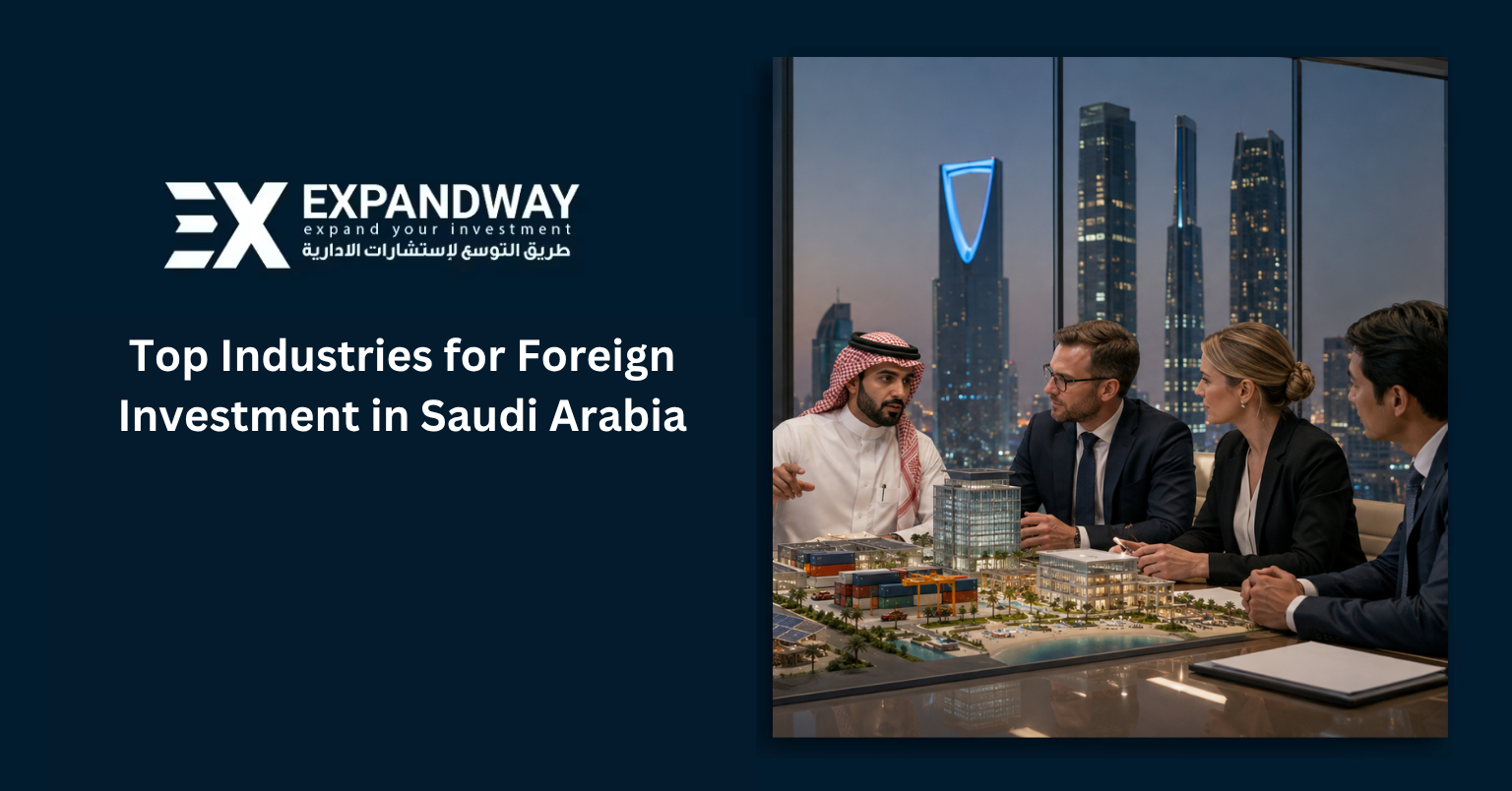
Top Industries for Foreign Investment in Saudi Arabia
1. Technology, AI, and Digital Services
Technology leads every practical ranking for foreign entrants. Saudi Arabia declared 2026 its “Year of AI,” backed by a $9.1 billion national AI strategy and the launch of HUMAIN, the PIF-backed AI company. In addition, the Kingdom’s data center market is surging, with $4.26 billion in investment and global players such as Google, Oracle, and Alibaba expanding local capacity.
The most promising subsectors include:
- AI and enterprise software
- Cloud infrastructure and data centers
- Cybersecurity and digital identity
- Fintech and payment solutions
- Smart-city, mobility, and construction technology
- HealthTech and educational technology
- Industrial automation and robotics
Demand comes from government digitization programs, large enterprises, and the giga-projects a combination few markets can match.
2. Renewable Energy and Green Industries
Energy transition is a national priority. Saudi Arabia targets 130 GW of renewable capacity by 2030, creating openings in solar, wind, green hydrogen, energy storage, waste management, and water treatment. Consequently, foreign firms with proven clean-energy technology or EPC expertise are finding strong local demand, often alongside continued investment in the broader energy and chemicals ecosystem.
3. Mining and Metals
Mining is one of the four core sectors of the National Industrial Development and Logistics Program (NIDLP). The Kingdom’s mineral wealth is now estimated at $2.5 trillion, spanning gold, copper, phosphate, bauxite, and rare earth elements. As a result, opportunities extend well beyond extraction into mineral processing, exploration services, and mining technology.
4. Advanced Manufacturing
The National Industrial Strategy focuses on 12 industrial clusters, including machinery and equipment, food and beverage processing, chemicals, medical devices, aviation, pharmaceuticals, building materials, and automotive/mobility. Localization incentives and industrial land programs make manufacturing especially attractive for investors ready to build in-Kingdom capacity.
5. Tourism, Hospitality, and Entertainment
Tourism sits at the heart of Vision 2030’s quality-of-life agenda. Saudi Arabia is investing heavily in hotels, resorts, cultural attractions, events, and sports to reach its target of 150 million annual visits. Therefore, operators, suppliers, and specialist service providers across the hospitality value chain all have room to grow.
6. Healthcare and Life Sciences
Population growth, healthcare transformation, and privatization are driving private-sector demand. Key opportunities include hospitals, clinics, diagnostics, telemedicine, pharmaceuticals, biotechnology, and medical devices. Foreign expertise is particularly welcome where it brings specialized clinical or operational capability.
7. Logistics, Transport, and Warehousing
Saudi Arabia aims to become a global logistics hub connecting three continents. Ports, freight forwarding, cold chain, fulfillment, aviation services, and supply-chain technology are all expanding rapidly supported by the NIDLP and the new Special Economic Zones.
8. Financial Services and Fintech
Payments, lending, insurtech, Islamic finance, and wealth management are growing quickly as the Kingdom digitizes its financial sector. However, note that many activities require authorization from SAMA (the central bank) or the Capital Market Authority, so licensing strategy matters from day one.
9. Real Estate, Construction, and Infrastructure
Urban expansion and giga-projects are generating sustained demand across commercial, residential, and hospitality real estate, as well as engineering, construction materials, and facility management.
10. Food, Agriculture, and Water
Food security and water efficiency are strategic national concerns. Accordingly, investors with technology in controlled-environment agriculture, aquaculture, irrigation, or food manufacturing will find strong government support.
Regulatory Considerations Before You Invest
Sector attractiveness does not automatically mean unrestricted market access. Before entering, every foreign investor should assess:
- Whether the activity requires a Ministry of Investment (MISA) authorization or sector-specific approval
- Licensing by regulators such as SAMA, the Communications, Space and Technology Commission, the Capital Market Authority, the Ministry of Health, the SFDA, or the Ministry of Industry and Mineral Resources
- Foreign-ownership conditions and activity-specific restrictions
- Saudization (Nitaqat) and workforce classification requirements
- Commercial registration, municipal licensing, VAT, ZATCA, and accounting obligations
- Local-content and localization requirements, particularly in defense, energy, and government projects
- The right structure: LLC, branch, regional headquarters, joint venture, or project entity
Getting this sequence right early saves months of delay later. [Internal link placeholder: /saudi-arabia-company-formation-guide/]
Practical Ranking for Foreign Entrants
For most foreign companies, the best initial shortlist looks like this:
- Technology and digital services
- Renewable energy and environmental solutions
- Healthcare, pharmaceuticals, and medical devices
- Logistics and supply-chain services
- Advanced manufacturing and industrial supply
- Tourism, hospitality, and entertainment
- Mining and mineral-processing services
- Fintech and specialized financial services
That said, the best choice always depends on your capabilities. A software company can scale relatively quickly through technology services. In contrast, a manufacturer must evaluate industrial licensing, land, local-content expectations, supply chains, and capital requirements. These sectors reflect national priorities rather than guaranteed profitability a proper feasibility study and activity-level licensing review remain essential.
How to Start Investing in Saudi Arabia
Ready to move? Follow these steps:
- Shortlist your sector against your capabilities and the priorities above.
- Verify licensing requirements for your specific business activity.
- Choose your legal structure (LLC, branch, or regional headquarters).
- Obtain your MISA investment license and complete commercial registration.
- Plan for Saudization, tax, and local-content compliance from day one.
Conclusion: The Window Is Open
Foreign investment in Saudi Arabia is being actively courted, generously incentivized, and structurally reformed. With FDI inflows rising, a new Investment Law in force, and Special Economic Zones now operational, 2026 offers a rare alignment of opportunity and policy support. The investors who win will be those who match their strengths to the Kingdom’s priorities and who get their licensing and market-entry strategy right from the start.
Ready to enter the Saudi market? Contact our team today for a free consultation on company formation, investment licensing, and market-entry strategy in Saudi Arabia. We’ll help you turn Vision 2030’s opportunities into your growth story.