
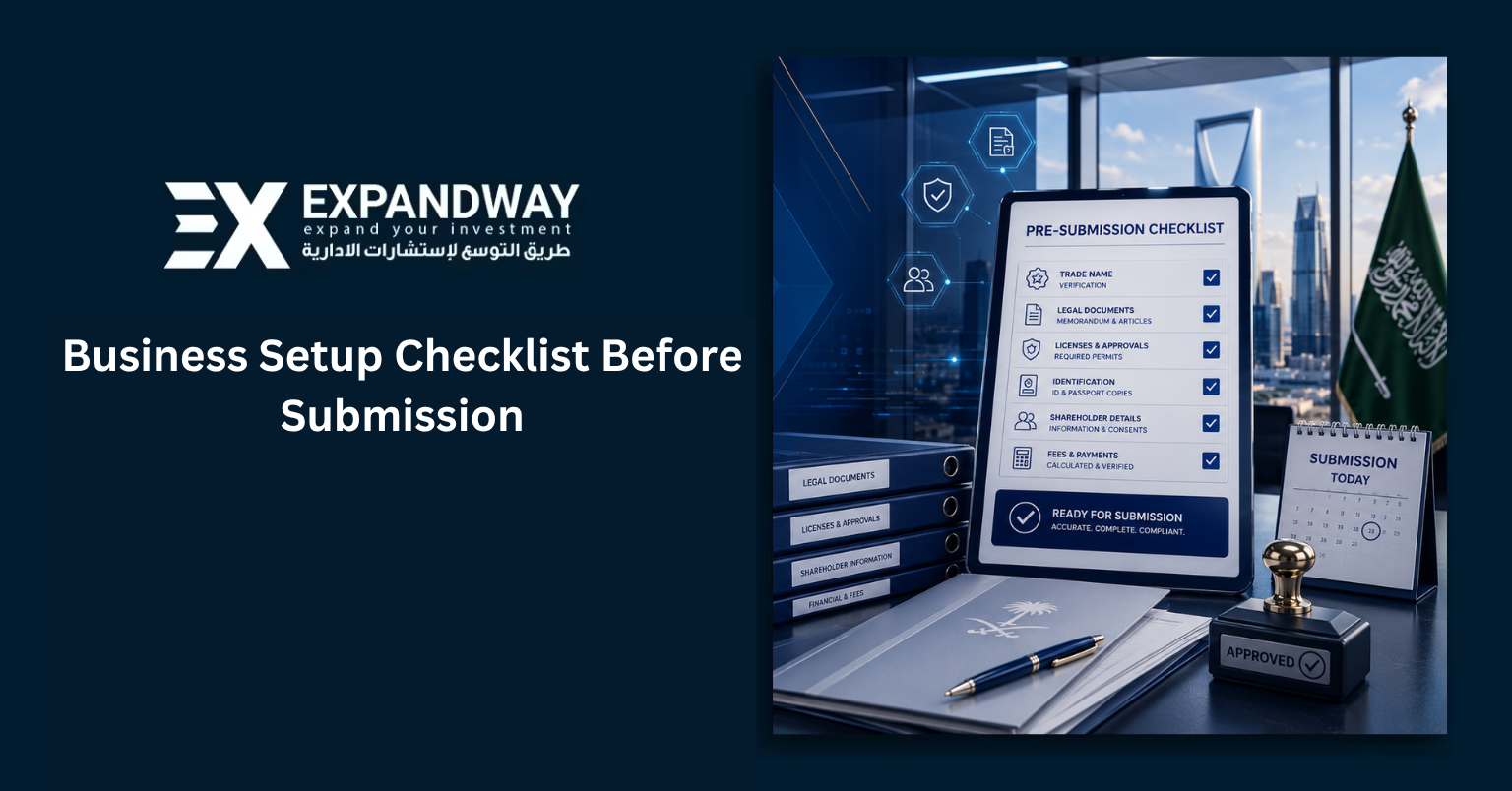
Business setup in Saudi Arabia rewards preparation. Get your pre-submission checklist right, and your MISA registration, commercial registration and licensing move quickly. Miss a step, however, and you invite costly rework, rejected applications and weeks of avoidable delay.
The stakes have rarely been higher. Saudi Arabia climbed to 13th place globally for foreign direct investment in 2025, attracting roughly $33 billion a 51% jump on the previous year as the Kingdom pursues its Vision 2030 goal of $100 billion in annual FDI by 2030. More investors mean tighter scrutiny at submission, so a clean, complete file is your fastest route through the gate.
This 2026 guide gives you a practical, pre-submission checklist for business setup in Saudi Arabia. Follow it in order before you file with the Ministry of Investment (MISA), the Ministry of Commerce or a free-zone regulator, and you will submit with confidence.
- Why a pre-submission checklist matters for business setup in Saudi Arabia
- 1. Strategic and market validation
- 2. Business plan and financial readiness
- 3. Choose the right legal structure and entity
- 4. Name, branding, and IP checks
- 5. Licenses, permits, and regulatory mapping
- 6. Documentation pack ready for submission
- 7. Financial and operational infrastructure
- 8. Internal approvals and risk checks
- Quick pre-submission sanity check
- The complete business setup in Saudi Arabia checklist (at a glance)
- How long does business setup in Saudi Arabia take?
- Get your Saudi business setup right the first time
Why a pre-submission checklist matters for business setup in Saudi Arabia
Every rejected application costs you time, money and momentum. Authorities expect a matching, internally consistent file: names, activity codes, capital figures and signatures must line up across every document. A single mismatch can send your application back to the queue.
The rules also changed recently. Saudi Arabia’s New Investment Law took effect in February 2025, replacing the old foreign investment “license” with a simpler MISA registration and granting foreign and Saudi investors broadly equal treatment. As a result, the entry process is faster but the compliance expectations at and after submission are sharper than ever.
In short, preparation is protection. Work through the eight sections below, tick every box, then run the final sanity check before you hit “submit.”
1. Strategic and market validation
Before any paperwork, confirm that the opportunity is real. Regulators and banks increasingly expect evidence that you understand the market you are entering.
- Validate your business idea with research on target customers, competitors and genuine demand in the Kingdom.
- Define a clear value proposition and explain how you will differentiate in the Saudi market.
- Decide whether you will operate full-time or part-time, and align partners or investors on roles, capital and expectations.
Above all, tie your plan to Vision 2030 priorities where you can. Activities in technology, manufacturing, tourism, logistics and healthcare often attract stronger institutional support.
2. Business plan and financial readiness
A concise, credible business plan does double duty: it guides your launch and satisfies reviewers. Therefore, prepare it before you file, not after.
- Draft a plan covering your business model, go-to-market strategy, operations plan and 12–24 month financial projections.
- Outline start-up capital needs and funding sources, including equity, debt, grants and Vision 2030 incentives.
- Build a basic budget and cash-flow forecast that shows you can sustain operations until revenue arrives.
Because banks and MISA both look at financial substance, realistic numbers matter more than optimistic ones.
3. Choose the right legal structure and entity
Your legal structure shapes your liability, tax position, ownership rights and setup timeline. Consequently, this is one of the most important decisions you will make.
Common options for business setup in Saudi Arabia include a limited liability company (LLC), a branch of a foreign company, a subsidiary, a sole establishment, or a regional headquarters (RHQ). For a side-by-side view, see our guide to LLC vs branch vs subsidiary in Saudi Arabia and how to choose the right legal structure.
Additionally, decide on your fiscal year-end and accounting method (cash vs accrual) early, so your setup aligns with group reporting and tax planning from day one.
Foreign ownership and sector rules
Saudi Arabia now allows 100% foreign ownership across most activities — a major draw for international investors. However, a handful of sectors still require a Saudi partner or special approvals, and some remain reserved for nationals. Confirm your activity’s status before you commit. Our explainer on 100% foreign ownership in Saudi Arabia breaks down where the limits still apply.
The RHQ advantage for multinationals
If you are a large group, weigh the Regional Headquarters (RHQ) program. It offers a 0% corporate income tax and 0% withholding tax rate on approved RHQ activities for 30 years, plus a 10-year Saudization exemption. Importantly, since 1 January 2024, foreign companies generally need an RHQ in the Kingdom to win most government contracts.
4. Name, branding, and IP checks
Your company name must be reserved and consistent everywhere. Reviewers reject files where the reserved name and the documents disagree, so lock this down first.
- Shortlist 2–3 name options and check availability in the Ministry of Commerce name reservation system.
- Search existing trademarks and similar names to avoid conflicts before filing.
- Secure your domain name and core social media handles early, before someone else does.
5. Licenses, permits, and regulatory mapping
Map every approval your activity needs then sequence them. Missing a sector approval is one of the most common causes of delay.
- Identify all required licenses: the MISA investment registration, commercial registration (CR) from the Ministry of Commerce, a municipal “Balady” license, and any sector approvals from bodies such as the CST (formerly CITC), SFDA or SAMA.
- Map pre-conditions that authorities expect at submission, such as a feasibility study, lease agreement or technical approvals.
- Prepare a compliance calendar for post-licensing obligations so nothing slips after launch.
For the exact sequence and paperwork, our step-by-step guides to MISA registration for foreign investors and the commercial registration process walk you through each stage.
Map your post-licensing compliance early
Getting licensed is the start, not the finish. Build these 2026 obligations into your calendar now:
- ZATCA e-invoicing (FATOORAH): Phase 2 integration is rolling out in waves. Wave 24 requires businesses with VAT-taxable revenue above SAR 375,000 (in 2022, 2023 or 2024) to integrate with the Fatoora platform by 30 June 2026. Choose accounting software that is ZATCA-ready from day one.
- VAT: The standard rate is 15%, administered by ZATCA. Register once you cross the threshold. See our guide to VAT in Saudi Arabia.
- Saudization (Nitaqat): A new three-year cycle begins 16 April 2026. The Yellow band is gone, the counted minimum wage rises to SAR 4,000, and quotas now cover 269 professions — for example, 30% in engineering, 40% in accounting (rising to 70% by 2028) and 60% in sales from April 2026. Falling into the Red band blocks visas, iqama renewals and government contracts.
- GOSI and payroll: Register employees with GOSI and stay compliant with Wage Protection System (WPS) rules.
6. Documentation pack ready for submission
This is where most delays hide. Gather, and where needed notarize, apostille and translate your documents into Arabic before you start the online application.
- Passport copies and, if applicable, Saudi residency IDs of shareholders and directors.
- Proof of address and CVs of key managers.
- A board resolution or power of attorney authorizing your local representative.
- Parent company documents for branches and subsidiaries: certificate of incorporation, articles or memorandum, commercial register extract and audited financials.
- Draft Articles of Association (AoA) or a local service agent agreement, as required by your chosen structure.
- A lease agreement or proof of office space, if your activity or city requires it.
- Any sector-specific technical studies or NOC letters.
Because foreign documents must be legalized correctly, start this step early. Our guides to the parent company documents required for Saudi expansion and power of attorney requirements explain exactly what to prepare and how.
7. Financial and operational infrastructure
Once your entity is approved, you need the machinery to actually operate. Plan it now so you are ready to trade on day one.
- Decide your banking setup, including a local KSA bank account, multi-currency needs and any FX requirements.
- Select accounting software that integrates with ZATCA e-invoicing and supports Arabic/English reporting.
- Plan payroll and contractor onboarding, including GOSI registration and WPS compliance.
- Line up key advisors — local legal counsel, a tax/ZATCA advisor and a PRO or license facilitator — if you do not have in-house capacity.
8. Internal approvals and risk checks
Finally, secure your own house before you file. Institutional investors, in particular, need a documented internal trail.
- Obtain internal investment committee or board approval for the KSA entity and its budget.
- Run a basic risk assessment covering sanctions, anti-money-laundering (AML), reputational and sector-specific risks.
- Confirm your operating model: will the entity be managed locally or remotely, and what governance and reporting lines apply?
Quick pre-submission sanity check
Before you hit “submit” on any government portal, confirm the essentials:
- Your company name is reserved and matches exactly across all documents.
- All foreign documents are properly legalized — notarized, apostilled and translated where required.
- Your activity codes and license types align with your actual planned operations and investor-visa needs.
- You have a clear plan for post-licensing compliance across tax, labor and sector obligations.
The complete business setup in Saudi Arabia checklist (at a glance)
Use this consolidated checklist as your final scan before submission:
- ☐ Market validation and value proposition confirmed
- ☐ Business plan with 12–24 month projections ready
- ☐ Legal structure chosen (LLC, branch, subsidiary or RHQ)
- ☐ Foreign ownership and sector rules verified
- ☐ Company name reserved and trademark cleared
- ☐ All licenses and sector approvals mapped (MISA, CR, Balady, CST/SFDA/SAMA)
- ☐ Documents notarized, apostilled and translated
- ☐ Articles of Association / POA drafted and signed
- ☐ Office space or lease secured (if required)
- ☐ Banking, accounting (ZATCA-ready) and payroll planned
- ☐ Compliance calendar set (VAT, ZATCA e-invoicing, Nitaqat, GOSI)
- ☐ Internal board approval and risk assessment complete
How long does business setup in Saudi Arabia take?
With a complete file, most foreign investors complete company registration in roughly 3 to 8 weeks, depending on activity, structure and how quickly documents are legalized. A missing apostille or a mismatched name is what usually stretches that timeline. For a realistic view of both time and money, see our breakdowns of the company registration timeline and the business setup cost in Saudi Arabia.
Get your Saudi business setup right the first time
A strong pre-submission checklist is the difference between a smooth launch and a stalled one. Work through all eight sections, complete the at-a-glance checklist, and you dramatically cut your risk of rework, rejection and delay.
If you would rather hand the paperwork to specialists on the ground, Expandway manages the entire process — from company formation in Saudi Arabia for foreigners to licensing, tax registration and compliance.
Ready to start? Book a free consultation with Expandway and get a tailored, jurisdiction-specific submission checklist for your activity — with exact document lists and typical timelines.