
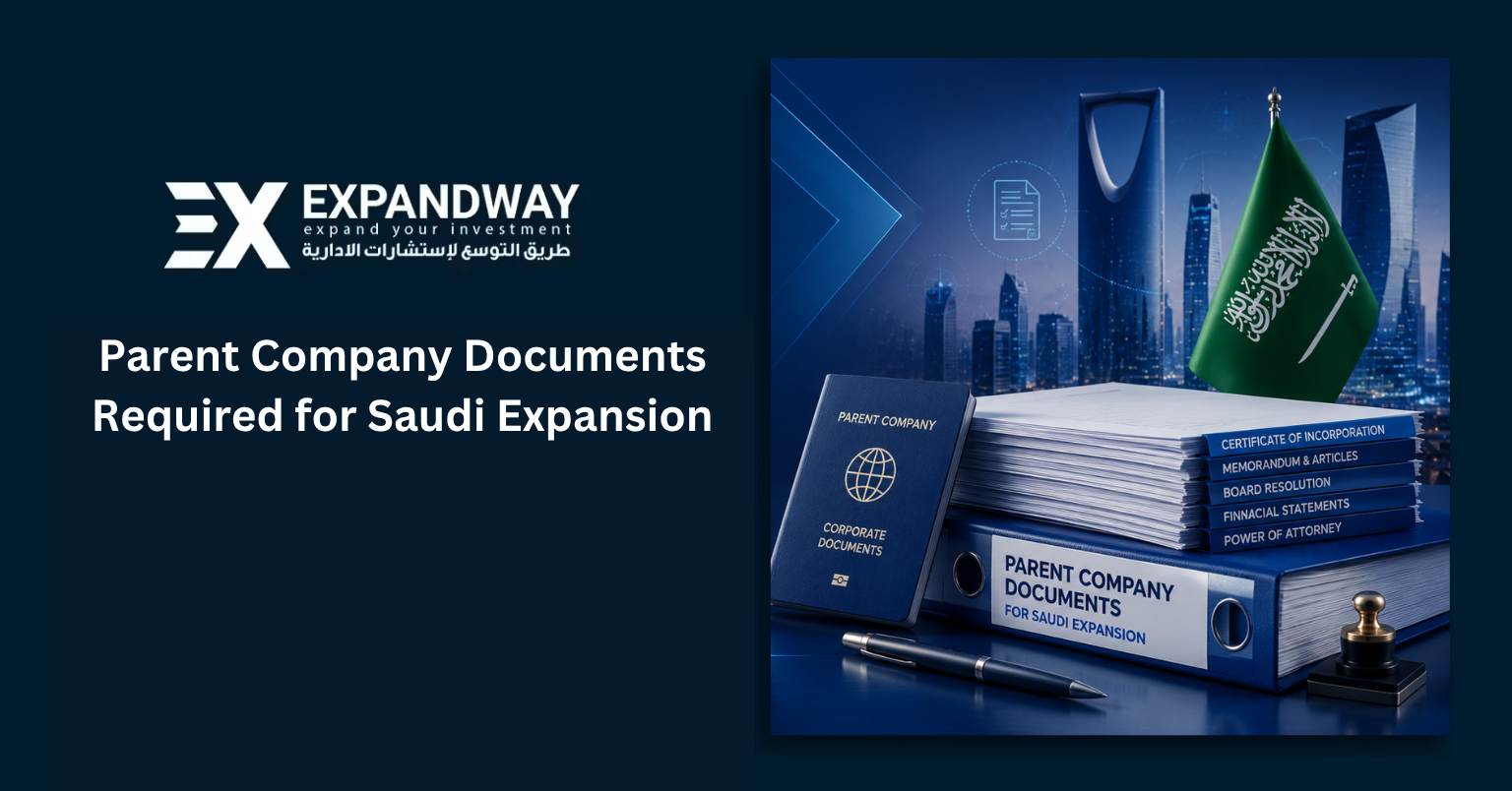
Expanding into Saudi Arabia starts with paperwork, not permits. Before you can open a subsidiary, branch, or regional headquarters, you must prepare a tightly defined set of parent company documents for Saudi expansion legalized, attested, and translated into Arabic. Get this pack right, and your registration with the Ministry of Investment (MISA) can clear in days. Get it wrong, and one mismatched date or missing stamp can stall your launch for weeks.
This 2026 checklist explains exactly which corporate documents Saudi authorities expect from your parent entity, how to legalize them, and where they fit in the MISA-to-Commercial-Registration (CR) timeline. Follow it closely, and you will avoid the most common cause of delay: incomplete or badly attested documents.
- What Counts as a "Parent Company" in a Saudi Expansion?
- Core Parent Company Documents for Saudi Expansion
- Branch vs Subsidiary: One Extra Document You Can't Skip
- Attestation & Arabic Translation Rules for Parent Company Documents
- How Parent Company Documents Fit the MISA → CR Workflow
- Optional Parent Company Documents for Complex Setups
- Common Mistakes That Delay MISA Registration
- Frequently Asked Questions
- Get Your Saudi Expansion Documents Right the First Time
What Counts as a “Parent Company” in a Saudi Expansion?
Your parent company is the foreign entity that will own the new Saudi business. In practice, that means the corporate shareholder behind a Saudi limited liability company (LLC), the head office behind a foreign branch, or the group that sponsors a Regional Headquarters (RHQ).
Because Saudi authorities are approving a foreign corporate investor, they need to see that the parent legally exists, is financially sound, and has formally authorized the expansion. That is why the parent-entity document pack sits at the heart of every foreign setup. If you are still deciding on a structure, review our guide to LLC vs branch vs subsidiary in Saudi Arabia before you gather documents, because the structure changes the exact list.
Core Parent Company Documents for Saudi Expansion
Below are the documents Saudi authorities typically require from the parent entity when you set up a subsidiary or branch. Prepare originals plus certified copies, because MISA and the Ministry of Commerce may each ask for their own set.
- Certificate of Incorporation / Registration — proof that the parent company legally exists in its home jurisdiction.
- Commercial Register Extract / Business License — the current registration or equivalent trade licence from the home country.
- Memorandum & Articles of Association (MOA/AOA) — the full constitutional documents showing shareholding, capital, objects, and management powers.
- Certificate of Good Standing — confirmation that the company is active and compliant in its home registry.
- Board Resolution approving the Saudi expansion — see the detail below.
- Power of Attorney (POA) / Authorization Letter — see the detail below.
- Audited Financial Statements — usually the last one to two fiscal years, proving financial capacity to operate in the Kingdom.
- Company Profile / Business Overview — a short description of activities, markets, and experience relevant to the proposed Saudi activity.
- Proof of Experience in the Proposed Activity — for example key contracts, client references, sector licences, or a portfolio summary. MISA often requests this.
Three of these documents cause the most confusion, so let’s break them down.
Board Resolution Approving the Saudi Expansion
A generic board minute will not pass. Your resolution must explicitly authorize three things: the establishment of the Saudi entity (LLC, branch, RHQ, or similar), the investment amount or capital commitment, and the appointment of the authorized signatory or signatories who will handle the Saudi filings. Name those people exactly as their passports read, because any spelling gap can trigger a rejection.
Power of Attorney (POA)
Because directors rarely fly in for every signature, a Power of Attorney lets a local representative or counsel act for the parent. A strong POA authorizes your representative to submit the MISA and CR applications, sign the Saudi Articles of Association, and handle government and bank formalities. For the exact wording and attestation route, see our detailed breakdown of Power of Attorney requirements for Saudi company formation.
Audited Financial Statements
MISA wants evidence that the parent can fund the venture. Therefore, prepare audited accounts for the last one to two fiscal years. Newer parent companies without a full audit history should speak to an advisor early, since alternative proof of capital may be accepted case by case.
Branch vs Subsidiary: One Extra Document You Can’t Skip
The list above covers most setups, but branch offices carry an added requirement. For a branch, the parent must also provide a parent company guarantee or undertaking that covers the branch’s liabilities in Saudi Arabia. A subsidiary (a separate Saudi legal entity such as an LLC) generally does not need this, because liability sits with the Saudi company itself. Weigh this difference carefully, and read our LLC setup guide for foreign investors if limited liability matters to your group.
Attestation & Arabic Translation Rules for Parent Company Documents
Saudi authorities are strict on document formalities. In fact, most delays come from the legalization chain rather than the documents themselves. Plan this sequence before you file with MISA:
- Notarization in the country of origin.
- Apostille if your country is a Hague Convention member, or consular legalization if it is not.
- Saudi Embassy or Consulate attestation in the origin country.
- Ministry of Foreign Affairs (MOFA) re-attestation in Saudi Arabia once the documents arrive. You can confirm current steps on the Saudi MOFA portal.
- Certified Arabic translation by a translator approved by the Saudi Ministry of Justice.
Practical Tips to Avoid Rejection
- Watch the six-month rule. Time your legalization so documents are no older than about six months when you submit them. Authorities routinely reject outdated corporate records.
- Order extra certified copies. MISA and the Ministry of Commerce may each request originals or certified duplicates, so build in a buffer.
- Match every detail. Company names, registration numbers, and activities must match exactly across passports, corporate documents, and applications. Even a small mismatch can cause clearance delays.
Because this chain can take longer than the government processing itself, start it as early as possible. Many foreign investors underestimate it, which is one of the common market entry mistakes we see every year.
How Parent Company Documents Fit the MISA → CR Workflow
Saudi Arabia streamlined foreign entry under a new Investment Law, which took effect on 11 August 2024, with Implementing Regulations issued on 7 February 2025. The headline change matters for your paperwork: the old per-sector “MISA licence” has largely given way to a single MISA registration that can cover multiple activities. In short, you register once as a foreign investor rather than buying a separate licence for each sector.
Here is where your parent-company documents come into play:
- MISA investment registration. Submit the legalized parent documents, audited financials, business plan, activity proof, passport copies, board resolution, and POA. Standard processing runs about three to five business days for non-regulated activities. Learn more in our guide to MISA registration for foreign investors.
- Commercial Registration (CR) with the Ministry of Commerce. Submit the MISA registration, the notarized Saudi Articles of Association, office lease or address proof, and shareholder or manager IDs. See the full Commercial Registration process.
- Post-registration compliance. Finally, complete registrations with ZATCA (tax and VAT), GOSI (social insurance), the municipality licence, the Chamber of Commerce, and your corporate bank account. If you are unsure what you will owe, read our comparison of zakat vs corporate tax in Saudi Arabia.
In practice, the parent-company document pack is consumed mainly at the MISA stage. After that, you reference the same documents again for CR, banking, and any sector licences — another reason to keep certified copies on hand.
Optional Parent Company Documents for Complex Setups
Depending on your structure and sector, you may also prepare a few extras. These are not always mandatory, but they often remove friction:
- Group structure chart showing the ultimate beneficial owners (UBOs).
- KYC/AML documentation for UBOs, especially in financial, fintech, RHQ, or other regulated sectors.
- Tax residency certificates, if relevant for treaty planning or specific incentives.
- Internal policies for RHQ or regional-management setups, to support MISA’s “regional headquarters” criteria.
If your target activity is regulated think fintech, healthcare, or defense-adjacent work assume the reviewer will ask for more, not less.
Common Mistakes That Delay MISA Registration
Even well-prepared companies trip over the same issues. Avoid these, and you protect your timeline:
- Expired attestations. Documents legalized too early breach the six-month window.
- Name and number mismatches between the parent’s records and the Saudi application.
- Missing certified Arabic translations, or translations from a non-approved translator.
- A weak board resolution that fails to authorize the signatory, capital, or entity type.
- Too few certified copies, which forces a second attestation round.
Want a realistic view of timing and budget? Compare our breakdowns of the company registration timeline and the business setup cost in Saudi Arabia.
Frequently Asked Questions
What documents does a parent company need for Saudi expansion?
At minimum: a Certificate of Incorporation, commercial register extract, MOA/AOA, certificate of good standing, a board resolution approving the expansion, a Power of Attorney, audited financial statements, a company profile, and proof of experience. Branches also need a parent company guarantee.
Do parent company documents need to be translated into Arabic?
Yes. Every corporate document submitted to MISA or the Ministry of Commerce needs a certified Arabic translation from a Saudi Ministry of Justice–approved translator, on top of full legalization.
How long are attested documents valid in Saudi Arabia?
Plan for a validity window of about six months. Authorities may reject corporate records that are older than roughly six months at the time of submission, so schedule attestation close to your filing date.
Do I still need a MISA licence in 2026?
Under the new Investment Law, foreign investors now complete a MISA registration rather than buying a separate licence for each sector. A single registration can cover multiple activities. Check the current requirements in our MISA license requirements guide.
How long does MISA registration take?
For non-regulated activities, MISA registration typically takes about three to five business days once your documents are complete and correctly legalized. Regulated sectors take longer.
Get Your Saudi Expansion Documents Right the First Time
The parent company documents for Saudi expansion are not complicated on their own — the difficulty is sequencing the legalization, translation, and filing so nothing expires or contradicts. When the pack is clean, MISA registration and CR move quickly. When it is not, you lose weeks.
Expandway handles this end to end. Our Riyadh-based team reviews your parent-company pack, manages notarization, apostille, embassy, and MOFA attestation, arranges approved Arabic translations, and files your MISA registration and Commercial Registration for you.
Ready to move? Book a consultation with Expandway or call +966 55 746 3554, and we will turn your document checklist into a live Saudi entity the right way, the first time.