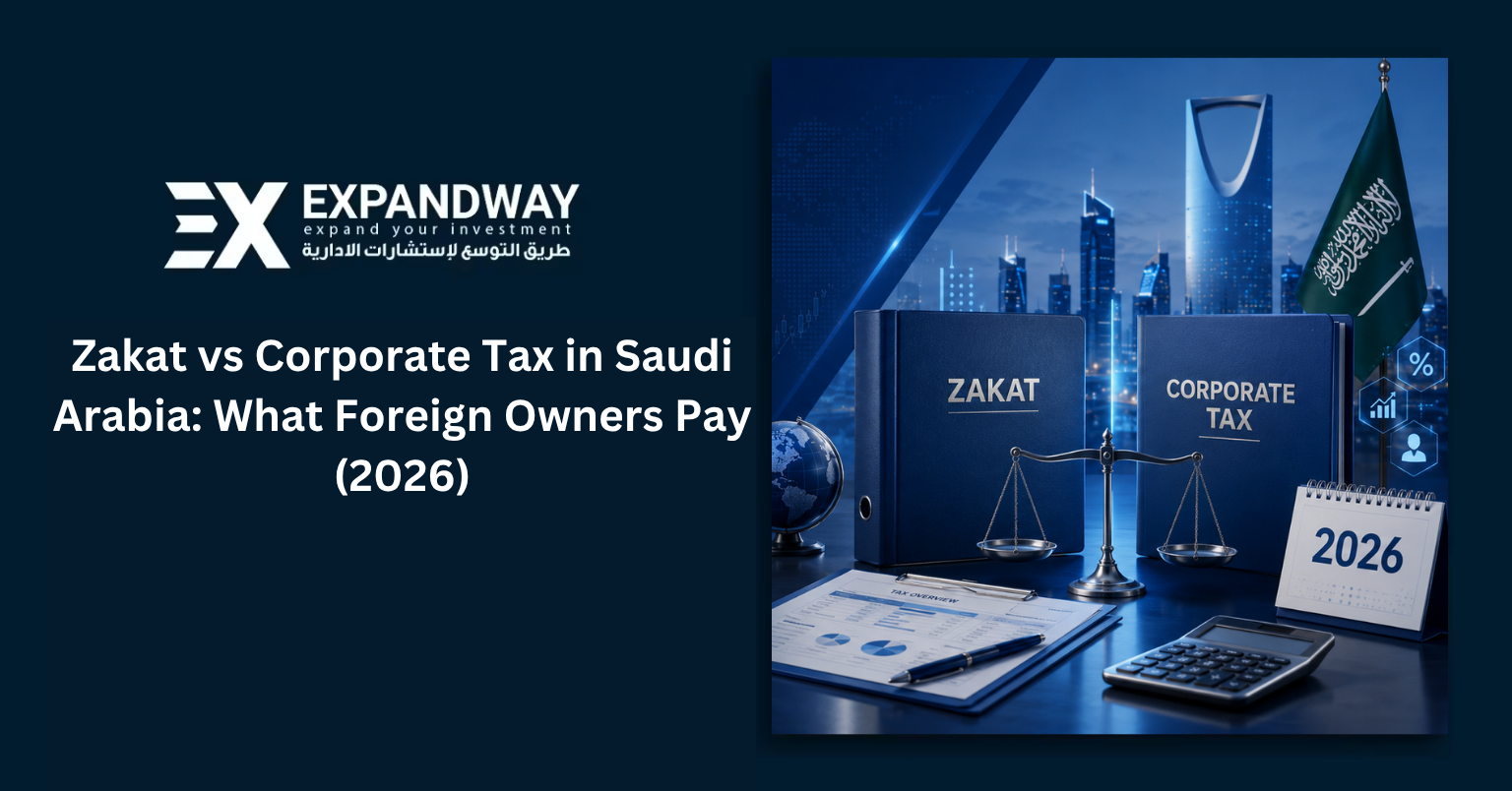
Whether you pay zakat vs corporate tax in Saudi Arabia depends on one thing: who owns the company. Saudi and GCC shareholders pay zakat at 2.5% of their share of the company’s net worth. Foreign (non-GCC) shareholders pay corporate income tax at 20% of their share of adjusted profit. Most foreign-owned businesses pay one, the other, or a blend of both and all of it is administered by ZATCA, the Zakat, Tax and Customs Authority.
This guide covers who pays which, how each is calculated, a worked example, and how filing works in 2026.
- Who pays zakat vs corporate tax in Saudi Arabia?
- How corporate tax in Saudi Arabia is calculated
- How zakat calculation works
- Worked example: a mixed-ownership company
- Tax for foreign companies in KSA: what differs by owner country
- Filing zakat and corporate tax with ZATCA
- Get your Saudi tax position right with Expandway
- Frequently asked questions
Who pays zakat vs corporate tax in Saudi Arabia?
Saudi Arabia doesn’t tax company profits the way most countries do. It runs two parallel systems, and your ownership decides which applies:
- Zakat (2.5%) a religious wealth levy paid by Saudi and GCC nationals, and by the share of a company they own.
- Corporate income tax (20%) paid on the profit share attributable to non-GCC foreign owners.
Because the split follows ownership, three situations are common:
| Ownership | What the company pays |
|---|---|
| 100% Saudi or GCC-owned | Zakat only 2.5% of the zakat base |
| 100% foreign (non-GCC) owned | Corporate income tax only 20% of adjusted profit |
| Mixed Saudi/GCC and foreign | Both zakat on the Saudi/GCC share, 20% tax on the foreign share |
One point trips people up: GCC ownership counts as Saudi here. A company owned by nationals of the UAE, Bahrain, Kuwait, Oman or Qatar is treated as a zakat payer, not an income-tax payer. What matters is the nationality of the ultimate owners not where a holding company is registered.
Certain sectors are taxed differently: oil and hydrocarbon producers pay 50%–85%, while natural gas activity falls under the standard 20%. Those special rates sit outside this guide; confirm your activity’s treatment with ZATCA or Expandway.
How corporate tax in Saudi Arabia is calculated
Corporate tax in Saudi Arabia is a flat 20% on net adjusted profit your accounting profit after ZATCA’s add-backs and allowed deductions. It applies only to the foreign-owned share of the company.
Deductible costs generally include:
- Salaries, rent, utilities and ordinary operating expenses
- Depreciation of business assets at set rates
- Cost of goods sold and documented professional fees
Non-deductible items include most provisions, fines, and costs that aren’t properly documented or business-related. What’s left is your tax base; multiply the foreign share of it by 20%.
Two extra layers often apply to foreign owners:
- Withholding tax on remittances. When after-tax profit leaves the Kingdom as a dividend to a non-resident shareholder, a 5% withholding tax usually applies. Interest is also 5%, royalties 15%, and some service fees 5%–20%. A tax treaty can reduce these.
- Transfer pricing. Dealings with related companies abroad must be at arm’s length and documented.
For a fuller walkthrough, see Expandway’s guide to Saudi corporate tax for foreign companies.
How zakat calculation works
Here is the key difference: zakat is not a tax on profit. Zakat calculation is based on the zakat base a measure of the company’s net worth, or the capital it has tied up in the business across the year.
In plain terms, the zakat base starts from equity and adjusted profit, adds items such as retained earnings, reserves and certain long-term liabilities, then subtracts things like net fixed assets and qualifying long-term investments. The base is floored against adjusted profit and can’t exceed adjusted year-end equity, so it rarely equals your bookkeeping profit.
You then apply the zakat rate to the Saudi/GCC share of that base:
- 2.5% if the company reports on the Hijri (lunar) year.
- About 2.577% if it reports on the Gregorian (365-day) year, because the rate is scaled up for the extra days.
Since the base reflects net worth rather than profit, a capital-heavy but low-profit company can still owe meaningful zakat a good reason to have the base calculated properly rather than estimated.
Worked example: a mixed-ownership company
Say a Riyadh LLC is 70% owned by a foreign investor and 30% owned by a Saudi partner, and it reports SAR 1,000,000 of net adjusted profit for the year.
Corporate income tax (foreign 70% share)
- Taxable profit share = 70% × SAR 1,000,000 = SAR 700,000
- Tax at 20% = SAR 140,000
Zakat (Saudi 30% share)
- Zakat is charged on the zakat base, not profit. Assume the Saudi partner’s share of the zakat base is SAR 300,000 (their share of the company’s net worth).
- Zakat at 2.5% = SAR 7,500
Total to ZATCA for the year: SAR 147,500, reported through one filing that carries both the taxable share and the zakat share.
If the foreign investor then sends their after-tax profit home, a 5% dividend withholding tax may apply on top — unless a treaty reduces it. The zakat base above is an illustration; your real base depends on the balance sheet, so confirm the figures with ZATCA or Expandway.
Tax for foreign companies in KSA: what differs by owner country
The 20%-versus-2.5% split is the same for everyone. But tax for foreign companies in KSA changes in the details mainly ownership treatment and how much of a dividend survives the trip home.
For UAE and other GCC companies. If your Saudi company is owned by GCC nationals, you are a zakat payer at 2.5%, not a 20% income-tax payer a real saving. But the relief follows nationality, not your trade licence: a UAE-registered company owned by non-GCC individuals is still treated as foreign. Fix the ownership structure before assuming you qualify.
For US companies. There is no double-tax treaty between Saudi Arabia and the United States. US owners pay the full 20% on their share and the standard 5% dividend withholding with no treaty reduction, and the same profit is reportable in the US (foreign tax credits usually prevent full double taxation). Plan both systems together.
For Indian investors. India and Saudi Arabia have a double-tax treaty, so withholding on dividends, interest or royalties sent to India may be reduced apply the treaty rate up front rather than chasing a refund. Your share of Saudi profit is still taxed at 20%, and India taxes global income with credit for Saudi tax paid.
For Pakistani nationals. Pakistan also has a treaty with Saudi Arabia, giving similar potential relief on withholding when profits are remitted home. The 20% corporate tax on the foreign share is unchanged; the treaty mainly helps at the remittance stage.
Filing zakat and corporate tax with ZATCA
Both taxes run through ZATCA on a self-assessment basis, and the calendar is the same:
- File within 120 days of your fiscal year-end, together with audited financial statements.
- Pay by the same deadline. Larger taxpayers also make advance payments in three instalments (in months 6, 9 and 12), each 25% of last year’s tax after withholding not required where that amount is under SAR 500,000.
- Late payment carries a penalty of 1% for every 30 days overdue, and other breaches can reach 25% of the tax due. Confirm any specific figure with ZATCA.
A mixed-ownership company files one return covering both the taxable share and the zakat share so clean shareholder records and a correctly built zakat base matter as much as the profit figure itself.
Get your Saudi tax position right with Expandway
Zakat vs corporate tax in Saudi Arabia looks simple as two headline rates 2.5% and 20% but the money is in the detail: splitting a mixed-ownership base correctly, building the zakat base, applying treaty relief on dividends, and filing on time. Expandway’s corporate services in Saudi Arabia team handles zakat and tax registration, calculation and ZATCA filing from end to end. Book a free consultation with Expandway and we’ll map your exact position well before your first return is due.
Frequently asked questions
Do foreign-owned companies pay zakat or corporate tax in Saudi Arabia?
Foreign (non-GCC) owners pay corporate income tax at 20% on their share of profit, not zakat. Zakat at 2.5% applies to the Saudi and GCC-owned share. A mixed company pays both, split by ownership.
What is the corporate tax rate in Saudi Arabia in 2026?
The standard corporate income tax rate is 20% of net adjusted profit on the foreign-owned share. Oil and hydrocarbon producers pay 50%–85%; natural gas activity is taxed at the standard 20%. VAT (15%) and zakat are separate charges.
How is zakat calculated for companies?
Zakat is 2.5% of the zakat base a net-worth figure built from equity, profit and certain liabilities, less fixed assets and long-term investments for a Hijri year, or about 2.577% for a Gregorian year. It is not simply a percentage of profit.
Are GCC and UAE owners treated as foreign for Saudi tax?
No. GCC nationals including UAE, Bahrain, Kuwait, Oman and Qatar are treated like Saudis and pay zakat at 2.5%, not the 20% corporate tax. Treatment follows the owners’ nationality, not the company’s country of registration.
When are zakat and corporate tax returns due in Saudi Arabia?
Both are filed with ZATCA within 120 days of the company’s fiscal year-end, alongside audited financial statements. Larger taxpayers also make three advance payments during the year.
Is there withholding tax when foreign owners take profits out?
Yes. Dividends to non-residents usually carry 5% withholding tax, interest 5%, royalties 15%, and some services 5%–20%. A double-tax treaty for example with India, Pakistan or the UAE can reduce these; the US has no treaty with Saudi Arabia.