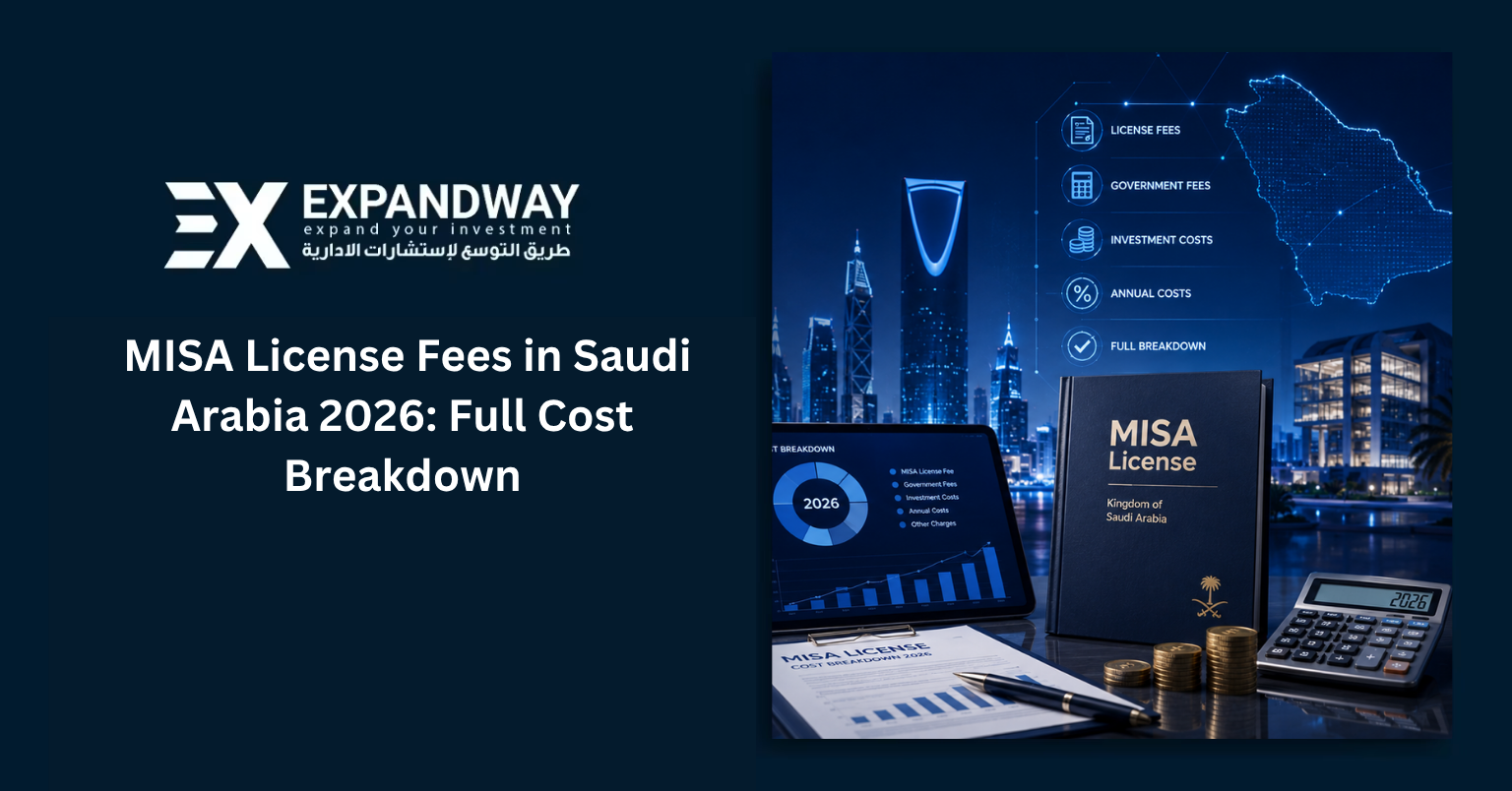
MISA license fees in Saudi Arabia are far lower in 2026 than most investors expect. Since the new Investment Law replaced the old foreign-investment licence with a simple MISA registration, the Ministry of Investment’s standalone government fee is currently waived for most investors — so many pay little or nothing to MISA itself to register. The real cost of setup sits in the steps around it: commercial registration, chamber membership, an office and visas. This guide breaks down the fees, renewals and hidden costs so you can budget your Saudi entry with confidence.
Many advisors and banks still say “MISA licence”; we use “licence” and “registration” interchangeably below — they mean the same permission to invest.
- MISA license fees at a glance (2026)
- What changed: from MISA licence to investment registration
- MISA license fees by licence type
- MISA renewal fees (and the new annual update)
- The hidden costs most investors miss
- How to pay MISA fees
- What differs by country
- Plan your Saudi setup with Expandway
- Frequently asked questions
MISA license fees at a glance (2026)
- MISA government fee: currently waived / suspended for most investors. Many pay SAR 0 to MISA to register right now. Confirm current status with MISA or Expandway before you budget.
- Historical fee (for reference, and what it may return to): about SAR 2,000 to issue the licence, plus an annual subscription that sources have cited from roughly SAR 10,000 up to SAR 62,000, depending on category and year.
- Renewal / annual update: free while the waiver applies; you still confirm your registration data with MISA each year.
- Everything else (the real spend): commercial registration, chamber, municipality, translation, office and visas — plan for roughly SAR 15,000–45,000+ in the first year on top of any minimum capital and professional fees.
Investor licence fees in Saudi Arabia used to be a genuine line item. Today the MISA licence cost in 2026 is mostly about the registrations around MISA, not the MISA fee itself.
What changed: from MISA licence to investment registration
The Investment Law (Royal Decree M/19) and its Implementing Regulations took effect in February 2025 and reshaped how foreigners enter the market. Three points matter for your budget:
- Licence became registration. Instead of a separate sector licence for each activity, you now hold one MISA registration that can cover activities across several sectors.
- Equal treatment. Foreign investors are treated the same as Saudi investors. Because Saudi nationals never paid the old foreign-investor licence fees, aligning the two is a big reason the MISA fee is currently waived.
- Annual update, not just renewal. You keep your registration valid by updating your details with MISA each year, rather than re-buying a licence.
None of this removes the other government registrations you still need, which is where the actual costs live.
MISA license fees by licence type
Under the new system, the MISA government fee is the same — currently waived — across the main categories. What really differs by licence type is the minimum capital you must put into the business (that is money you keep, not a fee) and the sector rules. Use this table for planning and confirm the current figures with MISA or Expandway.
| Licence / registration type | MISA government fee (2026) | Typical minimum capital | Notes |
|---|---|---|---|
| Service / professional | Currently waived (historically ~SAR 2,000 + subscription) | Usually none in most services | The most common route for consultancies and agencies |
| Industrial / manufacturing | Currently waived | Often ~SAR 1,000,000 (by project) | Reduced work-permit fees for industrial staff |
| Trading / commercial (100% foreign) | Currently waived | ~SAR 30,000,000 + commitments | High bar; many retailers add a Saudi partner instead |
| Entrepreneurial (Riyadi / startup) | Currently waived | None | Needs backing from an approved incubator or accelerator |
| Real estate | Currently waived | Large project thresholds apply | Regulated by REGA; Makkah and Madinah rights are restricted |
| Regional Headquarters (RHQ) | Currently waived | None | 30-year tax relief; often required to win government contracts |
Two reminders. First, minimum capital is working capital that stays in your company, not a payment to the government. Second, some sectors add a regulator’s own fee later — for example the SFDA for food, medical or cosmetics activities, or the Saudi Central Bank for finance — so factor those in for regulated fields.
MISA renewal fees (and the new annual update)
MISA renewal fees follow the same logic as the issuance fee: while the waiver is in place, renewing your registration is generally free. You still have a yearly obligation to confirm and update your investor details with MISA to keep the registration active, and you renew before it lapses so your Commercial Registration, bank account and visas are not disrupted.
If the government reintroduces a fee, expect renewal to mirror the annual subscription rather than the small one-off issuance charge. Because the policy can change, treat “SAR 0 renewal” as a current benefit, not a permanent rule, and confirm the live position with the authority or Expandway each year.
The hidden costs most investors miss
The MISA fee is rarely the number that surprises people. These surrounding costs are, and most are far more stable than the MISA fee itself. Figures are indicative for 2026 — confirm current amounts before you commit.
| Cost | Authority / provider | Indicative (SAR) |
|---|---|---|
| Commercial Registration + Articles + publication | Ministry of Commerce | ~1,700–2,500 total (CR ~200; establishment ~1,200 +VAT; publication ~500 +VAT) |
| Chamber of Commerce membership | Chamber of Commerce | ~1,600–10,000/year, by category |
| Municipality (Baladiya) permit | Municipality | ~1,000–10,000, by activity and premises |
| Notarising Articles + certified Arabic translation | Notary + translators | ~100–300 per document / page |
| GOSI + ZATCA (VAT) registration | GOSI / ZATCA | Free to register |
| National Address | Saudi Post | Nominal |
| Office / premises | Landlord | Virtual ~5,000–25,000/year; physical much higher |
| Investor + staff visas and Iqama | MISA / Jawazat | ~10,000–15,000 per person, first year |
| Work-permit levy per expat | Ministry of Human Resources | ~800–900/month (industrial roles reduced) |
| Government portals (Qiwa, Muqeem, Absher Business) | Various | ~2,000–4,000/year |
| Professional setup fee | Consultant (e.g. Expandway) | ~USD 5,500–10,000+, by scope |
A note on the Commercial Registration: the 2025 Commercial Register Law modernised it into a single national CR and replaced the old annual renewal with a yearly data confirmation. It is issued by the Ministry of Commerce and is what you need before opening a bank account, hiring or signing contracts. You can sanity-check your own numbers with Expandway’s cost calculator.
After you are trading, the running taxes are simple: 20% corporate income tax on the foreign-owned profit share, 2.5% Zakat on the Saudi or GCC share, and 15% VAT once turnover passes SAR 375,000, all administered by ZATCA.
How to pay MISA fees
Payment is fully digital, so you rarely visit a counter.
- MISA portal. You apply and manage your registration on MISA’s investor portal. When a fee applies, MISA issues an electronic invoice with a SADAD bill number.
- SADAD. You pay that bill number through Saudi online or mobile banking, usually within about 30 days of the invoice. SADAD is the national bill-payment system, so any local business account can settle it.
- Ministry of Commerce and others. CR, chamber and municipality fees are billed the same way through their own portals and paid via SADAD. Your consultant or General Manager can action these on your behalf with a Power of Attorney.
Keep every SADAD receipt. Banks and regulators sometimes ask for proof of payment when you open accounts or renew.
What differs by country
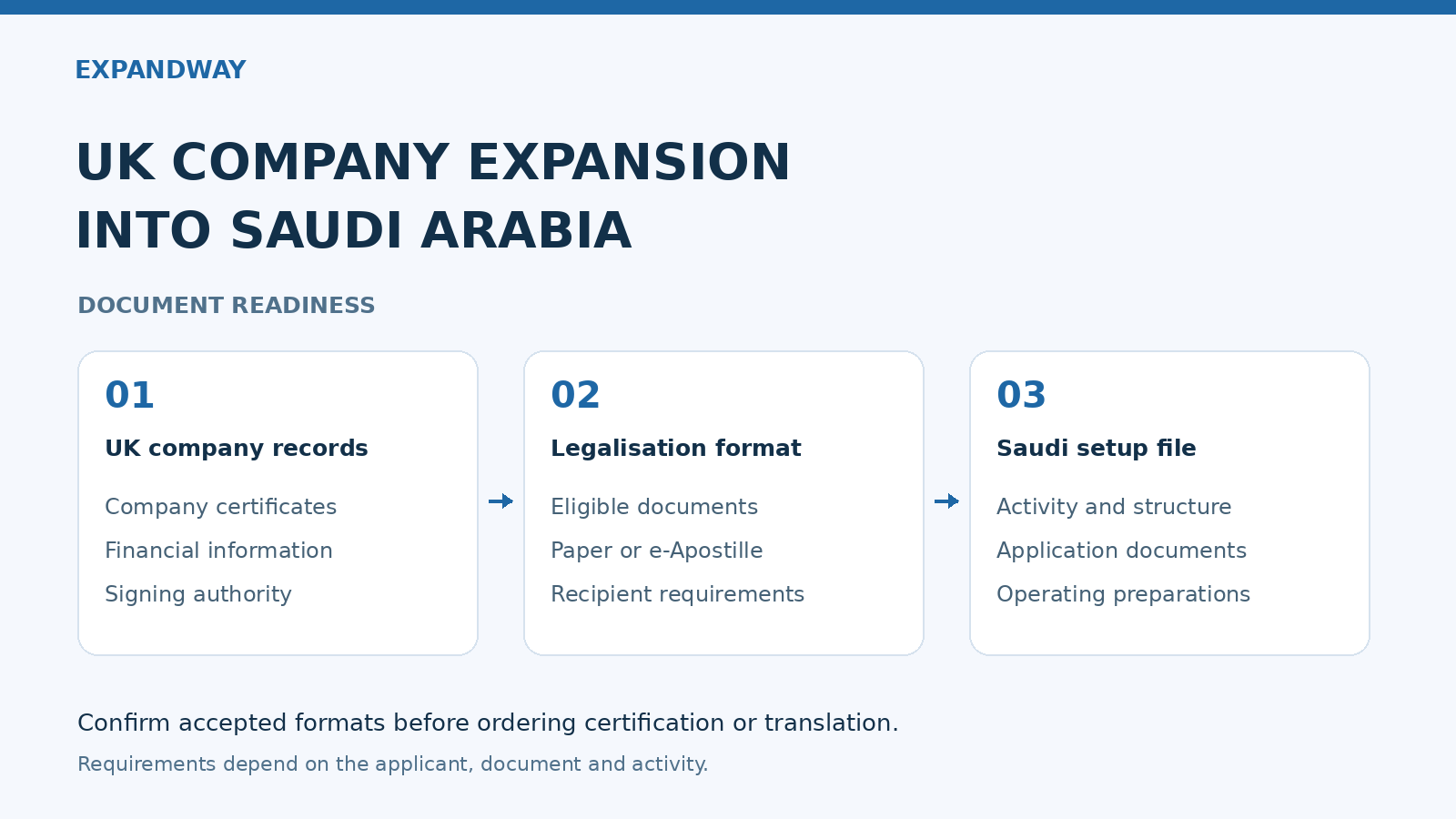
The MISA fee is the same wherever you are from. What changes by nationality is document attestation, the visa route and how you move money home. For the full picture, see Expandway’s guide to business setup in Saudi Arabia.
For US companies
US firms can usually legalise documents by apostille, the fastest route, and hold 100% ownership. There is no US–Saudi tax treaty, and US persons still report worldwide income (for example, Form 5471 for a controlled foreign corporation), so plan your US filings early. Saudi Arabia has no exchange controls, so profits and capital move out freely.
For UAE-based companies
GCC ownership is an advantage: a UAE (GCC-owned) company is often treated like a Saudi one for tax, meaning Zakat rather than corporate income tax on that share. Apostille is quick, existing audited accounts usually satisfy MISA, and capital moves freely across the GCC.
For Indian investors
Indian investors get full ownership. Confirm your attestation route early — although both countries use the apostille system, Saudi missions sometimes still expect additional consular steps, so check the current requirement before you courier originals. Outbound investment is remitted under RBI/FEMA rules (the ODI route for companies, LRS for individuals).
For Pakistani nationals
Pakistani nationals also own 100%. Documents commonly still go through the Saudi embassy/consular chain, so confirm the live route before you legalise them. Moving investment capital out of Pakistan needs State Bank of Pakistan clearance, which is worth starting well before you plan to fund the company.
Plan your Saudi setup with Expandway
MISA fees are the easy part in 2026. The two things that actually move your budget and timeline are picking the right registration category and getting your documents attested and translated correctly the first time. Book a free consultation with Expandway and we will map your activity, capital and costs — and if you want the background on the permission itself, read our MISA licence explained guide.
Frequently asked questions
How much are MISA license fees in Saudi Arabia in 2026?
For most investors the MISA government fee is currently waived, so you often pay SAR 0 to MISA to register. Historically the licence cost around SAR 2,000 to issue plus an annual subscription. Because this is a policy waiver that can change, confirm the current figure with MISA or Expandway.
What are MISA renewal fees?
While the waiver applies, renewing your MISA registration is generally free; you simply update your investor details each year. If a fee returns, renewal would likely track the annual subscription rather than the small issuance charge. Renew before expiry so your CR, bank account and visas keep working.
Do MISA license fees vary by licence type?
The MISA government fee is currently the same — waived — across service, industrial, trading, entrepreneurial, real estate and RHQ registrations. What differs by type is the minimum capital you must inject and the sector rules, not the MISA fee.
What hidden costs come with a MISA licence?
Commercial registration, chamber of commerce, municipality permit, notarisation and Arabic translation, office space, visas and portal subscriptions. Together these usually run from about SAR 15,000 to SAR 45,000 or more in year one, separate from minimum capital and professional fees.
How do I pay MISA fees?
Through MISA’s investor portal. When a fee applies, MISA issues an electronic invoice with a SADAD number that you pay via online banking, usually within about 30 days. Ministry of Commerce, chamber and municipality fees are paid the same way.
Is the MISA fee waiver permanent?
No. It is a current incentive tied to Saudi Arabia’s drive to attract foreign investment, not a permanent zero. Budget as though a fee could return, and confirm the live position with the authority or Expandway each year.