How to start an IT company in Saudi Arabia comes down to three moves: register as a foreign investor with the Ministry of Investment (MISA), get your Commercial Registration (CR) from the Ministry of Commerce, then finish your tax and social-insurance registrations. Software, SaaS and IT-services firms can be 100% foreign-owned with no local partner, and a standard company is usually trading within four to eight weeks.
Saudi Arabia is pushing hard to become the region’s tech hub under Vision 2030, so the rules now favour founders who build here from cloud and cybersecurity to fintech, AI and enterprise software. Below is the practitioner detail on how to start an IT company in Saudi Arabia: your licence options, the startup-friendly entrepreneur licence, the real costs, and how hiring and Saudization work for a tech team.
How to start an IT company in Saudi Arabia: your licence options
Almost every foreign-owned tech business starts with a MISA investment registration (many advisers still call it the “MISA licence”). Your activity decides the category, and for software and IT that is usually the service category. A single entity can hold several activity codes, so you can combine, say, software development, cloud services and IT consulting under one licence.
| Route | Best for | Notes |
|---|---|---|
| MISA service licence | Software houses, SaaS, IT services, cybersecurity | The default; 100% foreign ownership, no local partner |
| Entrepreneur licence | Early-stage startups and solo founders | Lower capital bar; judged on the business, not just cash |
| Regional Headquarters (RHQ) | Multinationals basing their regional team in Riyadh | Tax incentives; needed to win larger government contracts |
| CST registration | Cloud, hosting and telecom-style providers | An extra layer on top of MISA for regulated digital services |
Your MISA registration unlocks the Commercial Registration from the Ministry of Commerce, which is the identity you need for a bank account, visas and contracts. After the CR you complete Chamber of Commerce membership, a National Address, tax registration with ZATCA, and social insurance with GOSI.
A pure software or SaaS company almost always needs only the MISA service licence and CR — think of it as your software company licence in Saudi Arabia. You only reach for a separate digital business licence in Saudi Arabia if you provide regulated services: cloud and hosting providers register with the Communications, Space & Technology Commission (CST) under its cloud framework, graded Class A (public data) up to Class C (up to top-secret data). If your model is AI, cloud or data-heavy, read our guide to AI and tech-startup digital licensing before you file, or ask Expandway to confirm whether CST applies to you.
The entrepreneur licence for a tech startup in KSA
If you are pre-revenue or still raising, the entrepreneur licence is often the smarter door in. Instead of holding you to the higher capital some routes expect, MISA weighs your business model, your team, and how scalable and innovative the product is — a good fit for a tech startup in KSA that is long on IP and short on paid-up capital.
Typical features:
- 100% foreign ownership, like the standard route
- A far lower capital barrier than a conventional commercial licence
- Usually supported by a recommendation from a MISA-recognised Saudi incubator, accelerator, university or venture-capital firm
- A pathway into Saudi VC funding, Monsha’at SME programmes and, later, regulated licences
The details here shift as the programme evolves, so confirm the current conditions — especially the support-letter rule — with MISA or Expandway. Our full guide to the entrepreneur licence in Saudi Arabia walks through eligibility and documents.
What it costs
Government fees are modest; your bigger lines are the annual MISA service subscription, a real office address, professional setup and Saudi payroll. Treat the figures below as 2026 planning ranges and confirm current numbers with each authority or Expandway.
| Item | Authority | Indicative (SAR) |
|---|---|---|
| MISA registration | MISA | ~2,000/year |
| MISA service subscription | MISA | Discounted in year one, higher after (confirm) |
| Commercial Registration | Ministry of Commerce | ~200–1,200 |
| Chamber + National Address | Chamber of Commerce | A few thousand |
| Professional setup fee | Consultant (e.g. Expandway) | ~USD 5,500–10,000+, by scope |
| Attestation + Arabic translation | Home country + MOFA | Varies by country |
Most service and software activities carry no statutory minimum capital, and the entrepreneur licence is built to keep that bar low — a sharp contrast with a 100% foreign-owned trading company, which can face a much higher threshold. Minimum capital, where it applies, is money you keep in the business, not a fee.
On tax, expect 20% corporate income tax on the foreign-owned profit share, 2.5% Zakat on any Saudi or GCC share, and 15% VAT once turnover passes SAR 375,000. If you pay software-licence or technical fees to a parent company abroad, Saudi withholding tax applies too — commonly 5% on technical services and up to 15% on royalties. Confirm the rates for your structure with ZATCA or Expandway.
Hiring and Saudization for IT companies
Every company in Saudi Arabia hires under Saudization (Nitaqat), which sets a target share of Saudi nationals by sector and company size and sorts you into bands. Sitting in the Green or Platinum band keeps your visas, work permits and government-contract eligibility flowing; dropping into Red freezes them — so this is a compliance line, not a nice-to-have.
A few 2026 points that matter for a tech team:
- The Ministry of Human Resources (MHRSD) now sets many rules profession by profession, not just company-wide. Engineering roles, for example, carry a 30% Saudi quota for establishments with five or more workers, with a minimum monthly salary around SAR 8,000.
- A Saudi employee generally must earn at least SAR 4,000 a month to count as a full head toward your target.
- From 15 April 2026, Saudi contracts must be documented in the Qiwa platform to count.
- Administrative and support roles are heavily Saudised, so plan those hires locally from day one.
The upside: Vision 2030 has built a real pipeline of Saudi tech talent, and salary-support programmes can offset part of the cost of hiring nationals. Fold a realistic Saudization plan into your first-year budget and it rarely becomes a problem.
Country notes
Ownership is 100% for tech founders almost everywhere. What really differs by market is document attestation and how you move money.
For US tech founders
You can own the company outright and usually legalise documents by apostille — the fastest route. Remember that US persons still report worldwide income (for example, Form 5471), there is no US–Saudi tax treaty, and encryption or security software may sit under US export-control rules, so check before you ship code or appliances. The entrepreneur licence suits US-based founders testing the market first.
For Indian tech founders
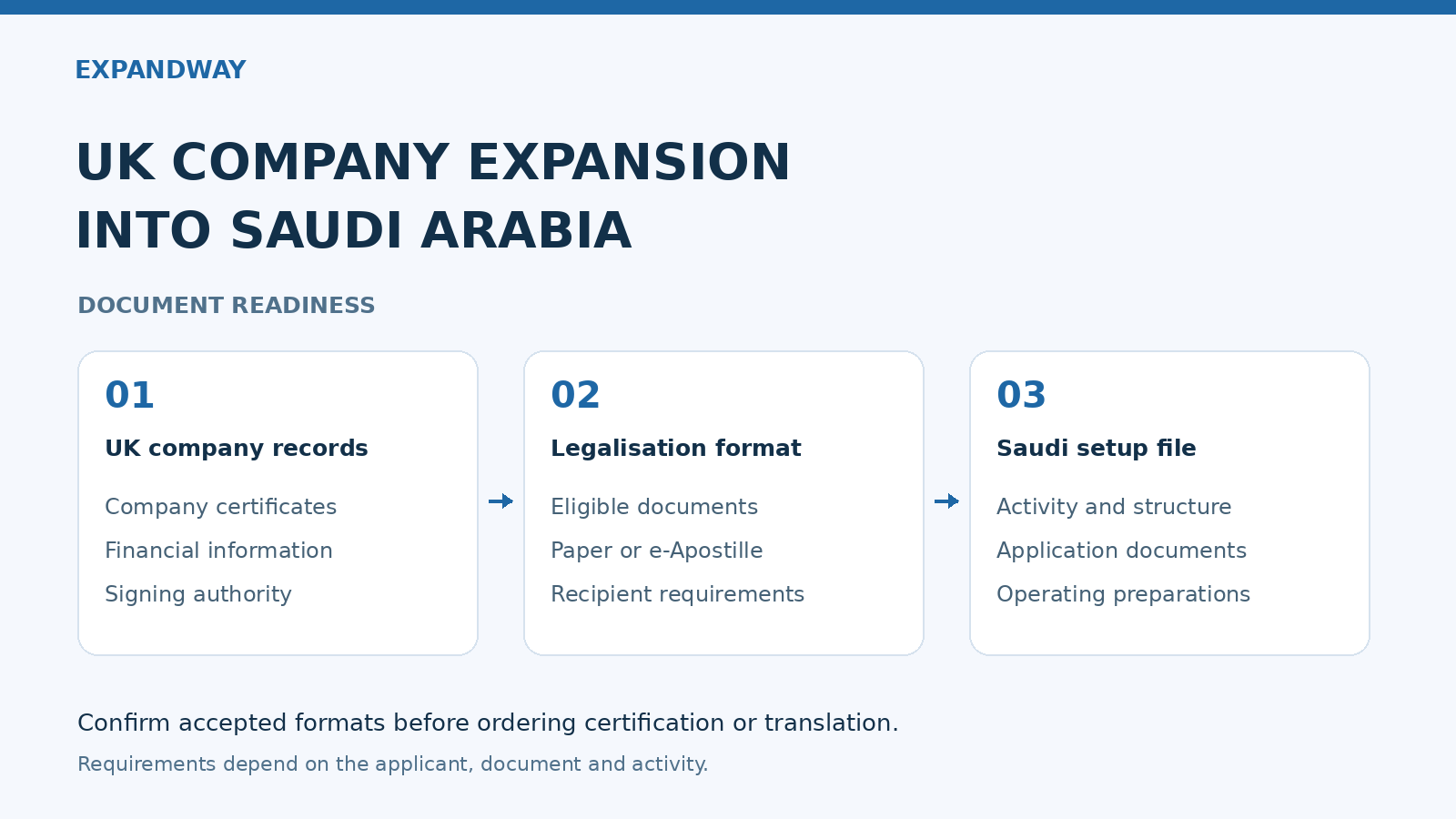
You get full ownership and can plug into the large Indian IT presence already serving Saudi clients. Remit capital under RBI/FEMA rules, usually the Overseas Direct Investment route. Your corporate documents generally still need embassy or consular attestation plus a certified Arabic translation — start this early, as it tends to drive the timeline.
For UAE-based SaaS companies
As a GCC-owned company you get national treatment: your GCC profit share is taxed as 2.5% Zakat rather than 20% corporate tax, and capital moves freely across the GCC. Attestation by apostille is quick, and many UAE groups expand through a Saudi branch. If your SaaS handles Saudi users’ data, factor in the Personal Data Protection Law (PDPL) and any data-residency rules before you launch.
Book a free consultation
Starting an IT or software company in Saudi Arabia is very doable in 2026 — the two things that trip founders up are choosing the wrong MISA category and underestimating Saudization. Expandway handles the whole path, from your first MISA registration to a licensed, hiring-ready company. Book a free consultation with Expandway and we will map your licence, costs and hiring plan before you commit.
Frequently asked questions
How do I start an IT company in Saudi Arabia?
Register as a foreign investor with MISA under the service category, get your Commercial Registration from the Ministry of Commerce, then complete Chamber, ZATCA (tax) and GOSI (social insurance) registrations. Software and IT firms can be 100% foreign-owned and are usually trading within four to eight weeks.
Can a foreigner own 100% of a software company in Saudi Arabia?
Yes. Software, SaaS and IT-services activities allow 100% foreign ownership through a MISA registration, with no local partner required in almost all cases.
Do I need a CST licence for a software company?
Usually not. A normal software or SaaS business needs only a MISA licence and CR. CST registration applies to cloud, hosting and telecom-style providers; confirm your specific activity with CST or Expandway.
What is the entrepreneur licence?
It is a MISA route built for startups and solo founders that judges your business model rather than demanding high capital. It keeps 100% ownership and is often backed by a recommendation from a recognised Saudi incubator, accelerator, university or VC.
How much does it cost to start a tech company in Saudi Arabia?
Government fees are low, but budget for the annual MISA service subscription, an office address, professional setup (often USD 5,500–10,000+) and Saudi payroll. Confirm current figures with MISA, ZATCA or Expandway.