To set up a factory in Saudi Arabia you need three approvals that stack in order: an investment registration from the Ministry of Investment (MISA), an industrial licence from the Ministry of Industry and Mineral Resources, and a factory site usually serviced land or a ready-built unit from MODON, or a plot inside a special economic zone. Foreign investors can own the plant 100%, and a straightforward project runs about three to six months from registration to production.
That is the short answer on how to set up a factory in Saudi Arabia in 2026. Below is the practitioner detail that keeps the process on schedule: the licences, the land options, the incentives and the real costs.
Manufacturing sits at the centre of Vision 2030 and the National Industrial Strategy. The Kingdom wants factories on the ground — in food, building materials, pharmaceuticals, machinery, auto parts, electronics and clean tech — so the rules now favour investors who commit, with subsidised industrial land, cheap energy and long-term financing all pointing the same way.
The three approvals you actually need
A manufacturing licence in Saudi Arabia is not one document. It is a short chain of approvals from separate authorities that must line up in the right order.
| Approval | Authority | What it does |
|---|---|---|
| MISA investment registration (industrial) | Ministry of Investment (MISA) | Lets a foreign investor own and run an industrial business; comes first |
| Commercial Registration (CR) | Ministry of Commerce | Your core trading identity; unlocks bank, visas and contracts |
| Industrial licence | Ministry of Industry and Mineral Resources (MIM) | The licence to actually manufacture; lists your products and site |
| Factory site | MODON, ECZA (SEZ) or a private developer | Serviced land or a ready-built unit to build and operate in |
| Environmental permit | National Center for Environmental Compliance | Clears emissions, waste and process safety |
| Civil Defense safety approval | Directorate of Civil Defense | Fire safety before you can operate |
| Tax and e-invoicing | ZATCA | Corporate tax, Zakat and 15% VAT registration |
| Social insurance | GOSI | Registers your workforce |
Food, pharmaceutical, medical-device and cosmetics plants carry one extra layer: product registration and licensing with the Saudi Food and Drug Authority (SFDA) before those goods can be sold.
Industrial licence and MODON land
The industrial licence the manufacturing licence that lets you produce at scale is issued by the Ministry of Industry and Mineral Resources through its mim.gov.sa platform, and it is what legally separates a factory from an ordinary trading company. It ties your permitted products, capacity and machinery to a specific approved site, and it is what unlocks industrial land, subsidised energy and access to development financing.
That land usually comes from MODON the Saudi Authority for Industrial Cities and Technology Zones, which runs 36 industrial cities and technology zones across the Kingdom under the Ministry of Industry. MODON leases serviced plots with power, water and roads already in place, and it offers ready-built factories from roughly 700 m² to 1,500 m² for firms that want to start production quickly rather than build from scratch. Securing an industrial licence, MODON land and your MISA registration in the right sequence is the core of a clean setup.
Indicative MODON costs run to about SAR 90,000 a year for a 700 m² ready-built unit and around SAR 150,000 for 1,500 m², while serviced land is charged at heavily subsidised rates that vary by city, plot size and activity. Treat these as planning figures and confirm current rates with MODON or Expandway.
Special economic zones in Saudi Arabia
If you export, re-export or serve regional supply chains, a special economic zone in Saudi Arabia can beat a standard industrial city on tax. The Kingdom’s four SEZs are regulated by the Economic Cities and Special Zones Authority (ECZA):
- King Abdullah Economic City (KAEC) advanced manufacturing, logistics and pharma, near Jeddah and the Red Sea.
- Ras Al-Khair shipbuilding, marine and heavy industry on the Gulf.
- Jazan energy-intensive and primary industry in the southwest.
- Cloud Computing SEZ data-centre and digital infrastructure (different tax model).
Across the three industrial zones (KAEC, Ras Al-Khair and Jazan), the headline package promoted to investors is a 5% corporate income tax for up to 20 years, a 0% withholding tax on profit repatriation, customs duties suspended on goods brought into the zone, VAT zero-rating on goods within the zone, and exclusion from Zakat. The detailed 2026 regulatory frameworks came into force in April 2026 and the specific tax rate is being formalised through ZATCA guidance, so confirm the exact terms for your activity with ECZA or Expandway before you model returns.
There is also the Special Integrated Logistics Zone (SILZ) near Riyadh’s main airport, aimed at logistics, light assembly and re-export, which advertises an even longer 0% corporate income tax period. A quick comparison:
| Location | Corporate tax | Best for |
|---|---|---|
| MODON industrial city | Standard 20% (2.5% Zakat on GCC share) | Domestic-focused manufacturing, subsidised land |
| SEZ (KAEC / Ras Al-Khair / Jazan) | 5% for up to 20 years (confirm) | Export and regional supply-chain plants |
| SILZ (Riyadh) | 0% for up to 50 years (confirm) | Logistics, assembly and re-export |
How to set up a factory in Saudi Arabia: the 7 steps
- Classify the activity and build a feasibility study. Fix your industrial activity code and a costed plan — MISA, MIM and the Saudi Industrial Development Fund all ask for it.
- Get MISA investment registration. As a foreign investor, register with the Ministry of Investment under the industrial category first; it is the gateway to everything else.
- Reserve the name and get your CR. The Ministry of Commerce issues the Commercial Registration, then add Chamber of Commerce membership.
- Secure your site. Sign a MODON land or ready-built agreement, an SEZ plot through ECZA, or private industrial land.
- Clear environmental and Civil Defense approvals. Obtain the environmental permit and fire-safety sign-off for your process and building.
- Apply for the industrial licence. File with the Ministry of Industry and Mineral Resources; after fit-out and machinery installation, pass inspection to receive the final licence.
- Register ZATCA and GOSI, bank and hire. Set up tax and social insurance, open a corporate account, arrange SIDF financing if needed, and recruit with Saudization in mind.
What it costs
Government fees are modest; the real money is land or building, machinery, utility connections and working capital. Use the ranges below as a starting point and confirm live figures with each authority or Expandway.
| Item | Authority | Indicative (SAR) |
|---|---|---|
| MISA registration | MISA | ~2,000/year + first-year service fee |
| Commercial Registration | Ministry of Commerce | ~200 |
| Industrial licence | MIM | Low government fee (confirm by activity) |
| MODON ready-built factory | MODON | ~90,000–150,000/year (700–1,500 m²) |
| MODON serviced land | MODON | Subsidised; by city, size and activity |
| Machinery, fit-out, utilities | — | The largest lines by far |
| Professional setup fee | Consultant (e.g. Expandway) | By scope |
On minimum capital, most industrial activities do not carry the high threshold that a 100% foreign-owned trading company faces. There is no single statutory figure for manufacturing, but MISA expects credible capitalisation, and light-industry projects are often planned around SAR 500,000 or more. Confirm your specific activity with MISA or Expandway.
Financing helps. The Saudi Industrial Development Fund (SIDF) lends up to about 75% of project costs in less-developed regions and around 50% in major industrial cities, with grace periods of up to three years and long repayment tenors — provided you hold a MISA licence and show modern, efficient production plans.
Outside the zones, the standard tax picture applies: 20% corporate income tax on the foreign-owned profit share, 2.5% Zakat on the Saudi or GCC share, and 15% VAT once turnover passes SAR 375,000.
Country notes: who is building in Saudi Arabia
Ownership is 100% for manufacturers in almost all sectors. What really differs by market is document attestation and how you move capital in.
For US companies
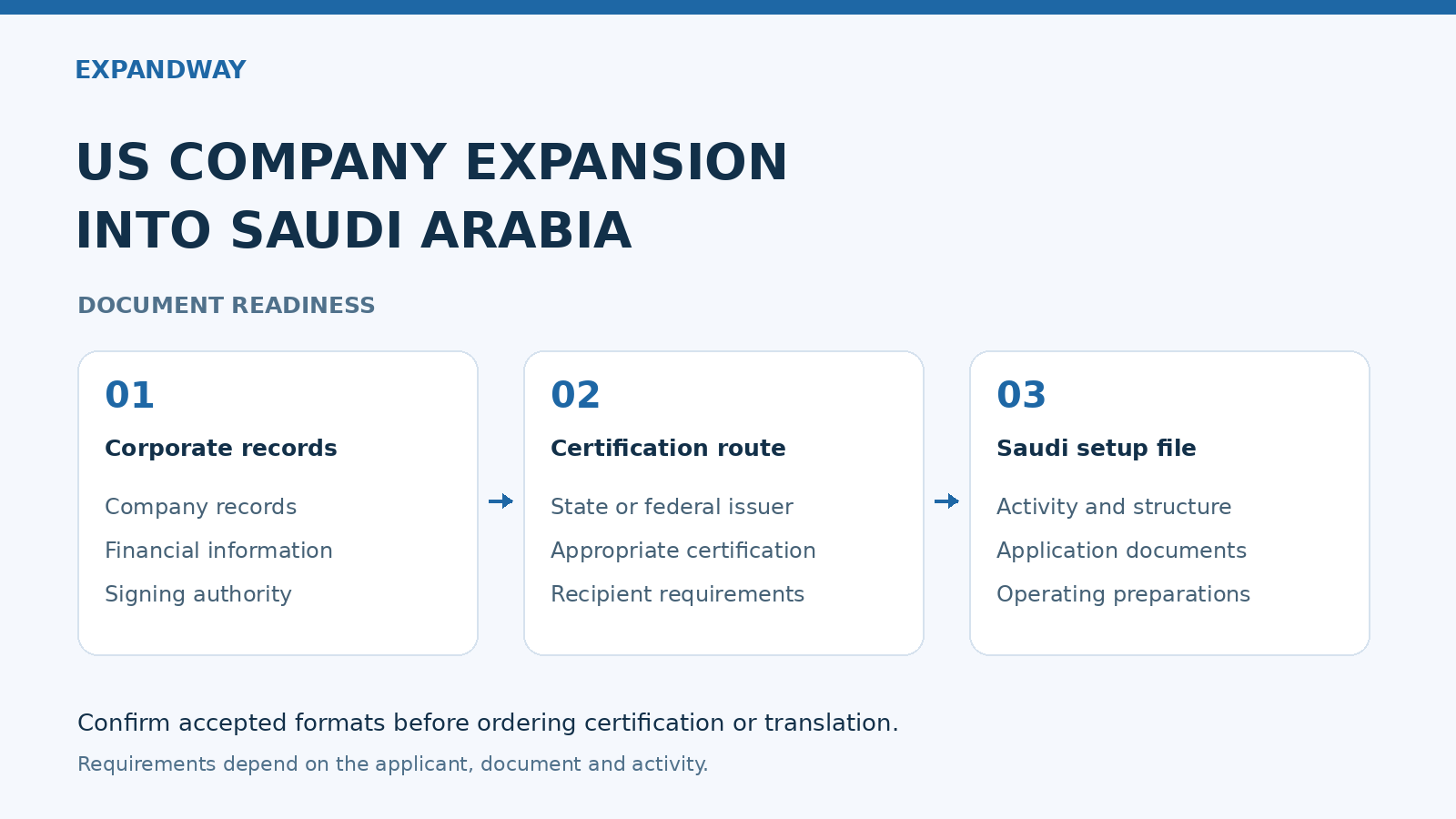
US manufacturers reshoring or de-risking supply chains can own the plant outright and typically legalise documents by apostille, the fastest route. Remember that US persons still report worldwide income (for example, Form 5471), there is no US–Saudi tax treaty, and any advanced production equipment may sit under US export-control rules — plan machinery shipments accordingly.
For Indian manufacturers
Indian investors get full ownership and often localise to win Saudi contracts. Remit capital under RBI/FEMA rules (usually the Overseas Direct Investment route) within the Saudi Central Bank framework on this side. Documents generally still need embassy or consular attestation — confirm the route — plus certified Arabic translations.
For China-linked manufacturers
Chinese and China-supplied manufacturers frequently choose an SEZ such as KAEC or Ras Al-Khair to serve regional and re-export demand while meeting local-content goals. Ownership is 100%; plan customs treatment for imported machinery and inputs, budget time for consular attestation of corporate documents, and expect joint ventures to be common in heavy industry.
For UAE-based industrial investors
As a GCC-owned company you receive national treatment: your GCC profit share is taxed as 2.5% Zakat rather than 20% corporate tax, and capital moves freely across the GCC. Attestation is quick by apostille, and many UAE groups expand through a Saudi branch or a new industrial entity close to their existing operations.
Get your factory licensed the right way
Setting up a factory in Saudi Arabia is very achievable in 2026 — the wins come from choosing the right MISA category, picking MODON land or the right special economic zone for your market, and clearing the industrial, environmental and safety approvals in the correct order. Expandway manages that end to end, from your first MISA registration to a licensed, operating plant. See our guides to business setup in Saudi Arabia and setting up in a special economic zone in Saudi Arabia, then book a free consultation with Expandway to map your licence, land and incentives before you commit.
Frequently asked questions
How long does it take to set up a factory in Saudi Arabia?
A typical project runs about three to six months from MISA registration to a licensed, operating plant. The variable is your site: a MODON ready-built unit is fast, while building on serviced land adds construction time to the schedule.
Can a foreigner own 100% of a factory in Saudi Arabia?
Yes. Foreign investors can own a manufacturing company outright through a MISA industrial registration in almost all sectors, with only narrow exceptions such as certain defence-related production. Confirm your specific activity with MISA or Expandway.
What is the difference between a MODON industrial city and a special economic zone?
MODON offers subsidised serviced land and ready-built factories across 36 industrial cities, taxed under the standard regime. A special economic zone (KAEC, Ras Al-Khair or Jazan), regulated by ECZA, layers on tax incentives such as a reduced corporate tax rate, making it stronger for export-focused plants.
Do I need an industrial licence and a MISA licence?
Both. A foreign investor first obtains a MISA investment registration to own the business, then the Ministry of Industry and Mineral Resources issues the industrial licence that permits actual manufacturing at your approved site.
How much does it cost to set up a factory in Saudi Arabia?
Government fees are low, but land or building, machinery, utility connections and working capital drive the real budget. A MODON ready-built unit is roughly SAR 90,000–150,000 a year; SIDF can finance a large share of project costs. Confirm current figures with each authority or Expandway.